A gas analyzer design employing a tunable diode laser (TDL) provides a reliable, cost-effective solution for combustion measurements in sulfur removal operations.
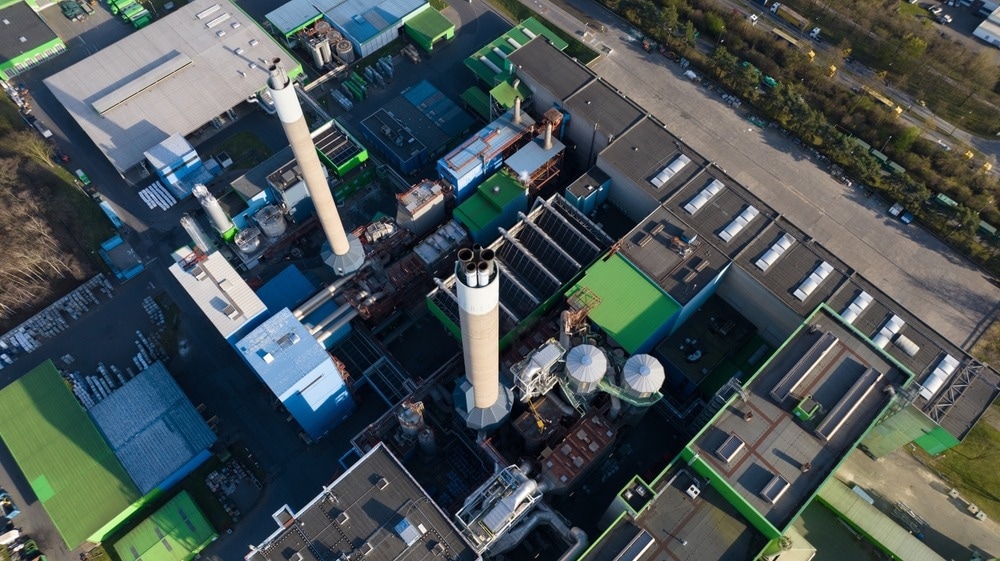
Image Credit: Make more Aerials/Shutterstock.com
Most oil and gas processing sites around the world rely on sulfur removal facilities, which may use a natural-draft or forced-draft design and operate at oxidizing temperatures between 650 °C and 1000 °C (1200 °F and 1800 °F).
Combustion control is key to safety, process efficiency, and emissions control. This necessitates an optimized air-to-fuel ratio, because the presence of excess air can lead to cooler burning, significantly reducing combustion efficiency due to increased loss of heat to the atmosphere.
This, in turn, increases already expensive fuel consumption. Excess available oxygen will also combine with nitrogen and sulfur, producing unwanted emissions.
Low-oxygen, fuel-rich conditions can potentially cause a dangerous explosive mixture, meaning that it is necessary to maintain an effective balance between efficiency and safety.
Accurate oxygen measurement is essential in ensuring combustion efficiency. Carbon monoxide (CO) measurement has become increasingly important due to the recognition of the risk of explosions from fuel-rich (high CO) conditions.
High levels of sulfur compounds in the gas stream mean that sulfur recovery unit (SRU) combustion applications are highly corrosive, however, presenting major challenges for gas analyzers employed in combustion control and efficiency.
Current gas analyzer installations used to monitor combustion control tend to be either zirconia or extractive solutions. These analyzers have been very successful, but it is possible for the zirconia sensor to be attacked by sulfur compounds, while analyser probe tubes can become clogged due to the corrosive effects of sulfuric acid.
Zirconia sensors are made from ceramic zirconium oxide that has been stabilized with an oxide of yttrium or calcium in order to form a lattice structure. This cell features a conductive coating that functions as electrodes on both sides of the lattice.
These lattice openings allow O2 ions to pass through at process temperatures above 700 °C (1292 °F). When a sample gas is introduced on one side of the lattice, the rate of the O2 ions’ passage is dictated by a combination of temperature and the difference in the O2 partial pressures of the sample gas and the reference gas (typically air) on the other side of the lattice.
O2 ions passing through the lattice produce a voltage across the electrodes, and the magnitude of this voltage is a logarithmic function of the ratio of the O2 partial pressures of the sample and reference gas.
The partial pressure of the reference gas is predetermined being atmospheric air, meaning that the voltage produced by the cell shows the oxygen content of the sample gas.
Zirconia-based oxygen analyzers offer an excellent response to changes in O2 content at ppm levels, and it is possible to use the same sensor to measure 100 % O2.
Ongoing exposure to sulfur compounds will eventually impact the measurements provided by a zirconia cell; however, these corrosive conditions mean that both zirconia and extractive solutions require frequent recalibrations and high levels of maintenance.
These factors have led many SRU operators to seek out an alternative measurement option able to deliver the same levels of accuracy while requiring less upkeep and support.
A Tunable Diode Laser Approach
Several of Servomex’s customers have field-trialed and ultimately switched to a Tunable Diode Laser (TDL) arrangement for their SRU thermal oxidizer applications, specifically opting to employ the SERVOTOUGH Laser 3 Plus combustion analyzer optimized for O2.
This compact gas monitor leverages TDL absorption spectroscopy for strong performance and can be installed in situ, enabling accurate measurement across the stack.
TDL is a single-line, monochromatic spectroscopy technique that offers high specificity to the gas being measured. TDL produces a stable, rapid, continuous measurement while successfully avoiding cross-interference from other gases.
A typical TDL system is comprised of a light source, transmitting optics, receiving optics, an optically accessible medium, and a detector. Signal information is contained within the gas absorption line shape, which is acquired by scanning the laser wavelength over the specific absorption line.
This approach leads to a reduction in measured signal intensity, which is detected by a photodiode and then used in the determination of gas concentration.
Servomex TDL technology has been developed by the company’s research and development team. This technology leverages a second harmonic detection (2f) modulation technique that affords it improved measurement accuracy, sensitivity, and reliability, most notably in low parts-per-million measurements where gas molecule absorption lines are typically close to other potentially interfering components.
TDL’s key benefit to the SRU application is that the laser has no contact with the sample. This means there is no corrosion of the sensor, considerably reducing maintenance and removing the need for cell replacement.
The laser measurement’s high stability means that calibration is required less often than with a zirconia cell. These notable cost-saving benefits have seen Servomex supply TDL systems throughout the Middle East, Singapore, the US, and Europe.
Improved Stability
TDL sensing in the Laser 3 Plus is supported by a line-lock cuvette system, ensuring the analyzer remains fixed on the target gas.
Like newer models, previous generations of TDL analyzers were set to measure a specific gas, however, if none of the specified gases were present the analyzer would instead drift to measure an incorrect, nearby absorption line.
For instance, an analyzer set up to measure CO could begin to measure an adjacent water line instead, therefore providing an incorrect reading. The Laser 3 Plus uses a line-lock system to solve this problem. This system consists of a beam splitter, and a cuvette filled with the target gas, alongside a secondary detector.
The filled cuvette ensures that the secondary detector always has a known target gas to sense, meaning this can always lock onto the center of the absorption peak. This innovative feature keeps the main detector locked into position, ensuring an accurate gas measurement, even in cases where the measurement falls to zero.
Acknowledgments
Produced from materials originally authored by Stephen Firth from Servomex Group Limited.

This information has been sourced, reviewed and adapted from materials provided by Servomex.
For more information on this source, please visit Servomex.