The quality of light in an LED luminaire depends on both the source and on how the light is distributed.
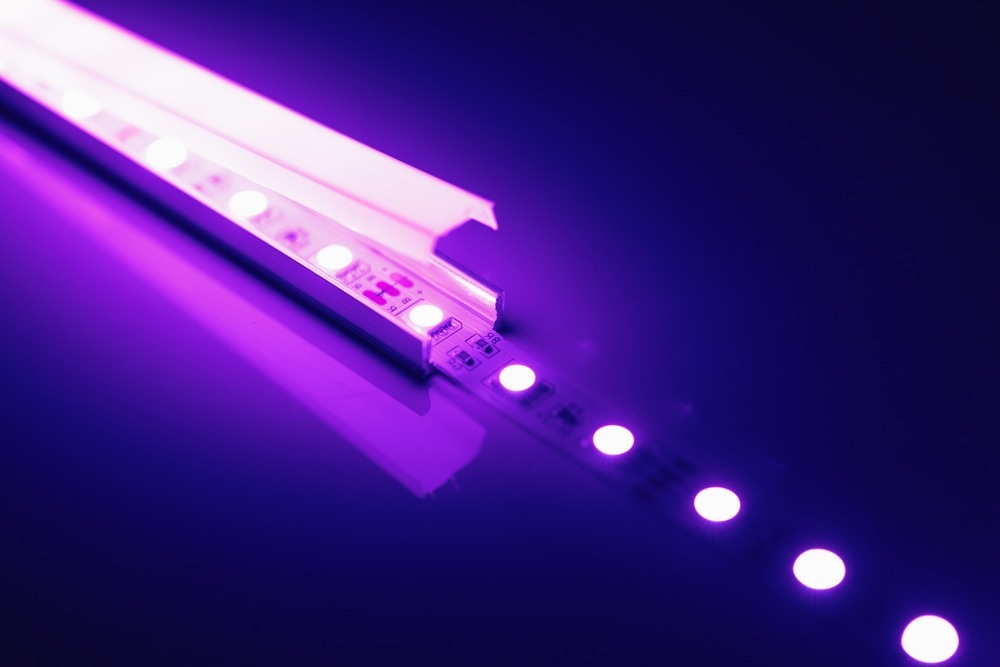
Image Credit: nikkytok/Shutterstock.com
LED diffusers are optical components that scatter, soften, and shape light to achieve the desired beam angle, visual comfort, and uniformity. Diffusers allow engineers to ‘shape’ beams of light, rather than accept the raw LED output. In doing so, they can design a soft, uniform architectural glow or a precisely directed task light.
This article describes how diffusers work, the types of diffusers available, and practical design strategies for beam-shaping optimization. Designers can use diffusers to fine-tune performance, aesthetics, and efficiency, all while continuing to accelerate product development.
Understand LED Diffusers
Diffuser Basics
An LED diffuser is a translucent or semi-transparent material placed in the light path to eliminate hotspots and scatter illumination.
LEDs are highly directional and can generate harsh glare without appropriate optical management. A diffuser spreads light via refraction, surface scatter, and internal diffusion, resulting in a more uniform and smoother output.
This process improves visual comfort while allowing designers to precisely tailor beam shape.
Materials and Form Factors
Popular diffuser materials include acrylic (PMMA), polycarbonate, and glass, typically with embedded scattering particles or surface textures, with diffusers supplied as flat sheets, domes, tubes, or films.
The key trade-off in diffuser design lies between diffusion strength (how widely light spreads) and transmission (how much light passes through the diffuser).
For example, strong diffusion yields improved uniformity but risks reducing brightness. Achieving the ideal balance depends on the application in question; for instance, task lighting prioritizes high transmission, while architectural lighting favors uniform diffusion.
Optical Principles
Diffusers rely on several optical principles:
- Refraction, which involves light bending when entering a medium of a different refractive index, therefore spreading the beam.
- Surface scatter, which relies on the use of rough or patterned surfaces such as frosted finishes to redirect light in multiple directions.
- Multiple internal scattering, which uses embedded particles to scatter rays repeatedly within thicker diffusers, enabling complete homogenization.
- Holographic diffusion, which uses micro-structured films to precisely control scattering, facilitates circular or elliptical beams while ensuring high transmission.
Beam Shaping with Diffusers
Controlling Beam Angle
Diffusers define a luminaire’s beam spread. Choosing a diffuser with a specified diffusion angle (e.g., 20°, 60°, or 120°) allows designers to set their desired light distribution.
For instance, Luminit Light Shaping Diffusers (LSDs) offer either circular or elliptical diffusion patterns, making them well-suited for applications such as corridor lighting or wall washing.
Selecting the right diffuser at an early stage accelerates optical design while removing the need for expensive custom lens tooling.
Achieving Uniformity and Eliminating Hotspots
Arranging multiple LEDs in arrays can cause individual sources to appear as bright spots. A diffuser homogenizes these bright spots into smooth, continuous illumination.
The distance between the LEDs and the diffuser is key in this case, as a larger air gap allows for greater blending. Where space is limited, it’s advised to opt for multi-layer configurations or higher-haze diffusers to maintain uniformity.
Reducing Glare and Improving Comfort
Diffusers can also help manage luminance distribution, limiting peak brightness that can cause glare or discomfort. For instance, prismatic diffusers redirect high-angle light to accommodate UGR (Unified Glare Rating) standards in office environments.
Diffusers contribute to aesthetic quality and compliance with visual comfort criteria by spreading intensity more evenly.
Types of Diffusers
Frosted and Opal Diffusers
These high-scatter diffusers are able to completely eliminate hotspots, producing a soft, uniform glow. Frosted and opal diffusers are ideally suited for decorative or residential applications where uniformity is more important than efficiency.
Prismatic Diffusers
Prismatic diffusers feature micro-lens patterns designed to shape light directionally. These diffusers are widely used in commercial lighting due to their ability to balance efficiency and beam control while providing reduced glare with moderate diffusion.
Holographic Light Shaping Diffusers
These advanced optical films are specifically engineered to deliver precise angular distributions (e.g., 30° x 70° ellipses) with >90 % transmission. Holographic light-shaping diffusers are ideal for high-performance retail, architectural, or stage lighting applications.
Diffuse Reflectors Versus Transmitters
Diffusers transmit light while diffuse reflectors scatter light internally within a luminaire. Examples of diffuse reflectors include white coatings or reflective films.
Using a combination of reflective chambers and diffusive exit surfaces has been found to yield excellent uniformity in systems such as edge-lit panels.
Design Advice for Using Diffusers
Prototype with Samples
It can be difficult to accurately simulate diffusion effects, but it is possible to gain immediate insight by prototyping with multiple diffuser samples and observing beam patterns on a test surface.
Suppliers such as Materials Direct, BrightView, and Luminit can provide small, laser-cut test samples ideally suited to quick experimentation.
Edge-Lit Versus Direct-Lit Considerations
Diffusers used in edge-lit systems ensure even illumination by complementing the light-guide patterns. Direct-lit systems typically need stronger diffusion or greater spacing to sufficiently conceal LEDs.
Finding a balance between uniformity and transmission requires testing multiple haze levels.
Color Fidelity
It is important to choose materials able to maintain chromatic integrity. For example, cheap plastics may distort color rendering or yellow over time, while acrylic offers superior optical clarity, and silicone diffusers excel for long-term UV resistance.
Efficiency Optimization
It is important to use only the amount of diffusion required to achieve the target beam. Holographic diffusers with 92 %+ transmission can minimize light loss, making them ideal in scenarios where lumen output is critical.
Custom Shapes and Laser Cutting
It is possible to custom-cut diffuser sheets and films to accommodate any geometry, including rectangular, circular, or complex profiles. Laser cutting offers both precision and rapid turnaround, allowing designers to iterate beam apertures or fixture shapes without the need for expensive molding.
Summary
Beam design is a creative process that blends artistry with optical science. Diffusers transform raw LED light into refined illumination, allowing lighting designers to control beam angles, improve uniformity, and eliminate glare.
Selecting the ideal diffuser type and prototyping efficiently is key to crafting lighting experiences that balance comfort, performance, and aesthetics.
Materials Direct supports rapid innovation through its instant online pricing and 24-hour manufacturing of custom optical materials, including LED diffuser films and sheets for light-shaping applications.
Quick access to precision-cut diffusers facilitates rapid experimentation and faster launches, whether refining a new luminaire or improving an existing design.
Acknowledgments
Produced from materials originally authored by Universal Science UK Ltd.

This information has been sourced, reviewed, and adapted from materials provided by Materials Direct.
For more information on this source, please visit Materials Direct.