Ethylene is a fundamental building block for many modern materials. Used in solvents, plastics, and a wide range of industrial chemicals, ethylene is produced on a huge scale, with over 20 million metric tons exported annually from the United States.
Much of this production is achieved via steam cracking, a process that pushes feedstocks to extreme pressures and temperatures to break long hydrocarbons into smaller molecules, such as propylene and ethylene.
Tight control is necessary across every production stage to maintain efficiency and safety in a steam-cracking operation, from furnace temperature and quench timing through to gas separation and recovery.
Analyzer sampling loops are an important part of this control. These small, conditioned streams feed Wobbe index analyzers, gas chromatographs (GCs), and oxygen detectors in order to provide the essential data required by operators to monitor coking, tune furnace severity, and ensure safe, efficient operation.
The Challenge
A system integrator was tasked with designing a sample conditioning system suitable for use in a Class I, Division 1 steam-cracking facility. This system would include different types of analyzers operating in parallel.
Process gas samples would be filtered and pressure-reduced in the sample room before being routed to each analyzer shelter prior and finally flared, vented, or recombined with the main process stream.
Each analyzer undertook a specific role within the system, meaning that the instrumentation was required to simultaneously satisfy all operational requirements:
- The liquid rejection membrane required stable backpressure in order to maintain filtration efficiency and prevent collapse.
- The oxygen analyzer needed precise flow and cell pressure to prevent drift in its readings.
- The gas chromatograph relied on stable backpressure and consistent split ratios to prevent the fluctuation of peak clarity and retention times as a result of changes in downstream venting or ambient pressure.
- The Wobbe index analyzer needed steady balance-loop pressure to ensure that combustion-quality calculations remained accurate.
These loops risked inconsistent sampling, poor furnace optimization, and unreliable analyzer data if dependable flow and pressure control were not in place at each point.
Smarter Options for Modern Sampling
The integrator employed Alicat’s IS-Max™ mass flow controllers and IS-Pro™ pressure controllers to simplify the system and improve performance. Implementing combined measurement and control in a single device helped reduce component count while providing digital communication directly to the control system at the plant.
The membrane loop uses a single IS-Max to ensure stable pressure downstream of the compression pump, while the oxygen analyzer maintains steady purge and cell pressure from just one device .
The GC benefits from automatic backpressure control, with split ratios kept constant without the need for seasonal rebalancing. The Wobbe analyzer also digitally verifies balance-loop pressure via an IS-Pro, logging real-time data for operators.
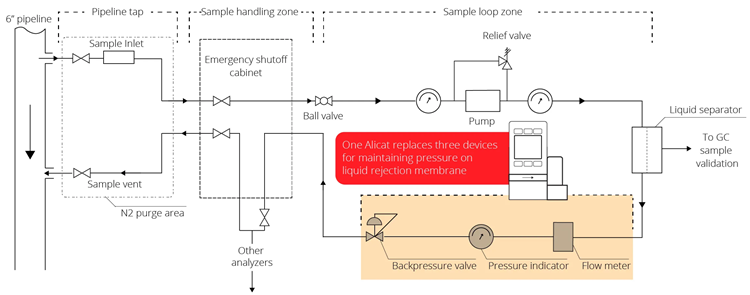
IS-Max Mass flow controller in a sample conditioning system. One device measures flow and maintains backpressure on a liquid rejection membrane, providing clean samples to the GC, while optimizing membrane throughput. Image Credit: Alicat Scientific
Cleaner Data and Safer Operation
The sampling system became simpler and more stable through the consolidation of instruments and the integration of digital control. Membrane performance remained consistent, analyzer readings stopped drifting, and the overall loop required less intervention from technicians in hazardous zones.
Operators also gained a complete record of sample conditions, thanks to the ongoing digital communication that fed pressure, flow, humidity, temperature, and totalized volume data directly into the DCS. This visible, trustworthy data proved key to compliance reporting and furnace optimization.
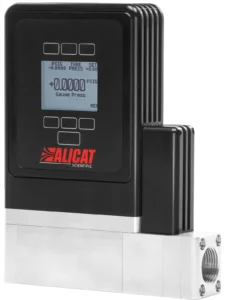
Image Credit: Alicat Scientific
The outcome was straightforward but significant: fewer devices and steadier analyzers resulted in cleaner data with fewer leak points. When working within a rapid and unforgiving process like ethylene cracking, this stability directly translates into safer operation, improved yield, and measurable efficiency gains.
EEthylene production is needed worldwide, meaning that systems supporting this process must evolve quickly. Consistent and dependable analyzer sampling ensures safety, emissions compliance, and optimal production.
Operators can modernize without sacrificing dependability by pairing proven control principles with intrinsically safe digital instruments to achieve safer operation, cleaner data, and a more robust foundation for the future of petrochemical processing.

This information has been sourced, reviewed, and adapted from materials provided by Alicat Scientific.
For more information on this source, please visit Alicat Scientific.