The close proximity of hydrogen and oxygen in water cracking operations employing proton exchange membrane (PEM) means that electrolyzers require continuous monitoring in order to maintain product purity and safety.
A degree of gas crossover through the PEM is unavoidable, meaning that laboratories are required to track key indicators, including gas quality, production rate, and energy efficiency, to confirm that crossover remains within acceptable limits.
Membrane failure can occur if crossover if left unmonitored, resulting in component degradation, water management imbalance, or membrane pinholing, potentially leading to eventual stack failure. Laboratories can mitigate these risks by integrating analytic equipment capable of strict safety compliance and high-precision measurement.
A PEM electrolyzer system was configured for use in a Class I, Division 2 (CID2) hydrogen lab. This system was equipped with parameters able to measure hydrogen and oxygen output, alerting operators to any cross-contamination.
Each outlet was fitted with an Alicat® Scientific intrinsically safe IS-MAX™ mass flow meter. The anode side flowed up to 850 NLPM of oxygen, and the cathode side flowed up to 1700 NLPM of hydrogen.
Downstream of these meters, the hydrogen and oxygen lines both diverted 0.5 NLPM into separate gas sensors to monitor the crossover rate.
Situating flow meters upstream of the sampling branch ensured that the purity sensors were working with a well-characterized and steady gas stream. The meters established the actual production rate of hydrogen and oxygen prior to drawing off any side stream, allowing sample readings to be understood in context.
This setup allowed the team to determine whether the crossover rate was anticipated for the current flow or if it indicated a deviation that could potentially signal water imbalance or membrane wear.
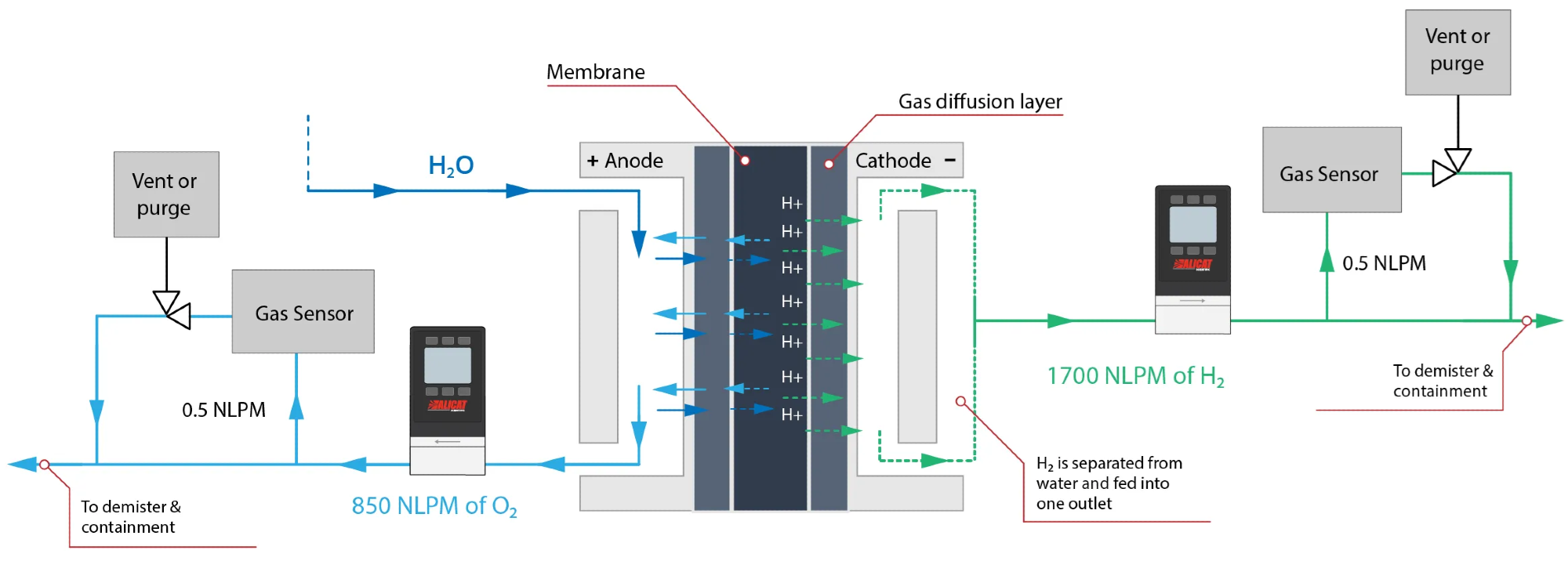
Example of electrolyzer setup. Image Credit: Alicat Scientific
Membrane Degradation and Catalyst Corrosion
Proton exchange membrane performance can decline under elevated temperature or low humidity, because these conditions have the potential to accelerate ionomer degradation.
Improper shutdown or inadequate gas flow control further compounds these risks, leading to issues such as flooding or starvation; there is also a risk of carbon corrosion in the catalyst supports of some electrolyzer designs. As carbon oxidizes, catalyst particles detach, conductivity decreases, and the electrode-membrane interface weakens, resulting in a more vulnerable membrane that is prone to gas crossover and physical failure.
Accurate flow measurement is key to preventing these problems, confirming that reactant gases are supplied at the correct stoichiometry, minimizing the chance of oxygen oversupply or hydrogen starvation. It also allows operators to detect abnormal shifts in output that may signal the onset of membrane pinholing or early-stage corrosion, while long-term trending helps track gradual degradation prior to the occurrence of irreversible damage.
Though PEM systems are engineered to operate far outside of lower or upper explosive limits, there is a risk of localized mixing in sampling lines, creating pockets where hydrogen and oxygen concentrations fall within hazardous ranges. Even trace crossover outside of design limits can disrupt downstream processes, lower product purity, and indicate potential structural or water-management issues in the membrane.
Accurate, real-time flow measurements enable crossover detection well before concentrations approach dangerous thresholds. This enables early intervention, with operators able to isolate an impacted cell or shut down the stack in time, reducing both ignition risk and downtime.
Multivariate Data Capabilities
The multivariate data reporting offered by the IS-MAX can capture up to 13 parameters, including temperature, mass, volumetric flow, and relative humidity, as well as absolute, gauge, and barometric pressures.
Consolidating these measurements via a single IECEx, ATEX, and CID1-compliant device reduces the need for separate enclosures and barriers, while also streamlining maintenance in hazardous areas.
The meter’s capacity to read humidity and dew point also functions as a helpful diagnostic tool for overall water management and membrane health. For example, sudden changes in process humidity could expose otherwise hidden facts about the membrane’s hydration balance or performance, indicating the need for additional inspection.
The meters’ laminar differential pressure sensing was determined to keep flow non-turbulent, ensuring repeatability and stability across the full range.
Short-lived crossover exposure was captured and trended thanks to the meters’ flow repeatability of 0.2 % of reading and ± 0.02 % of full scale, and a sensor response time of < one ms. Slower devices could miss these changes.
Measuring upstream of the sampling system allowed the direct correlation of purity sensor readings to validated process conditions, enhancing confidence in system health assessments.
Hydrogen's Greener Future
Safely running PEM electrolyzers in hazardous areas depends on detecting gas crossover levels before they exceed design limits. Flow meters can be used to measure the production of hydrogen and oxygen, providing a baseline for purity sensors to compare against.
This approach allows operators to differentiate between normal crossover and indicators of problems, such as pinholes, membrane wear, or water imbalance.
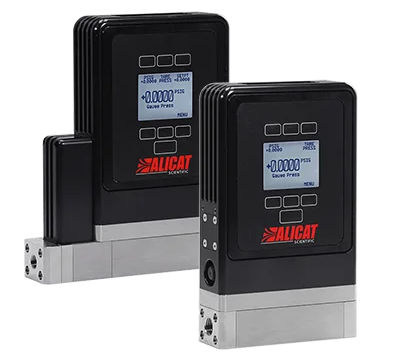
Image Credit: Alicat Scientific
Low humidity, high temperature, and poor gas flow can cause carbon corrosion or ionomer breakdown, further damaging the system. Measuring pressure, flow, and humidity helps ensure the gases are appropriately balanced, preventing starvation and flooding, and better maintaining stable membrane and catalyst layers.
Leveraging instruments that combine all these measurements in a single, intrinsically safe package reduces equipment requirements in hazardous zones and makes it easier to track system health over time. This streamlining leads to faster fault detection, safer shutdowns, and reduced risk of the formation of dangerous hydrogen-oxygen mixtures.
These tools are key to scaling up the wider hydrogen industry. As systems become more common and more complex, precise monitoring is key to maintaining high efficiency, minimizing downtime, and keeping operations in line with safety standards.
Reliable crossover detection methods and water balance checks allow hydrogen to be safely and consistently produced, paving the path towards a greener future.

This information has been sourced, reviewed, and adapted from materials provided by Alicat Scientific.
For more information on this source, please visit Alicat Scientific.