Hydrocarbon feedstocks are thermally broken down during steam cracking operations to produce light olefins, with ethylene as the principal target product. Precise flow control is key to these processes, enabling acetylene (C2H2) and other unwanted byproducts to be effectively analyzed and disposed of.
Acetylene is highly reactive and unstable, even in small concentrations. Its presence in ethylene production has the potential to increase the risk of reactions and disrupt downstream processes.
To combat this, some cracking facilities incorporate thermal-catalytic hydrogenation systems, which catalyze acetylene and increase ethylene yields. Such methods for selectively removing acetylene are effective, but these processes must be tightly controlled to avoid over- or under-conversion, both of which can adversely affect product safety and quality.
Monitoring the effectiveness of this removal, while ensuring that trace acetylene levels remain within acceptable limits, necessitates precise and regular gas sampling.
Many facilities leverage online analyzers to provide continuous process control, but post-hydrogenation acetylene analysis is typically achieved via closed-loop lab-based sampling. Such laboratories deliver actionable data that helps to confirm operational safety and process efficiency.
Case Study: A Closed-Loop Sample Line
A North American process laboratory working in a Class 1, Division 1 (C1D1) hazardous area employed a gas sampling system designed to monitor post-hydrogenation acetylene conversion from a side-stream off the primary process line.
Some of the hydrogenated gas was diverted via a sample tap conveyed through an electrically heated transfer line to prevent premature condensation prior to cooling. Following this, the sample entered a thermally insulated icebox that contained an impinger train, deliberately chilling the sample to condense and remove particulates and volatile components.
After it had been preconditioned in the ice bath, the sample was routed through an Alicat® Scientific IS-Max™ mass flow controller, then into a gas analyzer to confirm that residual acetylene concentrations had been reduced to safe operating levels.
The IS-MAX was able to maintain a precise 0–200 CCM sampling flow rate at an inlet pressure of 15 PSIG. Setpoints were controlled by a central PLC running via Modbus RTU over RS-485.
Able to achieve ± 0.5 % of reading or ± 0.1 % of full-scale accuracy, this instrument delivered stable flow while preventing pressure fluctuations or sample loss, which both have the potential to compromise trace measurements.
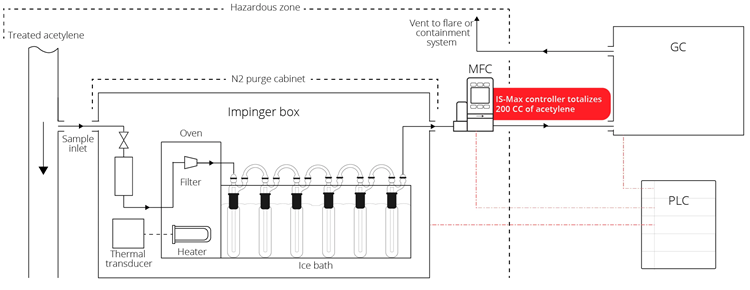
Image Credit: Alicat Scientific
The IS-MAX leveraged laminar differential pressure sensing in order to display real-time mass flow, temperature, pressure, and volumetric flow, with the ability to monitor up to 13 parameters, including temperature, humidity, barometric, gauge and absolute pressure, and totalized flow.
These parameters provide both diagnostic insight and process control when transmitted to the PLC, allowing operators to detect upstream or downstream pressure changes, confirm sample integrity, monitor for condensation or heating issues, and correlate analyzer data with totalized flow for traceability.
Sampling response time is as low as 30 ms, allowing the controller to maintain accuracy and system stability while continuing to support high-throughput analysis.
Outcome
Steady, traceable flow is key for the reliable quantification of acetylene and other contaminants in off-stream sampling systems where gas is not returned to the process line.
The IS-Max from Alicat Scientific is the industry’s first fully integrated mass flow controller able to achieve both C1D1 and Zone 0 certification. Most intrinsically safe systems necessitate the use of separate external control hardware and flow/ pressure sensors; Alicat’s innovative design conversely integrates sensing and actuation into one instrument.
This more streamlined approach reduces system complexity, shortens installation time, minimizes wiring, and enhances safety while maintaining a rapid control response and high measurement accuracy.
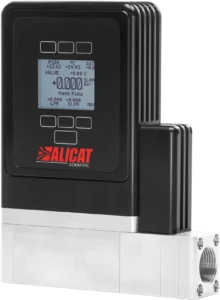
Image Credit: Alicat Scientific
Other intrinsically safe instrumentation can provide basic pressure control, rudimentary flow indication, and standalone data logging. The IS-MAX combines all these functions, as well as precise closed-loop flow control, active compensation for pressure changes, and direct integration with plant digital control systems in order to deliver a comprehensive solution for automated high-precision sampling.
The benefits of this setup extend beyond this specific process. For example, high-precision, intrinsically safe flow control in an integrated and compact package can reduce sampling systems’ footprint and complexity throughout the wider oil and gas industry.
These systems also reduce downtime for maintenance or reconfiguration, and enhance compliance with hazardous-area requirements. This translates into higher uptime, lower total cost of ownership, and more consistent data quality across multiple facilities.
The IS-Max and its related technologies support safer operations, strengthening both efficiency and regulatory compliance in safety-critical environments across the globe.
Acknowledgments
Produced from materials originally authored by Alicat Scientific.

This information has been sourced, reviewed, and adapted from materials provided by Alicat Scientific.
For more information on this source, please visit Alicat Scientific.