Inspired by the hidden architecture of cherry bark, researchers engineered regenerated cellulose fibers that resist cracking, stretch further, and bring sustainable high-performance textiles closer to reality.
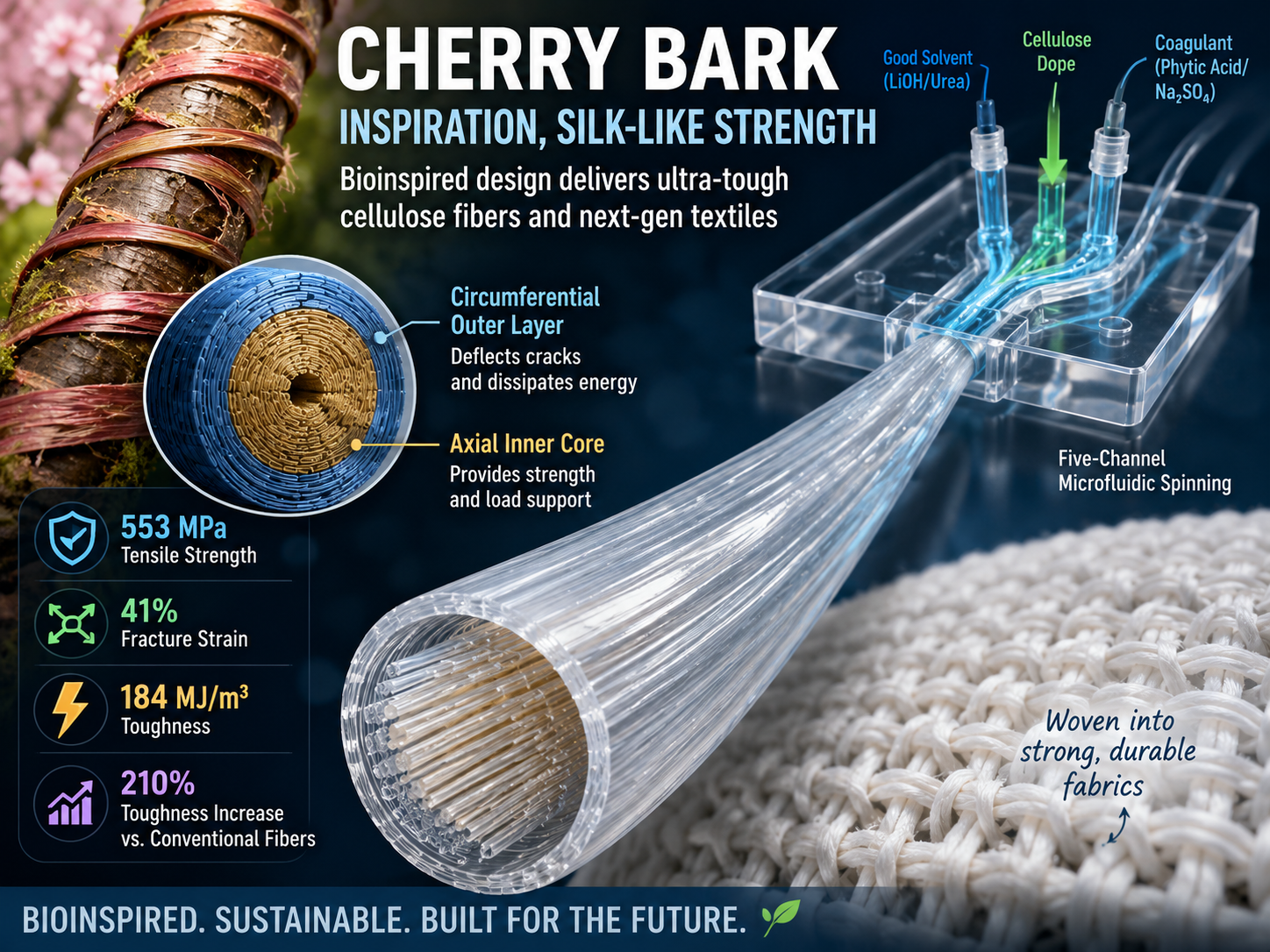
Bioinspired regenerated cellulose fibers were engineered using a microfluidic spinning process inspired by the helical nanoarchitecture of cherry bark, producing biaxially oriented fibers with spider silk-like toughness. Image Credit: AI-generated illustration created with ChatGPT/OpenAI
A recent Article in Press in the journal Nature Communications introduced ultra-tough regenerated cellulose fibers with spider silk-like toughness. Using a bioinspired microfluidic spinning process modeled on the helical architecture of cherry bark, researchers created fibers with a biaxial orientation structure that enhances tensile strength and fracture strain. This approach helps address the brittleness that traditionally limits regenerated cellulose materials and advances the development of high-performance, sustainable fibers for textiles, automotive components, and aerospace applications.
Inspirations for Enhanced Mechanical Properties
Natural materials often achieve remarkable mechanical performance through hierarchical structures that efficiently distribute stress and dissipate energy. Natural spider silk is a well-known example. Its semi-crystalline design combines protein nanocrystals with flexible amorphous regions, which provide exceptional toughness and impact resistance. Similarly, wood withstands mechanical stress through a multilayered cell wall structure, where cellulose microfibrils are arranged at different orientations, balancing strength and ductility.
Replicating these multidirectional architectures in biomaterials remains challenging. Most regenerated bio-based fibers exhibit primarily uniaxial alignment. As a result, they are often more brittle and more susceptible to crack propagation under mechanical stress.
Microfluidic Fabrication Techniques
To address the limitations, researchers developed a precision nano-orientation strategy using a customizable three-phase and five-channel microfluidic chip. The process began with a modified cellulose solution prepared in an aqueous solvent containing 8 wt.% lithium hydroxide (LiOH) and 15 wt.% urea. Then, this material was pre-crosslinked with epichlorohydrin at -5°C to establish an initial crosslinking density of approximately 60-80 mol/m3.
During flow through the microfluidic device, the core stream interacted with two sheath flows. One used LiOH and urea as a “good solvent,” while the other introduced a coagulation solution containing 5 wt.% phytic acid and 5 wt.% sodium sulfate (Na2SO4). Flow rates of 150, 300, and 400 μL/min were maintained using precision syringe pumps. Fluid behavior was analyzed through three-dimensional (3D) computational fluid dynamics simulations, and chemical variations were monitored with in situ confocal Raman imaging.
Structural features were characterized using scanning electron microscopy (SEM) and two-dimensional (2D) synchrotron small-angle X-ray scattering. Atomic force microscopy (AFM) mapped local mechanical properties across fiber cross-sections, while molecular dynamics simulations explored interchain sliding and deformation mechanisms. The authors noted that these simulations were intended mainly to provide mechanistic insight rather than direct numerical equivalents of experimental performance.
Mechanical Advancements and Performance Metrics
Characterization showed that the oblique inflow of the good solvent altered the surface velocity field of the cellulose dope, generating flow perturbation, dilution, and shear-induced velocity gradients. This interaction reoriented surface cellulose chains perpendicular to the primary flow direction, and exposure to the phytic acid coagulant locked this arrangement into the solidifying fiber structure.
Mechanical testing demonstrated clear advantages over conventional uniaxially aligned fibers. The tensile strength reached 553 MPa, compared to 473 MPa for reference fibers. Fracture strain increased by 175%, reaching 41%. Total toughness rose to 184 MJ m-3, representing a 210% improvement. Additionally, the circumferential outer layer acted as a protective shell around the axial core. Under loading, this outer layer encouraged cracks to follow complex Z-shaped paths, thereby dissipating energy and delaying failure.
Atomic force microscopy identified a gradient across the fiber cross-section, with the outer layer exhibiting an elastic modulus of about 4.0 GPa, while the inner core reached 8.0 GPa. Molecular dynamics simulations further showed that the circumferential chains gradually rotated toward the loading direction during stretching. This behavior improved load transfer and promoted interchain sliding, contributing to the fiber’s high toughness.
Scalability for Industrial Applications
The structural advantages of these bioinspired fibers have significant implications for future large-scale textile manufacturing. Leveraging existing commercial weaving equipment, researchers processed individual filaments into high-quality fabric sheets measuring approximately 15 cm × 90 cm, demonstrating compatibility with commercial weaving machinery.
Mechanical durability was assessed using drop-tower impact testing, comparing the bioinspired fabric with conventional materials, including cotton, modal, cuprammonium, and viscose. Under standard impact testing, the bioinspired fabric showed an impact duration of approximately 5.5 seconds, followed by a deformation phase lasting up to 12 seconds without visible damage. Under more severe failure testing, the bioinspired fabric sustained an impact force of up to 607 N and absorbed up to 1.75 J of impact energy. Conventional fabrics fractured under comparable conditions. The regenerated cellulose textile also maintained its integrity after repeated washing, showing no visible loosening or loss of structural integrity.
Conclusion and Future Directions
In summary, this bioinspired nano-orientation strategy addresses the brittleness that has traditionally limited the performance of regenerated cellulose fibers and related biomass-based materials. By using microfluidic flow control to replicate key features of cherry bark architecture, the study achieved a rare combination of high tensile strength and toughness in regenerated cellulose fibers, as benchmarked against selected cellulose and commercial textile comparators. The material also showed strong potential for industrial adoption due to its possible cost and processing advantages, although the authors acknowledged that the current lab-scale process involves a throughput trade-off compared with mature Lyocell production.
Future work should focus on increasing production throughput through multi-channel spinning systems and optimizing the rheological properties of cellulose solutions. This fabrication strategy may also apply to other natural polysaccharides, including chitin and chitosan, supporting the development of sustainable, high-performance materials for textiles and other industries.
Download your PDF copy by clicking here
Disclaimer: The views expressed here are those of the author expressed in their private capacity and do not necessarily represent the views of AZoM.com Limited T/A AZoNetwork the owner and operator of this website. This disclaimer forms part of the Terms and conditions of use of this website.