Could you tell us a little about your background and how you’ve seen the oil and gas industry change over that time?
I’ve been in the industry since around 2007. I started with a rep firm handling analyzer and instrumentation products, then worked for a few manufacturers, and eventually founded Kaizen Controls & Automation.
Twenty years ago, American natural gas companies were building LNG import facilities, heating gas from overseas and pushing it into US pipelines. Suddenly, fracking changed everything: the US was producing so much natural gas domestically that companies had to redesign import terminals to become export terminals.
That shift rippled across the whole industry.
The new infrastructure required updated measurement and control systems, causing safety, accuracy, and automation to overlap in a big way.
Most of those environments are hazardous. How does the industry take safety into consideration?
Many analyzer shelters in oil and gas are located in classified areas, such as Class I, Div 1 zones or Class I, Div 2, where flammable gases pose a potential risk.
There are three key methods for protecting equipment in these classified areas: purge and pressurization systems that push clean air through the enclosure; explosion-proof housings that contain internal ignition sources; and intrinsic safety. Though the first two work, they’re expensive, heavy, and difficult to maintain.
Intrinsic safety is increasingly favored for low-power instrumentation in some CID1 applications. The method limits the circuit energy so even in the case of a fault, there’s not enough power to cause ignition. Instruments such as Alicat’s IS-Max™ and IS-Pro™ series are good examples of this, as they’re designed for use directly in hazardous zones without requiring explosion-proof boxes or purge panels. This saves space, lessens the number of potential leak points, and simplifies compliance.
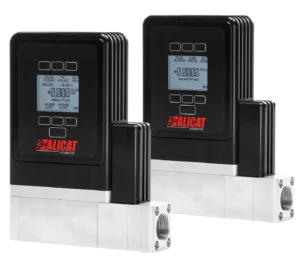
IS-Max Series mass flow & IS-Pro Series pressure controllers. Image Credit: Alicat Scientific
What makes integrated flow and pressure control more dependable than traditional setups with separate components?
A large part of this is taking out the old mechanical devices: regulators, rotameters, and variable-area meters. As time goes on, they stick or foul, especially if waxy hydrocarbons or particulates are present in the line. The float on a rotameter might look like it’s sitting at the right flow when seen from outside, but there’s nothing moving in reality.
This is where the human factor comes in.
A maintenance technician could be responsible for 20 or 30 square miles of analyzer stations. They drive by, glance at the rotameter through the glass, and think, “Looks good”. Meanwhile, the analyzer’s getting no sample and drifting out of spec.
To combat this, it is recommended to use an integrated digital flow controller or a digital pressure meter, which can help users see the actual flow and pressure values on screen or in the DCS. Feedback is accurate and instantaneous because these devices have measurement and control in the same body. Multivariate devices that report parameters such as pressure, temperature, flow, and totalizer provide much visibility in a sampling loop that runs every few milliseconds.
How does digital control compare to pneumatic or manual systems?
Though pneumatic systems are reliable, they are limited; they’re slow to react and don’t provide feedback. With digital control, it is possible to obtain precise, repeatable responses and real-time diagnostic data.
Modern intrinsically safe instruments can sample up to a thousand times per second, meaning they catch transient changes before they reach the analyzer. By using MODBUS RTU or a simple analog 4 – 20 mA signal, setpoints can be monitored and adjusted remotely: this is what operators have come to expect now – fast and stable control with lots of visibility.
Maintenance is a recurring challenge in manual systems. What would it look like to replace them with digital solutions?
Digital solutions require considerably less maintenance. To combat the effects of mechanical regulators drifting, rotameters fouling, and valves gumming up over time, many plants rebuild or replace equipment on a set schedule: often every year, and sometimes even more frequently.
But this is also dependent on the process. If a piece of equipment kicks up a lot of dust and dirt, that grime can transfer onto other devices. Though some customers are fine with these aesthetic issues, others desire a level of guarantee that their devices will not be compromised because of surrounding parts.
Intrinsically safe digital instruments, however, require fewer moving parts with no glass tubes or floats to clean. Dust and moisture are not a problem for IS-Max™ & IS-Pro™ as they are rated to IP 66, and they also hold calibration longer. Added diagnostics help too, because developing issues can be spotted remotely, without needing to access the device and troubleshoot.
Installation time and complexity are a major cost driver. What does that look like in practice?
In a typical analyzer shelter, there are often separate transmitters for temperature, pressure, and flow, with each requiring its own mounting, conduit, and wiring. That can add up, especially when trying to minimize the time that a team spends in a classified area.
Installing intrinsically safe electronic controllers simplifies this.
Only one instrument requires mounting, instead of three, and only one set of input, output, and power cables. For large sites, this could be the difference between a multi-day installation and one that’s finished in a matter of hours. The control signal can be digital or analog, meaning they fit into existing DCS architectures without re-engineering the system.
EPA compliance puts significant pressure on analyzer reliability. How does flow and pressure stability factor into that?
Pressure and flow stability are everything. The majority of EPA rules, such as Quad O (EPA 40 Code of Federal Regulations, Part 60, Subpart OOOO) or Refinery MACT require at least 98 % uptime for analyzers. If a sample system is not stable, this cannot be achieved, and there could be repercussions.
For flow and pressure stability, fluctuating pressure or inconsistent flow will throw off readings and calibration. In systems that perform flaring, backpressure spikes can push gas back into the analyzer and corrupt data.
If fast, closed-loop digital control is acquired, steady flow and pressure can be maintained, so the analyzer always sees the same conditions, with this consistency keeping users compliant and avoiding penalties.
Intrinsically safe digital control is changing how sampling systems are designed. What's different now compared to 10 years ago?
The technology has evolved, but just as importantly, so has the industry’s mindset. The industry is moving toward automation and remote operations, resulting in fewer people in the field and a much stronger focus on systems that can, more or less, take care of themselves.
Looking at the advancements made, if you needed instrumentation in a hazardous area ten years ago, you were almost guaranteed to rely on purge systems or explosion-proof enclosures that prove difficult to access. Those worked, but they added complexity and a lot of hands-on maintenance”.
Now there are digital options, such as intrinsically safe devices and IS-series instruments, that can sit directly in the hazardous zone without so much extra infrastructure. These instruments can still be interacted with during operation if necessary, but maintenance becomes far easier, with no specialized enclosures to open, no purging routines, and far fewer site visits just to check basic readings.
What’s next for process analysis and control?
The next step is intelligence, using all this new data for predictive operation instead of reactive. If you know when something is going to go wrong before it does, you can save uptime and cost.
In essence, the goals haven’t really changed; the industry still wants to keep people safe, keep analyzers accurate, and keep uptime high. What has changed is that there are finally tools available that make all three easier, while being remote. I believe the future is data, and the only question now is how far we can push what we do with it.
About Bobby Singh
Bobby Singh has worked in process automation and instrumentation since 2007, developing extensive experience across the industrial and energy sectors. He began his career with a manufacturer’s representative firm supporting mechanical, instrumentation, and analyzer technologies before joining Emerson Process Management in 2011. During his time there, he specialized in MicroMotion Coriolis, Rosemount Magnetic Flowmeters, and Vortex Meter technologies, working with major companies, including ExxonMobil, Shell, Dow, Monsanto, Chevron, and Marathon Petroleum to improve operational reliability and process efficiency.
Bobby later joined AMETEK Process Instruments as Regional Sales Manager, supporting channel partners across the Southeastern United States while broadening his expertise in process analyzers and integrated systems. In 2021, Singh founded Kaizen Controls & Automation, an independent manufacturer’s representative firm focused on delivering innovative analyzer, instrumentation, and control solutions for process industries. The company reflects his continued focus on continuous improvement and practical, solutions-oriented engineering support.

This information has been sourced, reviewed, and adapted from materials provided by Alicat Scientific.
For more information on this source, please visit Alicat Scientific.
Disclaimer: The views expressed here are those of the interviewee and do not necessarily represent the views of AZoM.com Limited (T/A) AZoNetwork, the owner and operator of this website. This disclaimer forms part of the Terms and Conditions of use of this website.