Per- and polyfluoroalkyl substances (PFAS) constitute a substantial category of synthetic compounds extensively employed in consumer goods and industrial applications owing to their heat-, water-, and oil-repellent characteristics. Recently, PFAS have garnered significant media and regulatory interest owing to their environmental persistence and broad contamination of water, air, and soil.

Image Credit: Francesco Scatena/Shutterstock.com
While regulatory bodies concentrate on curtailing PFAS exposure from outside sources, an increasing body of research indicates that exposure also transpires within residences, as these chemicals are commonly present in everyday consumer items, such as non-stick cookware, stain-resistant carpets, waterproof apparel, cosmetics, and food packaging.
For instance, one investigation revealed that for specific PFAS, like fluorotelomer alcohols, indoor settings represent a primary pathway for human exposure.1–2 These discoveries underscore the significance of the airborne exposome as a conceptual framework for comprehending personal exposure to PFAS emissions, even within indoor environments.
Herein, a new methodology is introduced for evaluating PFAS emissions from consumer chemical products employing a TOFWERK Vocus time-of-flight mass spectrometer, integrated with an Aim chemical ionization reactor and coupled to a PAL RSI autosampler (CTC Analytics) (Figure 1).
This apparatus delivers PFAS emissions data from headspace measurements within seconds. Its capacity to quantify PFAS emissions in air at exceptionally low concentrations was previously validated with a suite of calibration standards.3 Building upon this established foundation, the system is now adapted for automated headspace screening of PFAS emissions released from various nail polishes and wall paints.
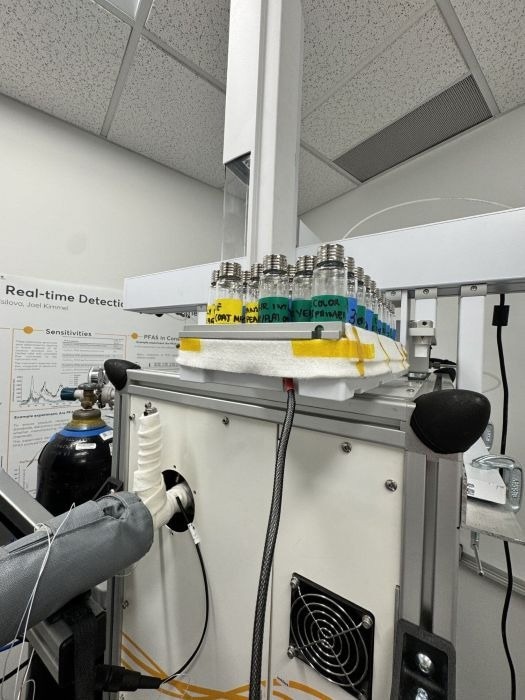
Figure 1. PAL RSI autosampler with vial tray mounted on top of a Vocus 2R time-of-flight mass spectrometer. Image Credit: TOFWERK
References
- Wu, Y., et al. (2020). Per- and polyfluoroalkyl substances in paired dust and carpets from childcare centers. Chemosphere, 251, p.126771. DOI: 10.1016/j.chemosphere.2020.126771. https://www.sciencedirect.com/science/article/abs/pii/S0045653520309644?via%3Dihub.
- Chang, N.Y., et al. (2024). Exposure to Per- and Polyfluoroalkyl Substances (PFAS) in North Carolina Homes: Results from the Indoor PFAS Assessment (IPA) Campaign. Environmental Science Processes & Impacts. (online) DOI: 10.1039/d4em00525b. https://pubs.rsc.org/en/content/articlelanding/2025/em/d4em00525b.
- TOFWERK (2024). Revolutionizing PFAS Detection in Air: High Sensitivity and Versatility with the Vocus Aim Reactor. (online) Available at: https://www.tofwerk.com/pfas-detection-air-vocus-aim/.
Read Next
- TOFWERK's In-focus Blogpost on PFAS and Teflon coating: https://www.tofwerk.com/assessing-pfas-replacements-vocus-aim/
Acknowledgments
Produced using materials originally authored by Maya Abou-Ghanem, Abigail Koss, Veronika Pospisilova, Spiro Jorga, and Omar El Haj from TOFWERK.

This information has been sourced, reviewed, and adapted from materials provided by TOFWERK.
For more information on this source, please visit TOFWERK.