A self-cleaning black metal surface turns sunlight, capillary flow, and salt crystallization into a prototype system that could help produce freshwater from seawater while reducing brine waste and recovering valuable minerals.
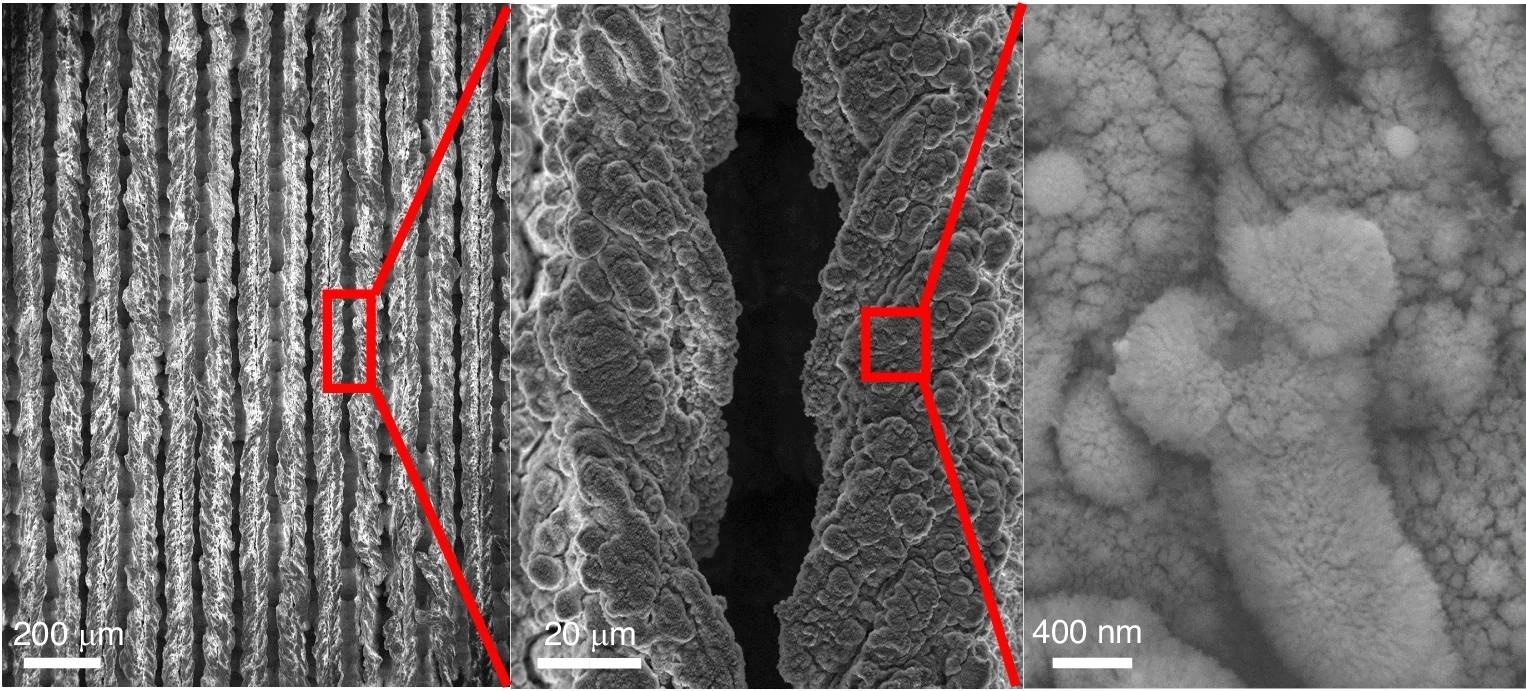
SEM images of the nanostructured SWBM surface under different magnifications (scale bar left to right, 200 μm, 20 μm, and 400 nm). Paper: Additive-free and brine-discharge-free solar-thermal desalination with simultaneous complete mineral mining from ocean water
A recent study in the journal Light: Science & Applications introduces a solar-thermal desalination system based on a nanostructured surface that generates water vapor for freshwater collection and recovers salts from real ocean water without brine discharge. The research demonstrates a self-cleaning interfacial evaporation strategy that continuously transports water and absorbs sunlight with high efficiency. The system also removes crystallized salt from active evaporation regions to prevent clogging.
Overcoming Salt Clogging in Solar Desalination
Freshwater scarcity has increased the demand for sustainable desalination technologies. Conventional systems consume large amounts of energy and generate concentrated brine waste, which damages marine ecosystems and the surrounding environments. These systems also recover only part of the input water, leaving behind significant volumes of saline discharge. So, researchers are exploring alternative desalination strategies that reduce energy consumption while eliminating liquid waste streams.
Solar-thermal interfacial evaporation offers an energy-efficient approach for desalination by using localized solar heating to accelerate evaporation. However, most existing systems fail with real ocean water because salt accumulation blocks water transport channels and reduces evaporation efficiency. Earlier solutions relied on simulated seawater, chemical additives, or mechanical cleaning, but these approaches still suffer from clogging and brine discharge.
Researchers are addressing these limitations by developing an additive-free and brine-discharge-free solar-thermal interfacial crystallizer called ABF-STIC. The system uses a nanostructured superwicking black metal surface that rapidly transports water, efficiently absorbs sunlight, and continuously moves crystallized salt away from active evaporation regions. This self-cleaning design enabled stable desalination of seawater collected from the Atlantic, Pacific, and Indian Oceans while simultaneously achieving promising small-prototype freshwater production and nearly complete salt recovery.
Designing Nanostructured Superwicking Surfaces
The researchers fabricated the superwicking black metal surface using femtosecond laser processing on thin aluminum foils. They controlled the depth and width of hierarchical microgrooves and nanostructures formed across the surface by adjusting the laser power. The optimized structures combined rapid capillary-driven water transport with strong broadband solar absorption.
The researchers evaluated desalination performance using real Atlantic Ocean water under one-sun illumination. Time-lapse imaging identified two coupled mechanisms responsible for the self-cleaning behavior. Evaporation-driven capillary flow transported dissolved salts toward the wetted boundary through the coffee-ring effect, while salt creeping promoted outward crystal growth through porous salt structures. Strong capillary flow continuously dissolved salt deposits and prevented channel blockage, enabling nearly complete salt recovery with zero brine discharge.
Efficient Ocean Water Desalination and Mineral Recovery
The optimized superwicking surfaces maintained stable desalination performance even with real ocean water. Conventional evaporators typically suffer severe salt clogging under these conditions, partly because less soluble magnesium and calcium compounds in real seawater can form non-porous crusts between sodium chloride crystals, obstructing capillary flow. Surfaces with shallow grooves rapidly accumulated salt across the active evaporation region. This buildup reduced evaporation rates by more than 45% within two hours. In contrast, surfaces with deeper and wider grooves remained clean during continuous operation. Salt crystallized only in passive regions located outside the active evaporation zone.
These optimized structures sustained evaporation rates near 1.84 kg m−2 h−1 under continuous illumination. Salt crystals confined to passive regions also slightly increased evaporation performance by providing additional evaporation surface area. Time-lapse imaging showed that salt crystals gradually expanded outward from the passive regions while the active surface remained free of deposits. Two coupled mechanisms drove this self-cleaning process.
Evaporation-induced capillary flow first transported dissolved salts toward the wetted boundary through the coffee-ring effect. Thin water films then moved through porous salt structures, driving outward crystal growth via salt creep. Larger grooves maintained strong capillary flow, continuously dissolving newly formed salt crystals and preventing channel blockage. In contrast, narrower grooves generated weaker flow, which caused backward crystallization and clogging. Based on these observations, the researchers identified groove depths greater than 110 µm and widths greater than 50 µm as critical design parameters for reliable self-cleaning in real seawater.
The platform also achieved zero-liquid-discharge operation in the tested prototype. The system recovered almost all dissolved salts from the evaporated seawater stream. Elemental analysis detected sodium, magnesium, potassium, and calcium in the collected salts, along with trace amounts of uranium, cesium, bromine, and gold. The researchers also demonstrated a preliminary proof-of-concept for lithium-selective extraction by modifying the surface with meta-titanic acid nanoparticles.
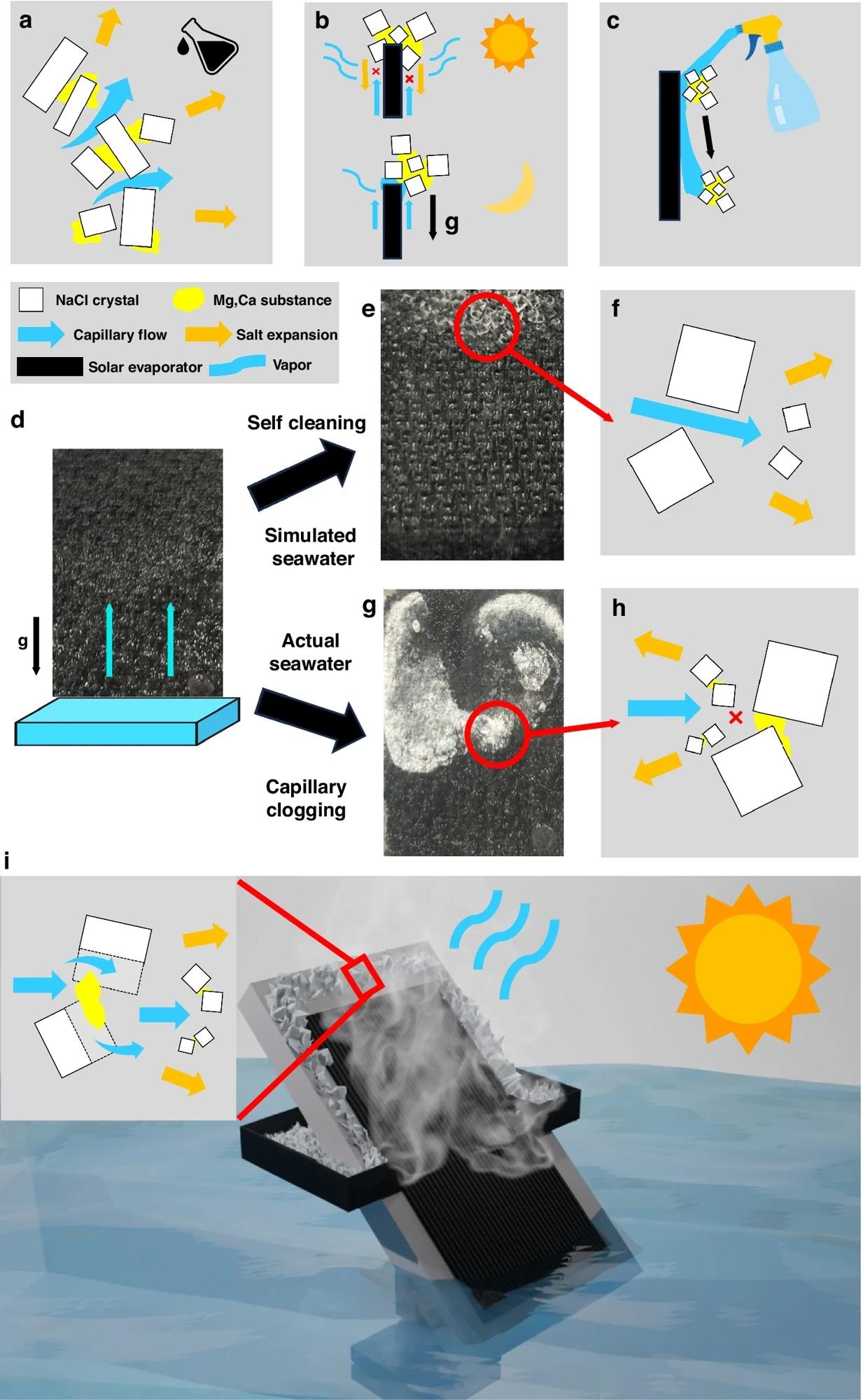
Simulated ocean water only contains NaCl crystals that have many open gaps inside when crystallized, but real ocean water also contains non-porous Mg, Ca substances, which will fill the open pores among NaCl crystals and block the capillary water transport. a Schematics showing chemical additives changing the crystal structures and open some pores. b Schematics showing nighttime salt dissolution and falling. c Schematics showing water spray for cleaning. d Commonly-used conventional wicking material. e Edgewise crystallization when desalinating simulated ocean water. f Schematics showing capillary flow can easily pass through open NaCl crystals for self-cleaning. g Capillary clogging when desalinating real ocean water. h Schematic diagram showing capillary clogging due to insufficient dissolution due to weak capillary flow, i Real ocean water interfacial solar-thermal crystallizer. Inset; a zoomed-in view showing strong capillary flow dissolve salt crystals enabling surface self-cleaning
Implications for Zero-Liquid-Discharge Desalination
The study establishes a new strategy for sustainable solar-driven desalination and seawater resource recovery by combining solar absorption, capillary water transport, and self-cleaning salt removal in a single material platform. The work demonstrates stable desalination of real ocean water without chemical additives or brine discharge, addressing major environmental limitations associated with conventional desalination technologies.
The researchers connected microcapillary geometry with capillary-driven salt transport and self-cleaning evaporation behavior. They engineered hierarchical groove structures that maintained strong dissolving capillary flow during long-term operation. The findings further highlight the importance of groove dimensions in preventing salt accumulation and sustaining continuous evaporation and freshwater-generation potential under realistic seawater conditions.
The solar-trackable architecture introduced in the study could support practical desalination systems capable of operating efficiently under varying sunlight conditions. The platform may also enable broader applications in solvent recovery, selective ion extraction, and sustainable mineral harvesting from seawater.
Overall, the research provides a promising foundation for next-generation solar-thermal desalination systems with stable long-term operation, zero-liquid-discharge capability, and integrated resource recovery, although scale-up, field durability, freshwater collection efficiency, and selective mineral purification require further validation.
Disclaimer: The views expressed here are those of the author expressed in their private capacity and do not necessarily represent the views of AZoM.com Limited T/A AZoNetwork the owner and operator of this website. This disclaimer forms part of the Terms and conditions of use of this website.
Source:
- Tang, L., Singh, S. C., et al. (2026). Additive-free and brine-discharge-free solar-thermal desalination with simultaneous complete mineral mining from ocean water. Light: Science & Applications, 15(1), 246. DOI: 10.1038/s41377-026-02315-4, https://www.nature.com/articles/s41377-026-02315-4