Among the wide array of airborne molecular contaminants (AMCs) requiring systematic monitoring during semiconductor fabrication production, per- and polyfluoroalkyl substances (PFAS) are increasingly a point of focus due to their adverse effects on the environment and on humans.
The manufacturing of PFAS in the semiconductor sector is connected to material off-gassing and, in some instances, their formation as secondary products of production operations. Given both the necessity for high-quality chip manufacturing and the escalating concerns surrounding PFAS, it is crucial to identify effective strategies for understanding and minimizing these emissions within semiconductor production.
The accurate and adaptable TOFWERK Semicon AMC Solutions provide cutting-edge instrumentation for the simultaneous, real-time measurement of numerous such compounds, entirely bypassing the need for sample preparation and achieving extraordinary precision.
A single AMC monitor or analyzer can provide users with a wealth of information about airborne PFAS emissions, even at concentrations in the parts-per-trillion (pptv) range, thereby offering users an unparalleled understanding of the origins and abatement of these substances.
Experimental Setup for PFAS Off-Gassing
To evaluate the capabilities of the AMC Solutions for PFAS analysis, sample resins commonly employed in semiconductor manufacturing materials were heated in a temperature-controlled oven, as depicted schematically in Figure 1. The emissions from the oven were subsequently analyzed by an AMC Analyzer, one of two Semicon AMC Solutions offered by TOFWERK.
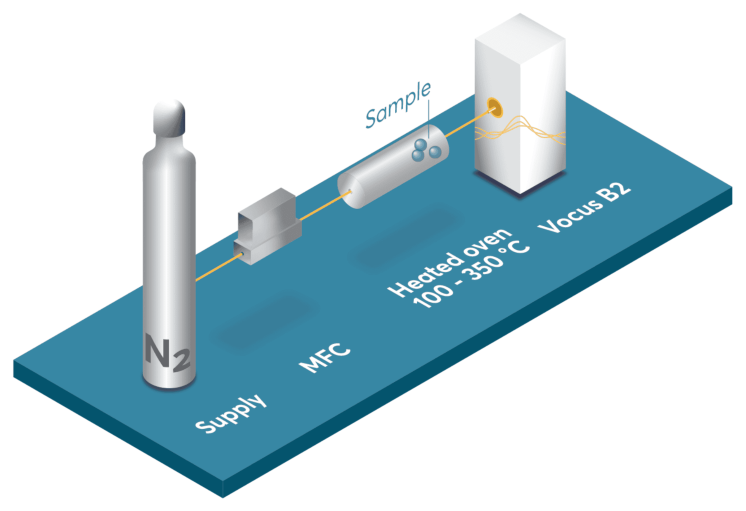
Figure 1. Experimental setup used in this study. Image Credit: TOFWERK
PFAS Off-Gassing From Resin Samples
Figure 2 illustrates representative PFAS emissions observed from two distinct resin samples during the experiment. As the temperature progresses through four incremental steps - starting from just over 100 °C and reaching 250 °C - the PFAS Off-Gassing emissions generally exhibit an increasing trend.
Nine different types of PFAS, all measured concurrently, were detected at concentrations ranging from below one pptv to approximately one ppbv.
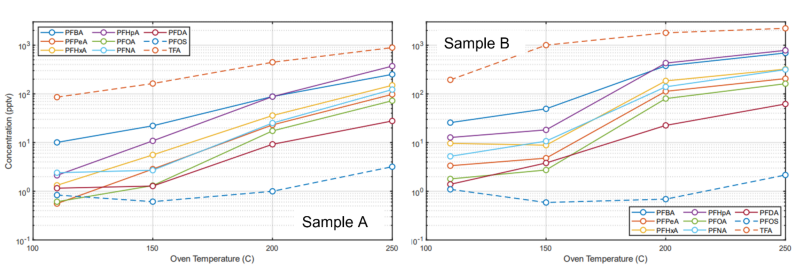
Figure 2. Concentration of nine species of PFAS versus oven temperature with concentrations averaged to each oven temperature setpoint and data background subtracted from blank (empty oven) measurements. Image Credit: TOFWERK
The advanced soft chemical ionization technology employed by the AMC Analyzer allows users to confidently identify a broad spectrum of PFAS simultaneously and without fragmentation, a challenge that can arise with higher-energy ionization techniques.
Figure 3 plots the mass defect of 24 molecules against their molecular mass (the molecule combined with the reagent ion, specifically I–).1 The dashed lines indicate the addition of either CF2 (represented in red) or O (represented in blue) to the parent molecule, providing direct insight into the formation of PFAS and its related molecules.
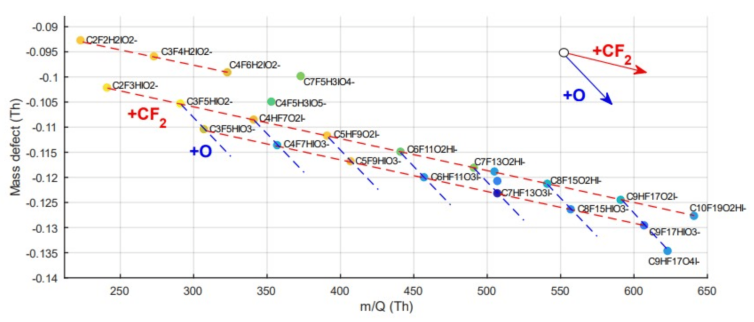
Figure 3. Complete PFAS observed from the resin sample plotted as log of the observed signal by mass to charge and mass defect. Image Credit: TOFWERK
Conclusion
Due to its rapid operation, soft ionization properties, and remarkable sensitivity, the Swiss-developed TOFWERK Semicon AMC Analyzer is uniquely positioned to efficiently and reliably measure PFAS emissions.
This single, compact, and portable instrument can detect and identify dozens of PFAS molecules within seconds, representing a crucial initial step in understanding these significant chemicals, protecting the environment, and fostering a sustainable future in one of the world's most critical industries.
References
- Riedel, T.P., et al. (2019). Gas-Phase Detection of Fluorotelomer Alcohols and Other Oxygenated Per- and Polyfluoroalkyl Substances by Chemical Ionization Mass Spectrometry. Environmental Science & Technology Letters, 6(5), pp.289–293. DOI: 10.1021/acs.estlett.9b00196. https://pubs.acs.org/doi/10.1021/acs.estlett.9b00196.
Acknowledgments
Produced using material originally written by Katie Schmidt, Felipe Lopez-Hilfiker, Priyanka Bansal, Carla Frege, and Veronika Pospisilova from TOFWERK.

This information has been sourced, reviewed, and adapted from materials provided by TOFWERK.
For more information on this source, please visit TOFWERK.