In this interview, AZoM speaks with Joerg Koehler of Bruker BioSpin about recent developments in NMR spectrometry for industrial R&D and quality control. He discusses how changes in magnet and probe design, along with software automation such as the ACP 2.0 platform for quantitative NMR, are lowering operating costs and shortening analysis time in pharma, chemicals, polymers, and battery research. Koehler also discusses how compact and benchtop systems can bring NMR measurements closer to the production floor, with automated workflows that reduce the need for an NMR specialist at the instrument.
To start, what does your role at Bruker involve, and how does the Avance NMR spectrometer series fit into your industrial portfolio?
I’m responsible for our portfolio strategy for industrial market segments and magnetic resonance-based technologies at Bruker. In this role, it’s key to build close relationships with players in the field: our customers, future customers, and strategic partners. With this network, we’re able to make the right decisions about where to evolve our portfolio to better serve our markets and customers.
The Avance NMR spectrometer series plays an essential role in that portfolio. It’s our flagship product line, and it plays a crucial role in the product innovation process for all our customers. Many globally active corporations in chemistry, polymers, and pharmaceuticals have been using this technology for decades, and they’ve made that journey together with Bruker over the years. We’ve reached a position in the global market where we can confidently say the Avance NMR spectrometer line is the most widely used NMR platform in the world.
NMR for Industry with Dr. Joerg Koehler
When you talk about smaller magnets in NMR products, what changes matter most in footprint, cryogenics, and shielding?
Over the decades, it was important to further evolve this technology, and Bruker was the frontrunner throughout, advancing NMR and its practicality in industrial environments.
If you look at the shrinking size of the housing for these cryogenically cooled magnets (the cryostat and thermal containment), the footprint has gone down considerably. A 600 MHz magnet today is dramatically smaller by volume than one from 10 or 15 years ago. That’s the obvious part. Then there are the boil-off rates of the liquid gases: there’s precious liquid helium inside these systems, and reducing that boil-off rate was key to bringing down the cost of ownership.
But the most important thing to mention is the shielding characteristics. In the past, the strong magnetic fields extended well outside the housing. Nowadays, they’re contained within it, so you’re able to place these magnets much closer to each other. Many of our customers run a significant number of these instruments, and lab space is precious; it needs to be air-conditioned and maintained. The closer you can pack these systems together, the lower your overall laboratory running costs. And Bruker has been a real frontrunner in advancing this technology.
What role has probe technology played in reducing trade-offs between compact and high-field NMR, and in improving throughput?
Reducing the cost of ownership of NMR systems has always been, and still is, a key priority. The smaller the magnet, the lower the evaporation rate of the liquid gases, and the lower the cost of ownership. We’ve also invested in the electronics in the spectrometer console and in our probe technology, enabling our customers to run more advanced, sophisticated NMR experiments at lower fields.
Probe technology also drives efficiency gains in NMR. Reducing experimental time and running more samples within 24 hours has also lowered the cost of ownership for these systems.
Bruker launched chemistry sample prep automation alongside ACP 2.0. What does an end-to-end automated qNMR workflow look like, from sample to report?
Automating NMR analysis is a key priority, and Bruker has been innovative in this space for many years. When it comes to pick-and-place robotics for already-contained samples, feeding them into the instrument and automating data analysis and interpretation, that’s one part of the picture.
We’re now launching Advanced Chemical Profiling 2.0, our latest release for Shimmer quantitative NMR. It’s a workflow creation tool that enables the specialist, the highly trained NMR expert, to build a fully automated workflow that includes the pick-and-place robot. It selects the sample, acquires the data, processes the data, interprets the data, and files a report. That filed report is then delivered to whatever destination folder the customer specifies.
With this setup, we further reduce the workload on highly trained experts. Rather than having them perform repetitive tasks such as data processing and interpretation, we let them focus on method development, validation, and maintaining the system. That’s a much greater added value to our customers than having specialists just process data.
ACP 2.0 also incorporates deep learning algorithms, part of the AI toolkit, to interpret data, reduce noise in the NMR spectrum, adjust baselines, and make the system more robust for autonomous, hands-off operation.
Another key element is that ACP 2.0 is an add-on to TopSpin, our industry-standard NMR control software. It integrates directly into TopSpin, so from an auditing perspective, which is critical in industrial environments, there’s no data handover, no import/export step to analyze and interpret data. It all happens within the instrument. It’s natively included in the workflow, which is why it can drive the autosampler and control everything running in the machine. Auditors appreciate that there’s no third-party software sitting on top; it integrates natively within our software infrastructure.
With TopSpin 5, we also opened up the front-end side of this. The analytical instrument and data interpretation are the core, but on the front end, there’s more than just pick-and-place robotics. The sample needs to be prepared: a bottle of process liquid arrives at the analytical lab, and there’s a specific task to prepare those samples for use not only with NMR, but also with mass spectrometry and other technologies.
The chemistry portfolio supports very sophisticated sample handling and preparation steps: dispensing, mixing solids and liquids, pressure cooking, stirring, agitation, whatever is required, as well as labeling, feeding data into the data management layer, registering the sample, and then executing the analysis. On the back end, we connect to most modern LIMS systems and other data management layers, because that’s ultimately where the information goes and where it adds value for our customers.
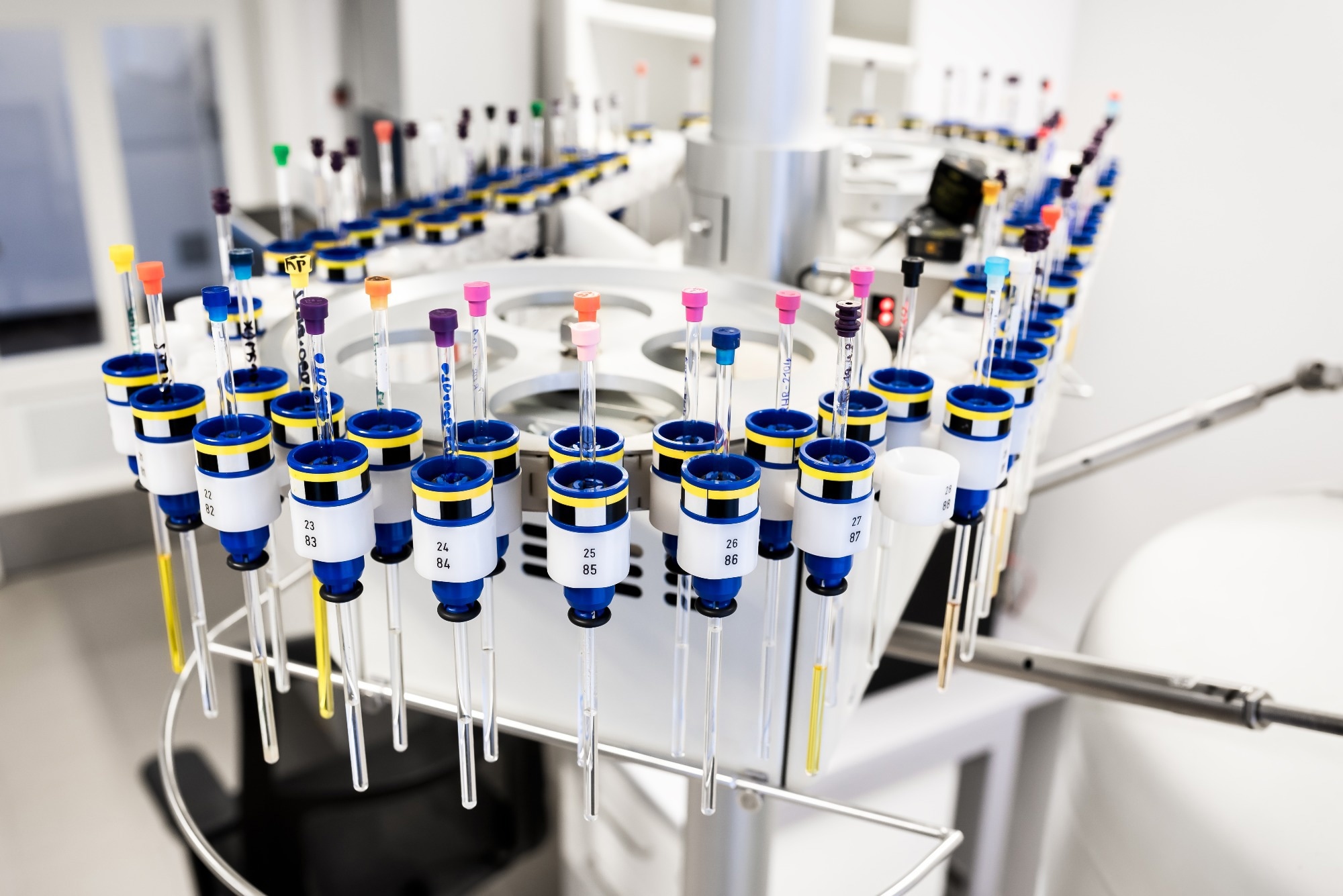
Image Credit: Forance/Shutterstock.com
As products move from R&D into pilot and manufacturing, where do compact and benchtop NMR systems fit?
NMR is a fundamental element in our customers’ product innovation steps. Everybody uses it, and experts run the NMR spectrometers, generating added value for the organization. But when it comes to rolling out new products, when the product innovation step ends and moves into pilot scaling and then volume manufacturing, there’s always a need to derive an analytical methodology, because high-field NMR machines are not something you typically have in a QC or broader manufacturing environment.
What our clients normally have to do is translate the analytical technology into a different technology altogether. This requires sophisticated cross-validation steps because product requirements are defined during the R&D process: R&D engineers design the product based on market requirements, which determine how testing should be conducted in manufacturing. That derivative technology could be mass spectrometry, it could be an optical method.
For some newer products, though, we’re seeing a trend toward staying within magnetic resonance. They use benchtop systems (both Fourier transform NMR and time-domain NMR). They stay close to the original R&D methodology, which allows the NMR expert in R&D to better define the derivative method. Cross-validation is also easier when you stay in the same technology.
There’s another notable benefit: when something goes wrong or challenges arise during the scaling process, the R&D expert is often called in to look at issues with the batch and process. If they’re looking at their native data, they see what they’re used to, and the troubleshooting is faster.
So the idea of using a benchtop NMR for rolling out new products into manufacturing is really about time. There’s a positive reduction in time-to-market for our customers: they reach the payoff phase faster, and that brings real benefits to their operations.
Analytica brings together many analytical technologies. How does advanced NMR fit into that broader ecosystem, especially with the push for data harmonization?
A clear trend we see is further harmonization of data and results. There is not one analytical technology that answers all the questions. That technology was not there in the past, and I strongly believe it will not be there in the future. So it’s always an interplay of different analytical technologies. Some are orthogonal and need to be orthogonal. Others are supporting each other. Some are gold standards and are used to calibrate others.
NMR is notably prominent here: it’s inherently quantitative, it spans a wide concentration range, and it’s often used to develop chemometric models for other technologies to validate and verify results. So it’s the connection of everything. This calls for data harmonization, and within the data layer where everything fits together, there are still efforts needed across the whole industry to further harmonize interfaces and data formats.
Customers often have a mixed park of instruments: different technologies, but also different vendors. Being cross-compatible, being able to connect different instrumentation together with sample preparation and robotics, that’s the key thing to do. Bruker is well-positioned with its chemistry portfolio, which, of course, features all the analytics Bruker offers. But we can also integrate any other analytical technology from any vendor. Being open and flexible, while keeping the bigger goal of knowledge creation in mind, that’s what matters.
Which market segments are driving NMR adoption and new applications right now?
NMR plays an essential role in the product innovation process at R&D facilities across various market segments, really, in any question arising out of analytical chemistry. The pharmaceutical industry comes to mind first, followed by the chemical and polymer industries. But look into electronics as well: the entire battery market, display research and development, and performance materials that need to perform on very specific characteristics. There’s a highly interactive play of different chemicals involved in all of that.
Look into mobility, too. A modern battery-driven vehicle requires significantly more performance materials than classical internal combustion cars. There’s simply more electronics involved, more monitoring and measuring. Autonomous driving also requires a certain set of sensory devices, and when you break it down, it’s chemistry happening in those sensors as well, materials interacting.
So across all these R&D facilities, there’s a lot of analytical chemistry, and NMR plays a crucial role in all of these processes.
If a reader is focused specifically on ACP 2.0, what changes most for day-to-day users once a workflow is set up and validated?
We’ve now released version 2.0 of the Advanced Chemical Profiling software, the second generation, which brings added value to NMR spectroscopy. NMR experts who run these highly sophisticated machines are often burdened with repetitive data processing, data interpretation, and report filing. ACP 2.0 natively integrates into TopSpin, our instrument control software, and enables the expert to create an automated workflow.
Once that workflow is validated, it can be executed by pretty much any engineer. The system, once started, will autonomously select a sample from the sample carousel, acquire and process the data, interpret the data using deep learning and artificial intelligence, and then feed the data into commonly used data management systems such as LIMS or similar platforms.
The NMR expert remains an essential part of this workflow, but their skills are better utilized in developing a method and monitoring the workflow, rather than processing or interpreting data or performing repetitive tasks.
These end-to-end automated workflows, from sample preparation through instrument control, data acquisition, processing, and interpretation, constitute an NMR-augmented workflow. Because the inherently quantitative power of NMR is utilized in a high-throughput setting without requiring an NMR expert sitting in front of the instrument.
About Joerg Koehler

Dr. Joerg Koehler is Head of Business Unit Industrial at Bruker, where he is responsible for the company’s global magnetic resonance activities across industrial market segments, including forensics. He holds a doctoral degree from the Institute of Biophysics and Physical Biochemistry at the University of Regensburg, where he also worked as a postdoctoral research scientist on NMR-based studies of folding intermediates of biochemically active macromolecules. Before joining Bruker, he held several roles in sales, sales management and business administration.
This information has been sourced, reviewed and adapted from materials provided by Bruker BioSpin Group.
For more information on this source, please visit Bruker BioSpin Group.
Disclaimer: The views expressed here are those of the interviewee and do not necessarily represent the views of AZoM.com Limited (T/A) AZoNetwork, the owner and operator of this website. This disclaimer forms part of the Terms and Conditions of use of this website.