Artificial intelligence (AI) capabilities are continuously increasing. Large language models (LLMs) and machine learning (ML) have already fundamentally transformed product development, shifting the paradigm from AI-assisted to fully autonomous workflows and from basic decision support to AI-led execution.
Beyond cost savings and cycle time reductions, AI has the potential to increase technical and economic possibilities by empowering organizations to solve complex problems, enter new market categories, fulfill stringent sustainability mandates, and differentiate themselves through superior performance. Ultimately, artificial intelligence is far more than an efficiency tool; it is a powerful innovation multiplier.
Pivotal Changes in Product Development Happening Now Include:
The Rise of Autonomous R&D
- Move from AI as a decision-support tool to AI-driven experiment design and execution
- Expanding autonomous labs with robots, machine learning, and closed-loop optimization
- Digital twins are being used to simulate materials, molecules, and processes
Foundation Models and Large Language Models (LLMs) in Scientific Workflows
- Domain-specific foundation models based on private experimental data and scientific literature
- Use LLMs for hypothesis formulation, scientific writing, lab protocols, and patent drafting
- Use chat-based interfaces to query complex datasets in natural language
AI-Augmented Human Expertise
- AI collaboration models for scientists and engineers can improve ideation and minimize cognitive burden
- Enhanced collaboration among domain experts and data scientists
- Democratize data insights for non-technical staff
Scalable Knowledge Reuse and Institutional Memory
- Utilizing intelligent knowledge graphs and semantic search to analyze decades of R&D data
- Achieve long-term competitive advantage by codifying and continually learning from knowledge systems
- Improved interoperability via APIs and data standards
Sustainability-Driven Innovation
- Utilize AI technologies to optimize formulations or processes for reduced carbon footprint, recyclability, and biocompatibility.
- Application of AI for green chemistry and circular product development
AI for Multiscale and Multimodal Science
- Integrating data at the molecular, process, and product levels for holistic modeling
- Integrating text, image, sensor, and simulation data to enhance material discovery and process optimization
How Do You Outcompete and Outperform with AI?
AI delivers faster innovation cycles, more detailed insights, and cost reductions. To reap these benefits, teams in R&D, PLM, and QC need to acquire high-quality, well-structured data.
Short-Term AI Benefits Include:
- Improved data analytics and pattern detection
- Reduced time to insight
- Improved decision-making
- Automated workflow processes
- Optimized trial costs
Long-Term AI Benefits Include:
- Faster innovation cycles
- Increased product success rates
- Improved knowledge retention and reuse
- Increased competitive differentiation
- Enables scalable cooperation across functions and sites
Why Data Capture is the Challenge
AI is only as effective as the data it sees. Essentially, you receive what you put in. Using data science and AI for product creation requires organized, AI-ready information.
While data availability varies by industry, each sector has one thing in common: scattered data repositories. Data is collected and stored independently by the many teams and systems used throughout the value chain. This includes:
Paper
- Runsheets and batch records
- Checklists, logbooks, manuals, and reports
- Change request forms
- Product requirement docs
- Spec sheets
Desktop/Cloud
- Excel experiment plans
- Statistical software
- LIMs
- ERP modules
- CAD software
- Analytical records and ELNs feeding into a data lake
- Quality management systems
- PLM platforms
Mobile
- Inventory management
- Inspection apps
- Issue tracking
- Compliance sign-offs
More data beats clever algorithms, but better data beats more data.”
Peter Norvig, Google Research Director and Distinguished Education Fellow, Stanford Institute for Human-Centered AI
How Does Uncountable Help Solve the Challenges of Today’s Product Development Teams?
Uncountable’s AI platform is designed specifically for end-to-end product development. As a result, it addresses the real-world data challenges that teams face daily in R&D, PLM, and quality assurance.
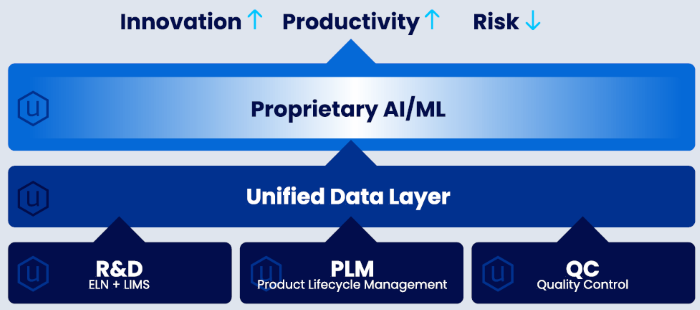
Image Credit: Uncountable Inc.
How Does Uncountable Work?
- Uncountable centralizes your data from several sources, including LIMS, ELNs, spreadsheets, historical reports, and labs. Uncountable combines it all into a single, structured, connected platform; no other solution can handle the complex, heterogeneous data that Uncountable handles.
- Uncountable’s global data search feature allows scientists to access institutional knowledge across the business, reducing the need for repeated effort.
- Uncountable’s unified visualization allows you to study and display everything in one location, in context, and at the pace of research.
- Uncountable’s AI-powered models assist teams in identifying patterns, predicting outcomes, and accelerating data discovery, providing a competitive advantage.

This information has been sourced, reviewed, and adapted from materials provided by Uncountable Inc.
For more information on this source, please visit Uncountable Inc.