In this interview, industry expert Tea Pavlek explains how AI-driven platforms enhance data use, optimize experiments, and improve formulation workflows, enabling faster innovation and more efficient product development across industries.
To get started, could you give us an overview of Uncountable and your role within the company?
My name is Tea Pavlek, and I lead global technical marketing and events at Uncountable, working with a team that operates across the US, Asia, and Europe.
Uncountable is an AI platform designed for end-to-end product development. We support some of the largest organizations globally in accelerating their product development processes across industries such as chemicals, advanced materials, food, and cosmetics.
What differentiates us is that we originally started as a data science company about 10 years ago, with predictive modeling at the core of our approach. Rather than adding AI capabilities on top of an existing system, we built the platform around predictive modeling from the beginning.
This means our data structures are inherently designed to work effectively with AI, ensuring reliable outputs rather than inconsistent or low-quality results.
What are some of the biggest challenges that materials scientists and formulation teams face today that Uncountable was designed to solve?
One of the biggest challenges lies in how data is collected, stored, and ultimately used. Many organizations have systems that store data effectively, but they struggle to extract meaningful value from it over time.
In formulation workflows, teams often need to reformulate, improve existing products, or develop entirely new ones. This frequently involves manually gathering data from multiple sources, such as different software platforms and Excel files.
As a result, scientists often end up repeating experiments because previous work is not easily discoverable across teams or locations.
For example, a team in one country may unknowingly repeat work already completed elsewhere within the same organization. This is not necessarily a flaw in existing systems, but rather a reflection of how demands have evolved. Today, organizations require greater connectivity, faster innovation cycles, and better ways to leverage historical data.
Uncountable addresses this by shifting the focus from simple data retention to true data utilization, helping organizations maximize the long-term value of their data.
Design of Experiments (DOE) has long been a key methodology in materials science. How does Uncountable enhance these approaches using machine learning to help scientists design smarter experiments?
Uncountable enhances DOE by enabling scientists to interact directly with their structured data using machine learning.
Once data is properly organized within the platform, scientists can ask targeted questions to inform their next formulation based on specific constraints. They can optimize for cost, regulatory requirements, ingredient restrictions, and other factors that matter to their development goals.
The platform can suggest new experiments, predict potential outcomes, and estimate factors such as cost and sustainability metrics, including carbon footprint.
Importantly, Uncountable does not simply provide recommendations. It also explains the reasoning behind those suggestions, allowing scientists to understand why a particular formulation or parameter is being proposed.
In addition, the platform can incorporate large language models to search external sources when needed, such as identifying alternative ingredients in response to supply chain or regulatory changes. This combination of machine learning and external data access allows for more informed and efficient experimental design.
Uncountable LLM Ingredient Research
Video Credit: Uncountable
When analyzing experimental results, what kinds of patterns or relationships can the system uncover that might be difficult for researchers to identify manually?
A key strength of the platform is that it connects all inputs and outputs across experiments. Every formulation, test, and result is linked, providing a complete and traceable history.
Traditionally, data analysis requires combining information from multiple sources, such as spreadsheets, reports, and emails. In Uncountable, all of this is integrated into a single environment. Scientists can design experiments, request tests, and analyze results within the same system.
The platform also offers a wide range of visualization tools, enabling users to generate graphs and explore data interactively. Each data point is linked back to its full experimental context, allowing researchers to investigate outliers, understand trends, and trace results back to their origins.
This level of connectivity makes it much easier to identify relationships between variables and outcomes, significantly reducing analysis time.
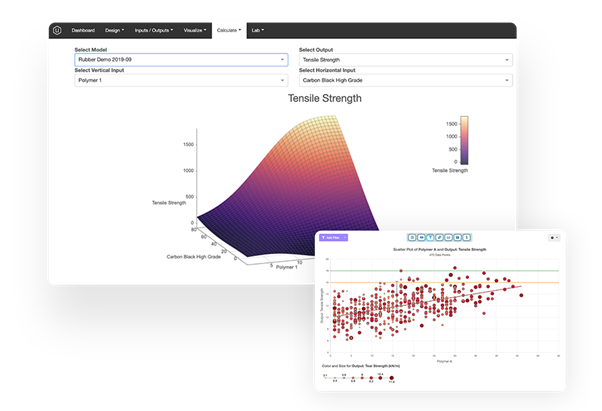
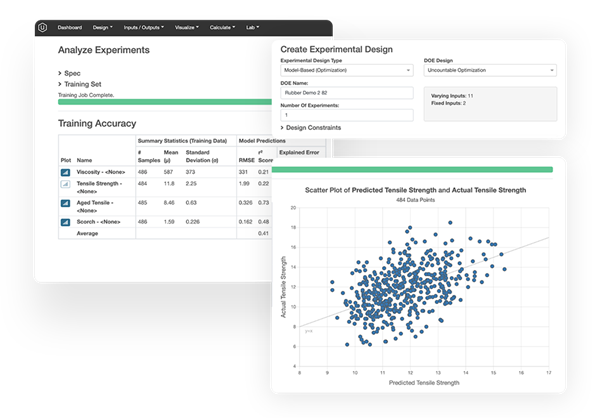
Image Credit: Uncountable
One particularly exciting capability you’ve developed is predicting the performance of a material while a researcher is still formulating it. How does that work in practice?
As scientists build a formulation within the platform, they can use predictive tools to estimate performance in real time.
Users can define their goals, such as optimizing for cost, performance, or compliance, and assign priorities to these objectives. The system then evaluates how close a given formulation is to meeting those goals and provides predictions accordingly.
It can also suggest modifications to improve the formulation and move closer to the desired outcome.
This capability is enabled by combining high-quality, structured data with machine learning models trained on historical experiments. Because the platform ensures a consistent data structure, the predictions are reliable and actionable.
In some cases, this has led to entirely new product ideas. One materials company, for example, discovered a formulation approach they had not considered in decades of work, which ultimately resulted in a new product.
What does the workflow actually look like for a formulator using these predictive tools? How do they interact with the model while adjusting a recipe?
The workflow is designed to be as intuitive as possible. Scientists can interact with the system through a chat-style interface, using either text or, in some cases, voice commands.
A user might ask the platform to visualize relationships between ingredients across multiple labs or request performance trends over time. They can also adjust formulations and immediately see the predictions update in response.
The goal is to reduce non-value-added tasks, such as manually compiling data from different sources, and instead allow scientists to focus on innovation. By centralizing data and enabling intuitive interaction, the platform reduces friction and accelerates decision-making.
Black-box AI can be a source of concern due to the lack of interpretability around how the model arrived at certain conclusions. How does Uncountable ensure its predictions remain transparent and explainable for scientists using the platform?
Transparency is a key priority for us. Scientists can access detailed reports that explain how each prediction or suggestion was generated.
This allows users to evaluate whether a recommendation makes sense and to refine or adjust the model inputs if needed. The system is interactive, so scientists are not forced to accept results blindly. Instead, they can explore the reasoning behind each outcome and iterate accordingly.
In practical terms, how much time or experimental iteration can predictive modeling eliminate in a typical materials development project?
While exact figures can vary, we have case studies showing significant reductions in both time and experimental workload.
In some cases, organizations have reduced the number of required experiments by around 50% or more. This is possible because reliable predictions allow teams to focus only on the most promising formulations, rather than testing every possibility.
These reductions translate directly into cost savings, faster development cycles, and quicker time to market. Although some data remains confidential, the available case studies clearly demonstrate substantial efficiency gains.
Image Credit: Uncountable
Beyond predictive modeling, Uncountable also incorporates LLM-based tools. How are these AI assistants helping researchers interact with their experimental data more effectively?
Large language models are particularly useful for working with unstructured data and external information.
For example, they can search for alternative ingredients when supply chain issues arise, summarize large sets of documents such as PDFs or reports, and extract insights from historical or unstructured data sources.
While machine learning is best suited for structured data and predictive tasks, LLMs complement this by handling broader information retrieval and interpretation. Together, they provide a more complete and flexible data ecosystem.
Scientific workflows rely heavily on documents like technical data sheets, safety data sheets, and certificates of analysis. How does the Uncountable platform transform these documents into structured, usable data?
We aim to reduce documentation burden by integrating it directly into the workflow.
The platform can help generate and prepopulate documents, such as certificates of analysis, ensuring they align with the underlying data. By automating parts of this process, we reduce manual effort and improve consistency.
Where possible, we transform or integrate document data into structured formats within the platform, allowing it to be used for analysis and decision making rather than remaining isolated in static files.
Which industries do you think stand to benefit the most from AI-driven platforms like Uncountable?
Our platform is particularly well-suited to industries that rely heavily on formulations and experimental data.
These include chemicals, advanced materials, food, cosmetics, and related sectors such as energy, petrochemicals, batteries, and rubber.
The key factor is not just the industry itself, but the nature of the workflow. Organizations that manage complex R&D processes, from formulation through to quality control and product lifecycle management, benefit the most.
Whether a company is developing products like coatings, creams, or consumer goods, the platform can provide significant value. We continue to expand into new areas, but we remain focused on delivering strong, targeted solutions rather than trying to cover every possible use case.
About Tea Pavlek 
Tea Pavlek works at the intersection of scientific workflows and digital transformation, with experience supporting laboratory environments in academia and industry. At Uncountable, she has led technical marketing and events across global regions, helping communicate how connected R&D data platforms support researchers with visualization, knowledge sharing, and predictive capabilities.

This information has been sourced, reviewed, and adapted from materials provided by Uncountable Inc.
For more information on this source, please visit Uncountable Inc.
Disclaimer: The views expressed here are those of the interviewee and do not necessarily represent the views of AZoM.com Limited (T/A) AZoNetwork, the owner and operator of this website. This disclaimer forms part of the Terms and Conditions of use of this website.