Sponsored by Vitrek, LLCReviewed by Olivia FrostJul 20 2026
Cable assemblies are continually evolving as products become more compact, powerful, and interconnected.
Today's designs often function at greater voltages while fitting into smaller packaging envelopes, forcing engineers to strike a compromise between electrical performance and available physical space. At the same time, many assemblies now have more conductors and incorporate mixed-signal and power pathways in a single harness.
Environmental demands are also increasing. Depending on the application, cable systems may be required to withstand vibration, severe temperatures, wetness, chemicals, or continuous motion.
Along with these technological requirements, manufacturers are now expected to provide tighter quality documentation and traceability throughout the production process.
These trends are evident in electric vehicles, aviation electronics, robots, medical equipment, and defense platforms, where cable dependability is inextricably linked to system performance and safety.
The Hidden Cost of Manual Testing
Many manufacturers still use manual cable testing procedures designed for smaller products and lower production volumes. While these tactics may appear feasible on the surface, they frequently involve hidden costs that become more severe as complexity develops.
One often seen problem is sluggish throughput. During the testing process, operators must continually relocate leads, reconnect fixtures, and walk from point to point, adding labor time to each unit produced.
Manual workflows also raise the possibility of human error. Missing test points, faulty setups, or inconsistent processes might allow bugs to escape or result in unnecessary retesting.
Traceability is a further problem. Many manual environments store results independently from production data or without a direct link to a serial number, making auditing and root cause investigation more complex.
Scaling production becomes similarly problematic: a technique that works for 20 cable assemblies per day may quickly fail when demand increases to hundreds of units per shift.
What Intelligent Cable Testing Looks Like
Modern cable testing systems use automated operations to replace manual repetition. Instead of needing operators to physically transfer test leads between conductors, automated switching systems route test points electronically and sequentially. This shortens setup time while assuring that all essential connections are tested consistently.
Advanced hipot capabilities increase trust by confirming dielectric withstand strength and leakage current performance using precision measurement control. Guided operator processes enhance consistency by including barcode scanning, recipe-based test selection, and unambiguous user prompts that reduce training needs and setup errors.
Digital reporting is equally crucial in today's production scenarios. Automated systems can generate quick PDF or CSV records based on part numbers, serial numbers, or manufacturing data systems. Scalable architectures also enable firms to improve test capacity as products become more complicated or manufacturing quantities increase.
Common Cable Test Failures
- Leakage current drift
- Pin-to-pin shorts
- Connector damage
- Insulation breakdown
- Miswiring
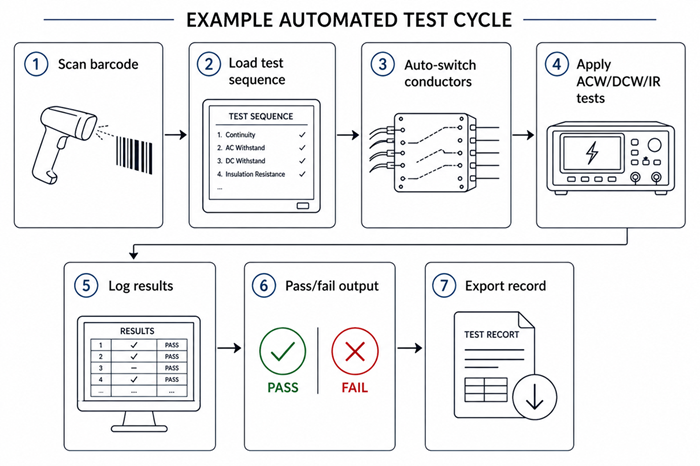
Image Credit: Vitrek, LLC
Why Combining V10X & 964i Matters
The Vitrek V10X and 964i together meet these modern standards in a single cable-testing platform. Together, the system provides high-voltage performance, sensitive measurement capability, and quick multi-point switching for complex cable assemblies.
The V10X features a modern touchscreen interface that facilitates setup and operation while also offering integrated reporting for traceability and compliance. The 964i improves test capability by automating switching, which allows many conductors and points to be checked without constant operator intervention.
The end result is a production-ready system that converts cable testing from a bottleneck to a measurable competitive edge.
How Automation Improves Production Metrics
Repeatability also improves because the same approved sequence is used every time. Instead of depending on individual operator habits or memory, automated systems run identical test routines with consistent timing, constraints, and order of activities. This helps to ensure consistency in results across shifts, operators, and manufacturing lines.
Another significant advantage is the reduction of false failures. Stable programmed limits, regulated ramp times, and repeated switching paths reduce nuisance trips and unreliable readings in manual environments. This reduces unnecessary retesting, saves manpower, and avoids delays caused by investigating non-existent defects.
Training is also much easier when systems are recipe-driven. Instead of mastering difficult manual procedures for each product variant, operators may scan a barcode or select a prepared test program. This saves onboarding time, decreases reliance on tribal knowledge, and enables teams to respond more swiftly to staffing changes.
Traceability is enhanced by automatically generated digital records connected to serial numbers, part numbers, or batch data. Test results can be promptly saved, searched, and retrieved for audits, client documentation, or internal quality review. This improves visibility of production efficiency while simplifying compliance requirements.
Business Results Manufacturers Can Expect
The advantages of intelligent cable testing extend far beyond the test bench. Improved throughput enables manufacturers to process more products with less manual handling and fewer steps. Better quality is achieved through uniform execution across all assemblies, minimizing variability and preventing defects from escaping.
Compliance is also made easier when test records are produced automatically and saved in a manner appropriate for audits, client needs, or internal quality systems.
Guided workflows alleviate the training burden by reducing reliance on tribal knowledge or highly experienced operators. Perhaps most crucially, automated platforms enable future readiness by enabling next-generation cable designs, increased volumes, and changing customer expectations.
The Role of the V10X and 964i in Cable Test Applications
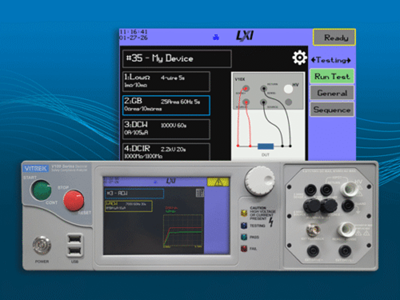
V10X Hipot Tester. Image Credit: Vitrek, LLC
The Vitrek V10X and 964i are designed to assist manufacturers in incorporating these automation benefits straight into cable and harness production.
They combine high-voltage testing capabilities with intelligent switching to create a versatile platform for certifying complicated assemblies more quickly and consistently than manual approaches.
The V10X acts as the system's measurement engine, offering comprehensive hipot and electrical safety testing via a modern touchscreen interface, programmable test sequences, and integrated reporting features.
With its high-voltage performance and sensitive measuring capabilities, producers can confidently evaluate dielectric withstand, leakage current, and insulation quality across a wide range of cable products.
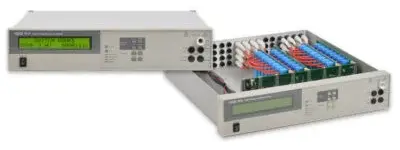
964i HV Switch. Image Credit: Vitrek, LLC
The 964i enhances this capability by automating access to various conductors and test sites.
Instead of needing workers to physically shift leads from pin to pin, the 964i electronically routes connections via a controlled switching sequence. This shortens setup time, decreases handling errors, and makes high-point-count cable assemblies realistic for testing in production applications.
When combined, the V10X and 964i form a scalable solution that enables quicker throughput, repeatable execution, simpler operator operations, and comprehensive digital traceability.
Whether the application is EV cables, aircraft harnesses, medical assemblies, or industrial wiring systems, the platform can help transform cable testing into a streamlined and data-driven manufacturing procedure.
Conclusion
Cable testing has evolved into more than just a final inspection step at the end of production. As assemblies become more complicated and performance expectations climb, manufacturers require testing systems that can keep up with higher voltages, increased conductor counts, stricter quality requirements, and rising production volumes.
Using manual methods in this setting increases risk, slows throughput, and provides limited visibility into product quality.
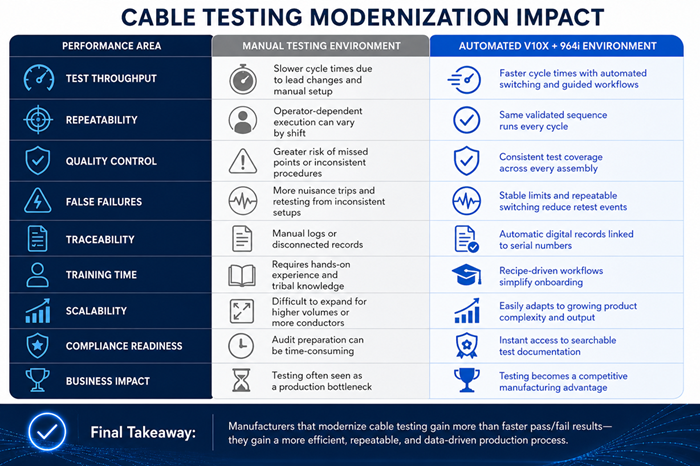
Image Credit: Vitrek, LLC
This information has been sourced, reviewed, and adapted from materials provided by Vitrek, LLC.
For more information on this source, please visit Vitrek, LLC.