Critical Link, LLC, a maker of production-ready System on Modules (SOMs) and embedded solutions, today announced that its Holoscan Sensor Bridge with MitySOM-A5E won a Best in Show award at Embedded World North America Sept. 2026. Embedded Computing Design awarded the achievement in the AI & Machine Learning category. The platform connects to NVIDIA GPUs to enable an FPGA + GPU solution for physical AI and edge applications such as robotics, industrial vision, and medical imaging, combining deterministic sensor processing with AI compute.
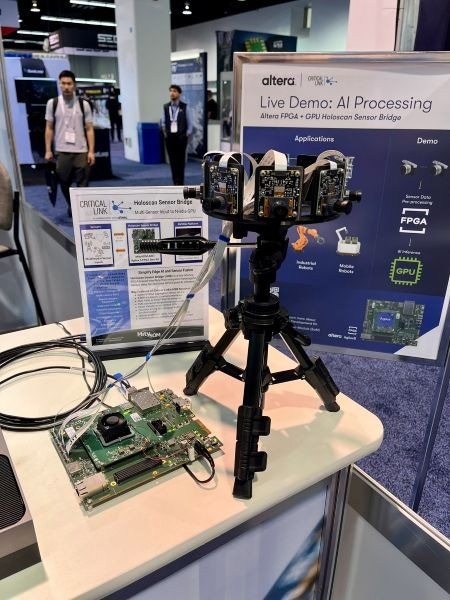 Image Credit: Critical Link, LLC
Embedded Computing Design's content team judges Best in Show entries on a 15-point rubric covering design excellence, relative performance, and market impact or disruption.
Critical Link developed the Holoscan Sensor Bridge (HSB) with MitySOM-A5E in collaboration with Altera. It is a low-latency, FPGA-based interface that combines and prepares data from many sensor types before delivering it to NVIDIA GPUs for AI processing. At its core is Critical Link's production-ready MitySOM-A5E. The SOM is built on the Altera® Agilex® 5 SoC FPGA E-Series.
"Edge AI systems are only as good as the sensor data they can bring in. Getting many high-bandwidth sensors into a GPU with low latency and tight synchronization has been one of the hardest problems in robotics, medical, and safety-critical design," said Tom Catalino, Vice President and Founder of Critical Link. "The Holoscan Sensor Bridge with MitySOM-A5E gives developers an off-the-shelf answer. Altera's Agilex 5 FPGA handles sensor aggregation and pre-processing, while NVIDIA GPUs provide the AI compute. Because it's built on our long-lifespan, production-ready SOMs, customers can take the same platform from prototype to deployment. We're grateful to Embedded Computing Design for this recognition and to Altera for its partnership."
Sensor Fusion Beyond the Camera
The HSB with MitySOM-A5E goes beyond imaging. Designers can bring LiDAR, radar, acoustic, and other high-bandwidth inputs into the same real-time AI pipeline. The FPGA aggregates and synchronizes the sensor data in hardware, then sends it over dual 10 or 25 Gb Ethernet directly to a compatible NVIDIA GPU.
Key features include:
- Agilex 5 FPGA sensor aggregation: Combines multiple sensor inputs in programmable logic for deterministic, low-latency processing
- Eight MIPI CSI-2 camera interfaces: Supports eight 4-lane CSI-2 inputs for multi-camera systems
- High-speed transport: Dual SFP28 ports support 10 Gb or 25 Gb Ethernet, at up to 28 Gb/s per port
- FMC expansion: An FMC port (LPC plus eight transceivers) adds more sensor inputs
- Precision timing: Hardware-based synchronization keeps multi-sensor data aligned
- Production-ready foundation: Built on Critical Link's long-lifespan MitySOM-A5E, with US-based support and obsolescence management
The platform targets robotics and humanoids, multi-camera AGVs, robotic surgery equipment, diagnostic imaging, industrial automation and visual inspection. Other target uses include biometrics, safety-critical analysis and scientific instrumentation.
Altera FPGAs: The Fabric for Physical AI
Physical AI starts at the point where real-world sensor data enters the AI pipeline. Sensors bring different interfaces, data formats, and real-time requirements for deterministic, low-latency operation, creating challenges that AI compute alone does not address. Altera FPGAs provide a flexible hardware fabric between sensors and AI compute, enabling sensor connectivity, aggregation, data pre-processing, and efficient delivery of sensor data to GPUs. This is the role of a GPU companion: complementing GPU compute while giving developers flexibility as sensor configurations and system requirements evolve.
"Physical AI requires a flexible fabric between the physical world and AI," said Farhad Shafai, Head of Business Solutions and Marketing at Altera. "Critical Link's Holoscan Sensor Bridge with MitySOM-A5E demonstrates the value of Altera's Agilex 5 FPGAs as the fabric connecting sensors, aggregating sensor data, pre-processing it, and seamlessly delivering it to NVIDIA GPUs. We congratulate Critical Link on this award and are proud of our collaboration to help bring physical AI from concept to deployment.”
Availability
The Holoscan Sensor Bridge with MitySOM-A5E is available now. The platform uses the MitySOM-A5E Standard Development Kit hardware with custom programming.