Sponsored by Vitrek, LLCReviewed by Maria OsipovaApr 6 2026
Electrical safety testing has moved from a standalone bench task to a core part of modern production and product verification. With products growing more complex and manufacturing more automated, choosing a hipot tester now involves far more than voltage range or leakage resolution alone.
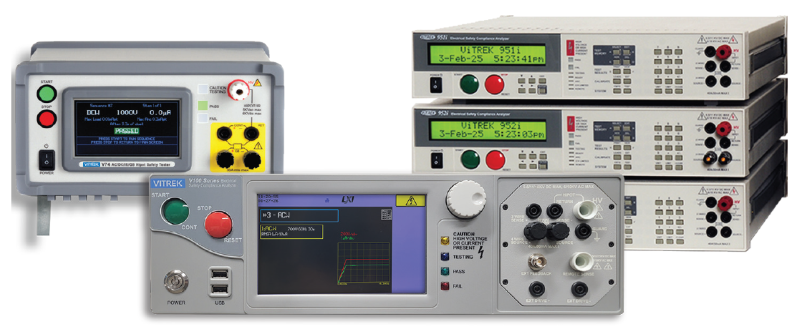
Image Credit: Vitrek, LLC
When choosing the best hipot tester for you, you should consider:
- Data
- Scalability
- Integration
- Long-term adaptability
Vitrek’s V7X, 95X, and the most recent V10X series hipot testers offer three distinct methodologies for electrical safety testing, each corresponding to different phases of production maturity and operational requirements.
From Entry-Level Testing to Production Confidence
For many organizations, electrical safety testing starts at the bench or in low-volume manufacturing. Under these conditions, simplicity, dependability, and cost-effectiveness are critical.
The V7X series is engineered specifically for this role, delivering fundamental AC, DC, and insulation resistance testing, plus optional ground bond testing, mandatory for compliance – without unnecessary complexity.
Rapid assessment times, user-friendly touchscreen operation, and automation-ready interfaces make the series a practical option for producers who need reliable outcomes without over-engineering their test stations.
As manufacturing volumes increase and products require higher voltages, greater currents, or tighter tolerances, testing specifications evolve.
The 95X series addresses this with increased output capacity, picoamp-level leakage measurement, sophisticated ramp and dwell control, and faster throughput, making it well-suited for rigorous manufacturing settings.
It supports more complex sequences, integrates smoothly into automation systems, and addresses the higher stresses associated with EV parts, power distribution products, and regulated medical or industrial equipment.
When Automation and Data Become Strategic Assets
In fully automated or Industry 4.0 production settings, electrical safety testing must do more than pass or fail a unit. It must produce traceable data, integrate with factory networks, and grow as products and standards advance. This is where the V10X series distinguishes itself.
When Automation and Data Become Strategic Assets (Continued)
The V10X series is engineered to serve as a future-proof testing architecture. Network connectivity, a simple and fully featured ASCII-based command set, touchscreen operation, and integrated reporting instruments permit it to operate as part of a connected manufacturing ecosystem. Sophisticated sequencing, multi-dwell testing, and high-speed chaining facilitate intricate test methods without hindering throughput.
For organizations investing in long-term automation, centralized data control, and audit-ready documentation, the V10X becomes a strategic tool rather than a simple tester.
Aligning the Platform with the Production Method
Selecting between the V7X, 95X, and V10X is less about feature checklists and more about aligning test capability with business goals. The V7X supports efficient, economical compliance evaluation. The 95X provides power, speed, and versatility for high-throughput manufacturing.
The V10X serves as the basis for intelligent, data-driven safety testing in automated settings. The systems possess Vitrek’s fundamental advantages: measurement precision, safety-oriented engineering, and automation-ready architecture, but differ in how they scale with system complexity.
All three platforms facilitate multi-point assessment via integration with Vitrek’s 964i automated switching system. The 95X and V10X platforms are engineered for advanced testing and manufacturing line applications, whereas the V7X is optimized for independent or less complex automated test settings.
In an age where electrical safety testing directly influences throughput, quality, and regulatory risk, choosing the appropriate hipot system is a strategic decision. The optimal selection addresses current needs while also supporting the evolution of the manufacturing operation.
How Vitrek Compares to Other Industry-Leading Testers
As electrical safety testing becomes more tightly integrated into automated production and compliance processes, differences between hipot platforms reach far beyond basic voltage ratings. Variables including measurement reliability, automation readiness, ease of use, throughput, and data traceability increasingly define practical performance.
Knowing how Vitrek testers compare to other industry-leading solutions helps engineers and producers select systems that meet existing specifications and support long-term manufacturing strategies.
Measurement Precision and Noise Floor
Vitrek’s V7X, 95X, and V10X testers are recognized for high-sensitivity leakage measurement and stable hipot outputs with reduced ripple and noise. The 95X and V10X platforms provide picoamp-level resolution that rivals that of high-end testers, especially for insulation resistance and leakage current measurements.
While other competing systems reach comparable voltage ranges, their noise performance can be less uniform at extremely low leakage levels, leading to jitter that hinders the validation of products with tight insulation margins or delicate electronics.
A reduced noise floor directly corresponds to more accurate outcomes, fewer false failures, and uniform pass/fail decisions - particularly in high-voltage, low-current applications.
Automation and Integration
Automation is a crucial differentiator in contemporary assessment settings, and Vitrek strongly emphasizes integration versatility. Ethernet, USB, simple and full-featured ASCII-based command sets, RS-232, and digital I/O are standard on higher-end models, with the option of a GPIB interface.
The V10X further expands these capabilities through its integrated web browser portal and built-in remote-control functionality. In addition, Vitrek systems integrate smoothly with QT Insite test management software and automated high-voltage switching solutions such as the 964i, facilitating coordinated multipoint testing without excessive external logic control.
While other industry leaders also provide automation interfaces, many depend on proprietary protocols or optional interface modules. Vitrek’s implementation of standard communication techniques and optional GPIB, featured in the 95X and V10X, minimizes integration friction, reduces deployment time, and simplifies automated test system scaling as manufacturing increases.
How Vitrek Compares to Other Industry Leading Testers (Continued)
User Experience and Control
User accessibility is crucial to manufacturing efficiency, and Vitrek’s interface design reflects this priority. Touchscreen controls on the V7X and V10X systems assist engineers and operators with test configuration and execution, providing clarity and simplicity.
The V10X’s integrated barcode scanner further streamlines testing, enabling test selection, execution, and data entry directly from the scanner wand. Combining this approach with remote control interfaces reduces configuration errors and minimizes operator training requirements.
Conversely, certain legacy systems continue to rely on text-based menus or deep configuration trees, which impede test creation and increase the risk of errors.
Even when competitors offer advanced user interfaces, the increased complexity may be better suited to laboratory environments than to fast-paced manufacturing lines. Ultimately, a clean, intuitive interface enhances coordination between engineering, quality, and manufacturing teams.
Assessing Speed and Throughput
Vitrek testers are engineered to operate in high-throughput manufacturing environments without compromising measurement accuracy. Rapid evaluation cycles, in the order of 100 milliseconds per condition, alongside sophisticated sequencing capabilities on the 95X and V10X, allow producers to maintain demanding Takt times.
When coupled with automated switching systems such as the 964i, multi-point test setups can still attain high throughput without creating bottlenecks.
Although competing models may be recognized for high-speed operation, Vitrek maintains an advantage, especially when considering total system performance, including network communication and automation overhead. Faster cycles lead to more units tested per hour and lower unit costs in high-volume production.
Data Logging and Reporting
Documentation and traceability are increasingly critical, specifically in regulated sectors. The V10X platform addresses this necessity directly through integrated PDF and CSV reporting for immediate, on-device reporting.
To satisfy more complex test management requirements, Vitrek’s QT Insite software expands these functions by centralizing data acquisition, managing test sequences, and preserving extensive, searchable test records across various stations.
This combination is especially important in medical, EV, and aerospace applications where audit trails, operator responsibility, and long-term data retention are mandatory.
Although certain competing systems depend entirely on external PC software or controllers for logging and reporting – introducing complexity and maintenance overhead – Vitrek provides a layered approach.
On-device reporting supports streamlined manufacturing settings, while QT Insite facilitates enterprise-level traceability, compliance documentation, and quality system integration, streamlining alignment with ISO, IEC, and internal quality standards.
Customization and Accessories Ecosystem
Vitrek’s ecosystem enables scalable, multi-output test systems with minimal reengineering. Integration with the 964i high-voltage switching system permits efficient evaluation of intricate products, including cable assemblies, harnesses, and power distribution parts. Uniform accessories across platforms streamline system expansion.
Additionally, Vitrek maintains close collaboration with clients to evaluate test specifications and develop solutions tailored to their products and manufacturing processes. This unified, application-focused strategy minimizes the learning curve, reduces the total cost of ownership, and speeds up deployment as testing requirements advance.
Conclusion
Vitrek hipot testers stand out by combining ease of use, speed, automation, and measurement accuracy. Their intuitive interfaces help reduce operator error, while fast test times and integrated switching support high-throughput manufacturing without sacrificing performance.
With built-in reporting on the V10X and centralized data management via QT Insite, Vitrek also makes traceability and compliance easier in regulated environments. Combined with a scalable range of accessories and a consistent system architecture, this provides manufacturers with a practical, adaptable approach to electrical safety testing that can grow with production needs.
Vitrek Hipot Selection Guide. Source: Vitrek, LLC
| Decision Question |
Outcome |
Recommended Platform |
| Bench or low-volume testing? |
Standalone/basic automation |
V7X Series |
| Higher voltage or tighter leakage limits? |
More power & precision needed |
95X or V10X Series |
| Multi-point automated testing? |
Requires HV switching |
V7x, 95X or V10X + 964i |
| Centralized data & audit traceability? |
Enterprise test management |
V10X + 964i + QT Insite |
Vitrek Hipot Feature Comparison. Source: Vitrek, LLC
| Feature / Capability |
V7X Series |
95X Series |
V10X Series |
| Target Use Case |
Bench & Entry-
Level Production |
High-Power Production & Compliance |
Advanced Automation
& Industry 4.0 |
| AC Hipot Testing |
Available (model dependent) |
 |
|
| DC Hipot Testing |
Available (model dependent) |
|
|
Insulation
Resistance (IR) |
Available (model dependent) |
|
|
Ground Bond
Testing |
Available Up to 30 A
(model dependent) |
Available Up to 40 A
(model dependent) |
Available Up to 40 A (model dependent) |
Max AC Output
Voltage |
Up to 5 kV |
Up to 10 kV
(30 kV option) |
Up to 10 kV
(30 kV option) |
Max DC Output
Voltage |
Available Up to 5 kV
(model dependent) |
Up to 15 kV |
Up to 15 kV |
Leakage Measurement
Resolution |
Nanoamp-level |
Picoamp-level |
Picoamp-level |
Multi-Step Test
Sequences |
|
|
|
Advanced Ramp/
Dwell Control |
– |
|
|
Ethernet/Network
Connectivity |
– |
|
|
| Automation Interfaces |
RS-232, Digital I/O |
Ethernet, RS-232, Digital I/O, Optional GPIB |
Ethernet, USB, RS-232, Digital I/O, Optional GPIB |
Built-in Reporting
(PDF/CSV) |
– |
– |
|
964i HV Switching
Compatible |
|
|
|
QT Insite Software
Compatible |
|
|
|
Best Fit
Summary |
Cost-effective, compact
safety testing |
High-voltage, high-throughput
production |
Future-ready automation
with data-driven QA |
This information has been sourced, reviewed, and adapted from materials provided by Vitrek, LLC.
For more information on this source, please visit Vitrek, LLC.