Continuous manufacturing builds upon the known relationships among pump speed, fluid properties, displacement, and the fluid path, and how these determine actual delivery.
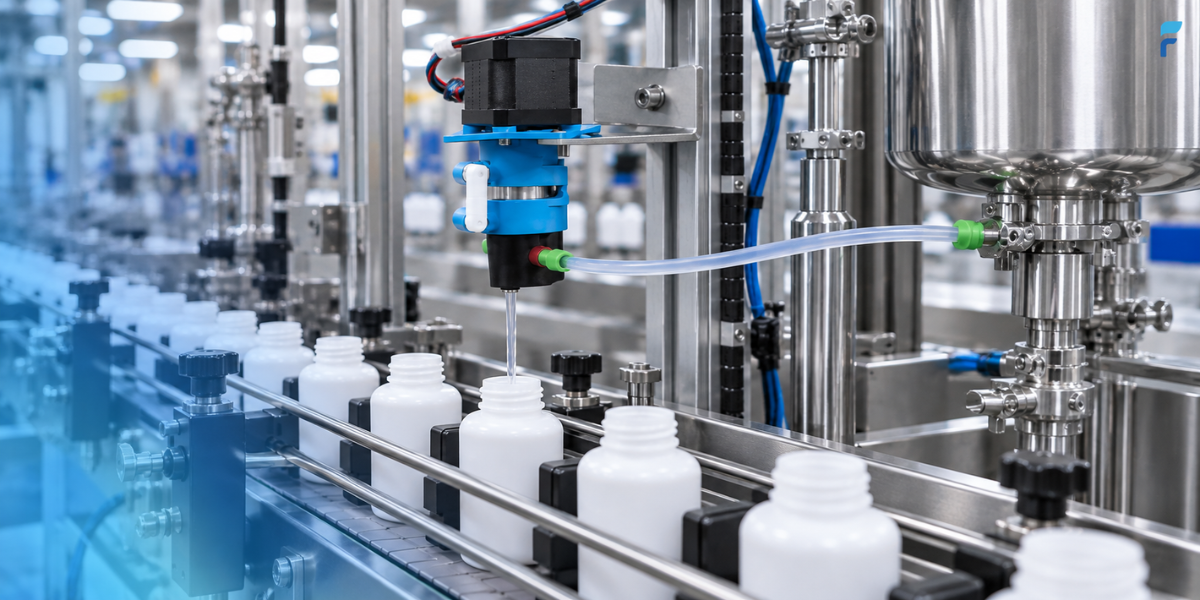
Image Credit: Fluid Metering, Inc.
However, the challenge is more than simply achieving a target flow rate. Fluid delivery may also need to be adjusted when starting production, or during steady operation and rate changes. Moreover, if there is an interruption or shutdown, flexibility is key, making pump speed a fundamental part of the process-control strategy.
From Flow Control to Process Control
Throughout continuous manufacturing, fluid delivery is carefully aligned to the related process steps. When there is a change in production conditions, the required fluid delivery rates may also need to adjust.
Engineers, therefore, need to establish the following points:
- How changes in flow rate correlate to production rate
- How fluid streams sustain their required relationship
- How pumps respond during startup, shutdown, rate changes, and interruptions
- How the manufacturing system acknowledges and controls these changes
- Whether the pump, motor, and fluid path are compatible with the complete operating range
Knowing these requirements helps establish the appropriate speed control strategy.
Selecting a Pump Speed Control Strategy
The right approach is dependent on the frequency of any changes in flow requirements and how the pump is incorporated into the process.
Fixed-speed operation may be most appropriate when there is a consistent flow throughout normal production. Pump displacement, motor speed, and the fluid path should be chosen for the intended operating point.
Open-loop, variable-speed control allows the system to control and vary motor speeds as flow requirements change. Because actual flow depends on the entire fluidic system, engineers should determine controlled speed versus delivered flow across the operating range.
Feedback or feedforward control may be best when pump commands are determined by process measurements or other process information. Depending on the circumstances, variables such as flow, pressure, or mass may influence the control strategy.
Each approach affects the operating requirements for the sensors, control logic, response time, integration, and validation.
Coordinating Multiple Fluid Streams
More than one metered fluid stream may be required for continuous manufacturing processes. When there are changes in the production rate, the required flows may also need changing.
However, it is not entirely necessary to set every pump to the same speed to maintain a defined relationship between streams. Pump displacement, fluid properties, tubing volume, and restrictions can vary between fluid paths.
Instead, the control strategy should determine the required flow for each stream, how to adjust the flows with production rate, and how each flow is translated into a pump-speed command. The ultimate goal is coordinated fluid delivery, not coordinated motor rpm.
Managing Process Transitions
Steady-state operations in continuous manufacturing processes can be disturbed by startup, production-rate adjustments, interruptions, shutdown, and restarts. Pump-speed control should take these disruptions into account.
Depending on the application, engineers may need to establish:
- The starting and stopping sequence of fluid streams
- A pump’s rates of acceleration and deceleration
- Transitions between production rates
- Responses to disruptions or loss of fluid supply
- Conditions required prior to resuming production
The behaviors should be carefully evaluated across the entire process.
Accounting for Differential Pressure and Fluid Properties
A validated speed command at one point of operation may not produce the same flow across the entire production range; differential pressure can vary with flow and with any restrictions from tubing, fittings, filters, and valves. Fluid viscosity and inlet conditions can also affect the pump's performance.
Assess pump speed in relation to the intended fluid and fluid path across the required flow, differential pressure, and speed ranges.
How Will the Manufacturing System Control the Pump?
Defining pump speed is just one part of the control decision. Engineers also need to establish how the manufacturing equipment will communicate the appropriate commands to the pump. In an automated process, pump operations can be controlled using a programmable logic controller (PLC) or another process controller. This raises several key questions:
- Will speed be controlled locally or by an external controller?
- What control signal or communication method is best for the equipment?
- What are the minimum and maximum speed commands?
- How will changes in start, stop, and speed be managed?
- How should the system respond outside its defined operating range?
Industrial equipment can incorporate a variety of analog command signals such as 0–5 VDC, 0–10 VDC, or 4–20 mA, along with other interfaces. The required method is dependent on the equipment and controller, so compatibility must be verified for the specific configuration as intended. Early interface planning ensures compatibility between the pump fit and both the fluidic and control architectures.
Motor Technology Is a Key Part of the Decision
The controller can request speed adjustments, but the motor and drive must be capable of delivering performance that matches the application's operating conditions.
Motor selection requires the following considerations:
- Speed range and the torque available across that range
- Expected pressure differential
- Fluid viscosity
- Pump displacement
- Startup and transient conditions
The operating conditions will be influenced by pressure differential, viscosity, pump configuration, and speed, all of which the motor and drive must be able to support. Motor technology should therefore be assessed against the entire operating range rather than simply maximum rpm alone.
Bringing the Pump and Control Architecture Together
In continuous manufacturing, engineers do much more than select a pump. Rather, they are determining the compatibility and functionality of the pump, motor, controller, control interface, fluid, and fluid path as a system.
Fluid Metering's CERAMPUMP® valveless technology uses the synchronized rotation and reciprocation of a ceramic piston within a precisely matched cylinder liner. When combined with a compatible motor and controller, its rotational speed can control fluid delivery. Before settling on a configuration, engineers should ask the following questions:
- What is the required flow range of the process?
- What fluid and viscosity limits will the pump encounter?
- What is the expected pressure differential?
- What motor technology and speed range are most compatible?
- Will a PLC or another controller command the pump?
- What control signal or interface does the equipment require?
The available motor, controller, and interface requirements are dependent on the configuration selected and should be chosen to meet a given application's fluidic and control requirements.
Pump Speed as Part of the Continuous Process
In continuous manufacturing, the most fundamental question is: How should pump speed change in line with production variations, and how will the manufacturing system best incorporate those commands for communication?
To get the best answer, engineers should carefully evaluate the flow range, displacement, viscosity, differential pressure, motor capability, control signals, multiple fluid streams, and process transitions as a single control architecture.
Defining these requirements as early as possible provides a solid foundation for selecting the most appropriate pump, motor, and controller.
Fluid Metering works closely with equipment manufacturers and process engineers to assess flow requirements, fluid properties, pressure conditions, pump and motor configuration, control requirements, and system integration for reagents, buffers, additives, and other process fluids.
Acknowledgments
Produced using materials originally authored by Kevin Maldonado.

This information has been sourced, reviewed, and adapted from materials provided by Fluid Metering, Inc.
For more information on this source, please visit Fluid Metering, Inc.