Researchers fill a fragile copper-based MOF with ionic liquids to test how far focused ion beams can pattern it without cryogenic cooling.
Paper: Ionic-liquid-assisted room-temperature dry etching of metal–organic frameworks. Image Credit: LabChemOS / Shutterstock
A study published in the journal Communications Materials presents an ionic-liquid-assisted method for dry etching beam-sensitive MOFs at room temperature.
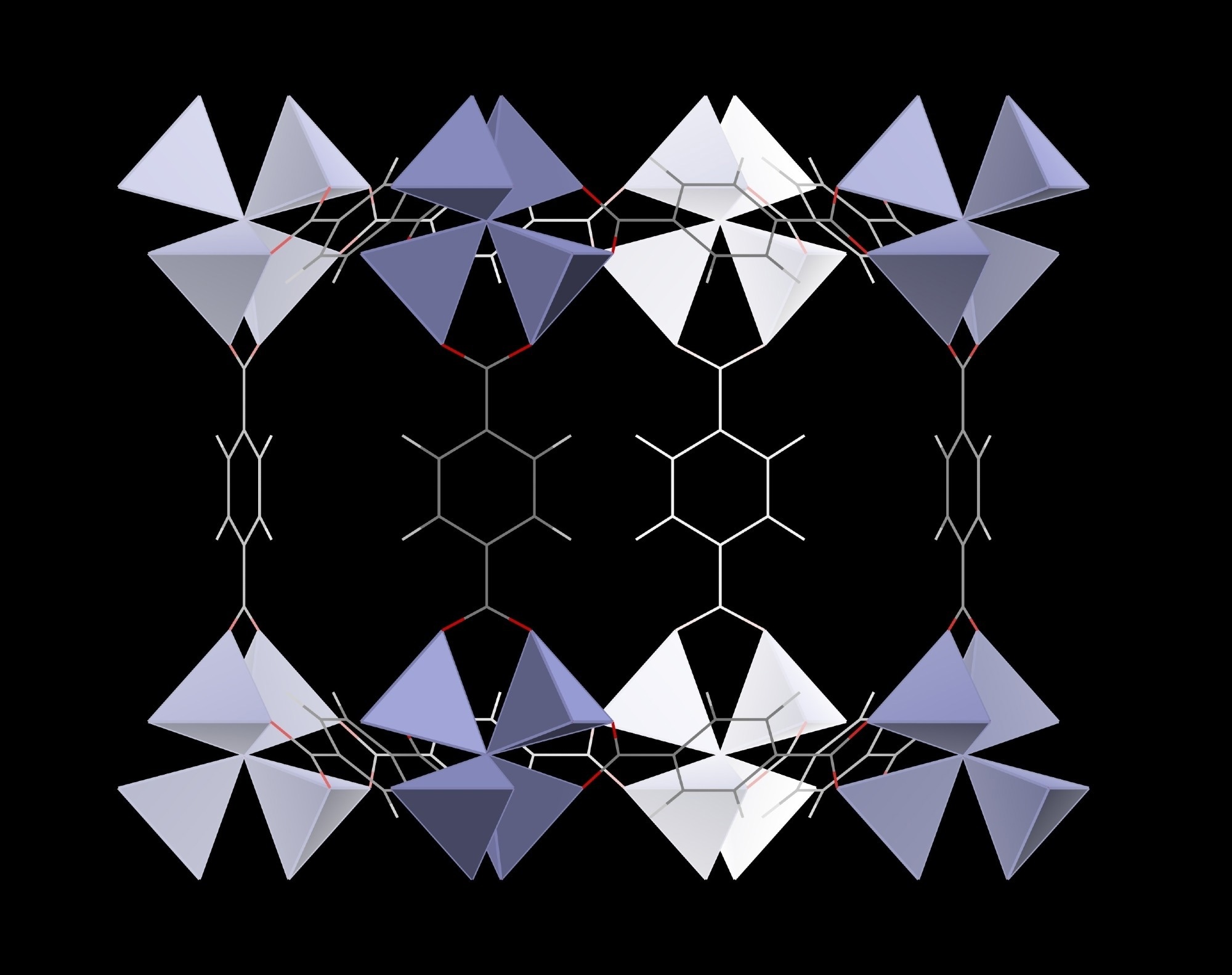
MOFs are porous crystalline materials built from metal centers and organic linkers. The researchers infiltrated a copper-based MOF with ionic liquids to improve its resistance to electron- and ion-beam damage. The method could support the fabrication of precisely patterned MOF structures for electronic and sensing applications.
Challenges of patterning beam-sensitive MOFs
MOFs have high surface areas, tunable pores, and varied chemical properties, which make them useful for gas storage, separation, sensing, and electronic applications. Integrating them into functional devices requires precise patterning. Their relatively weak metal–ligand bonds and organic components make them vulnerable to particle-beam damage, which can limit accurate material removal.
Electron irradiation can trigger ionization, radiolysis, localized heating, and lattice distortion. Focused ion beam (FIB) processing can also displace atoms, break metal–ligand bonds, and generate heat through energetic ion collisions.
Researchers have developed several methods to pattern MOFs, including crosslinking, solvent development, X-ray exposure, and photoacid-induced chemical reactions. These approaches can produce fine features, but anisotropic dry etching remains difficult because ion bombardment can damage the porous crystal during material removal.
Cryogenic FIB processing can reduce some forms of beam-induced damage. It requires specialized equipment, liquid-nitrogen cooling, and careful temperature control. The study tested whether ionic liquids placed inside MOF pores could stabilize the crystal during room-temperature ion-beam etching. It also examined how ionic-liquid composition affects etching performance and resistance to damage.
Preparing and characterizing ionic-liquid-filled MOFs
The team selected single crystals of Cu3BTC2, a copper-based MOF also known as HKUST-1. They synthesized millimeter-sized crystals using a solvothermal method and removed residual solvents to prepare the pores for ionic-liquid infiltration.
The researchers investigated four imidazolium-based ionic liquids: [C2mim][Tf2N], [C4mim][Tf2N], [C8mim][Tf2N] and [C4mim][PF6]. Differences in cation chain length and anion composition allowed the researchers to test how ionic-liquid chemistry affects the resulting composites.
To prepare the IL@MOF materials, the researchers immersed the crystals in excess ionic liquid under vacuum at 120 °C for 12 hours. Gravimetric measurements indicated that the liquids occupied about 50–60% of the available pore volume. The team used X-ray diffraction (XRD) to examine crystallinity and lattice parameters, and Fourier-transform infrared spectroscopy (FTIR) to identify changes in chemical bonding.
For dry etching, the researchers used a 30 kV gallium ion beam at normal incidence. They varied the ion dose from 0.5 to 4.0 nC μm−2 and examined the etched surfaces by scanning electron microscopy.
In a separate experiment, X-ray photoelectron spectroscopy (XPS) tracked changes in copper oxidation states after brief, low-energy Ar+ ion milling. TG-DTA measurements assessed the thermal stability of pristine and ionic-liquid-filled MOFs.
Ionic liquids improve etching stability and pattern quality
XRD measurements showed that ionic-liquid infiltration preserved the cubic Cu3BTC2 crystal structure, with lattice parameter variation below 0.2%. FTIR analysis confirmed ionic-liquid incorporation and showed a shift in the Cu–O stretching mode toward a lower wavenumber, consistent with changes in the local metal–oxygen coordination environment.
Room-temperature FIB processing severely damaged pristine Cu3BTC2, causing loss of crystallinity and cavity formation. Brief subsequent SEM exposure further expanded the damaged region, causing edge bulging and cracking.
By comparison, C4@MOF retained a smooth etched surface without apparent microstructural damage. The team also fabricated complex patterns, including characters, pillars, and a thin wall about 240 nm thick, showing that precise MOF patterning was possible without cryogenic cooling.
Etching behavior varied with ion dose and ionic-liquid composition. At higher doses, cavities about 1 μm in size developed near the bottom edges of the etched region and extended toward the center. Above 2.5 nC μm−2, the entire etched bottom was damaged, but the sidewalls retained their structure. At 0.5 nC μm−2, the researchers reached etching depths of several hundred nanometers while preserving the bottom surface.
Etching rates were 21, 15, 19, and 14 nm/s for C2@MOF, C4@MOF, C8@MOF, and PF6@MOF, respectively. C4@MOF and PF6@MOF had the highest reproducibility and resistance to beam-induced damage.
Nanoindentation measurements showed increased hardness after ionic-liquid infiltration, while the reduced elastic modulus remained nearly unchanged. Etching rates did not directly track hardness, indicating that beam-induced crystal damage also contributed to material removal.
In the separate Ar+ milling XPS test, pristine Cu3BTC2 showed partial reduction of Cu2+ to Cu+. C4@MOF largely retained its Cu2+ signatures, indicating better protection of the copper centers. TG-DTA measurements showed that decomposition occurred at higher temperatures for C2@MOF and C4@MOF, while C8@MOF did not show the same clear change.
The authors propose that confined ionic liquids buffer transient heating and charge accumulation and may relax mechanical strain during ion-beam processing. Because the ionic liquids have lower thermal conductivity than Cu3BTC2, the proposed thermal protection relies mainly on their heat capacity and possible vibrational energy transfer rather than simple heat conduction.
Advancing the fabrication of MOF-based devices
The results show that ionic liquids can act as internal stabilizing media during focused ion beam processing of beam-sensitive MOFs.
Under the proposed mechanism, mobile ions help neutralize accumulated electrical charges, and the liquids’ heat capacity and viscoelastic properties can buffer localized thermal and mechanical stresses. The Ar+ milling XPS results support the view that ionic-liquid infiltration limits chemical changes at the copper centers under ion bombardment.
The method also has practical advantages over conventional cryogenic FIB processing. It operates at ambient temperature and uses standard FIB equipment, so liquid-nitrogen cooling and dedicated cryogenic hardware are not needed during milling. A stable wall about 240 nm thick was produced.
The authors still describe Cryo-FIB as the gold standard for atomic-resolution sample preparation. Preparing the IL@MOF samples still involved solvent removal, vacuum heating at 190 °C, and 12 hours of ionic-liquid infiltration at 120 °C. The room-temperature claim applies to the FIB etching step, not the full preparation process.
Only Cu3BTC2 was tested, so further research must establish whether the method works equally well with other MOF compositions and porous materials. Refining ionic-liquid chemistry and ion-beam conditions will also matter because excessive ion doses can still damage the etched regions.
The results identify ionic-liquid infiltration as a method for improving the beam resistance of Cu3BTC2 while retaining its structure. The work also provides a testable route for adapting room-temperature FIB patterning to other beam-sensitive porous materials.
Disclaimer: The views expressed here are those of the author expressed in their private capacity and do not necessarily represent the views of AZoM.com Limited T/A AZoNetwork the owner and operator of this website. This disclaimer forms part of the Terms and conditions of use of this website.