Plastic produces ash content when it is burned. This inorganic residue contains the components of the material that were not affected by heat, such as fillers, pigments, and reinforcements.

Image Credit: sasirin pamai/Shutterstock.com
Ash content can affect plastic characteristics in different ways, depending on its composition. For instance, a plastic containing a filler like talc or calcium carbonate will likely exhibit increased thermal stability and stiffness, but too much filler could lower the plastic’s strength.
Undertaking ash content analysis provides useful insight into what the plastic contains and how that content could impact its overall properties. This knowledge can be applied to quality control measures to optimize plastics as they proceed through development.
This optimization is key to ensuring that completed plastic products perform as expected, while also helping manage the costs of plastic production.
Thermogravimetric analysis (TGA) is a technique used to determine the ash content of plastics. TGA analyzes changes in a material’s mass as the temperature is altered, providing information on any processes that could modify this mass change.
TGA can be applied to plastic to determine its weight loss when subjected to a high temperature, enabling understanding of the levels of inorganic materials contained in the plastic. This article outlines best practices for performing TGA to analyze plastics.
Ash Content Determination: A Step-by-Step Method
Sample Preparation
Accurate weighing is crucial to ensure the reliability of results. A small sample of 10–50 mg of plastic material should be weighed into a tared TGA crucible. This small sample size is sufficient due to the TGA instrument’s sensitivity and precision.
Initial Heating Under an Inert Atmosphere
The crucible should then be loaded into the TGA instrument before setting a temperature ramp under nitrogen or another inert atmosphere. The temperature should then be programmed to increase to approximately 600–800 °C.
This step pyrolyzes the sample, removing all organic components via thermal decomposition without oxidation. The inert atmosphere is important because it prevents combustion, thereby leaving behind inorganic residues and ensuring that only the organic parts of the sample are decomposed.
Oxidative Atmosphere and Final Heating
The atmosphere should be switched to oxidative (air or oxygen) after the pyrolysis phase. The temperature should also be increased, typically to around 800–1000 °C.
This stage fully oxidizes any remaining inorganic residue, converting it to ash. The oxidative environment also burns off all combustible components, ensuring that only the inorganic ash content is left.
Continuous Weight Measurement
TGA continuously measures and records the sample weight throughout the entire process. The resulting thermogram plots weight changes against time or temperature, while the final stable weight, reached following the oxidative heating, represents the original plastic sample’s inorganic ash content.
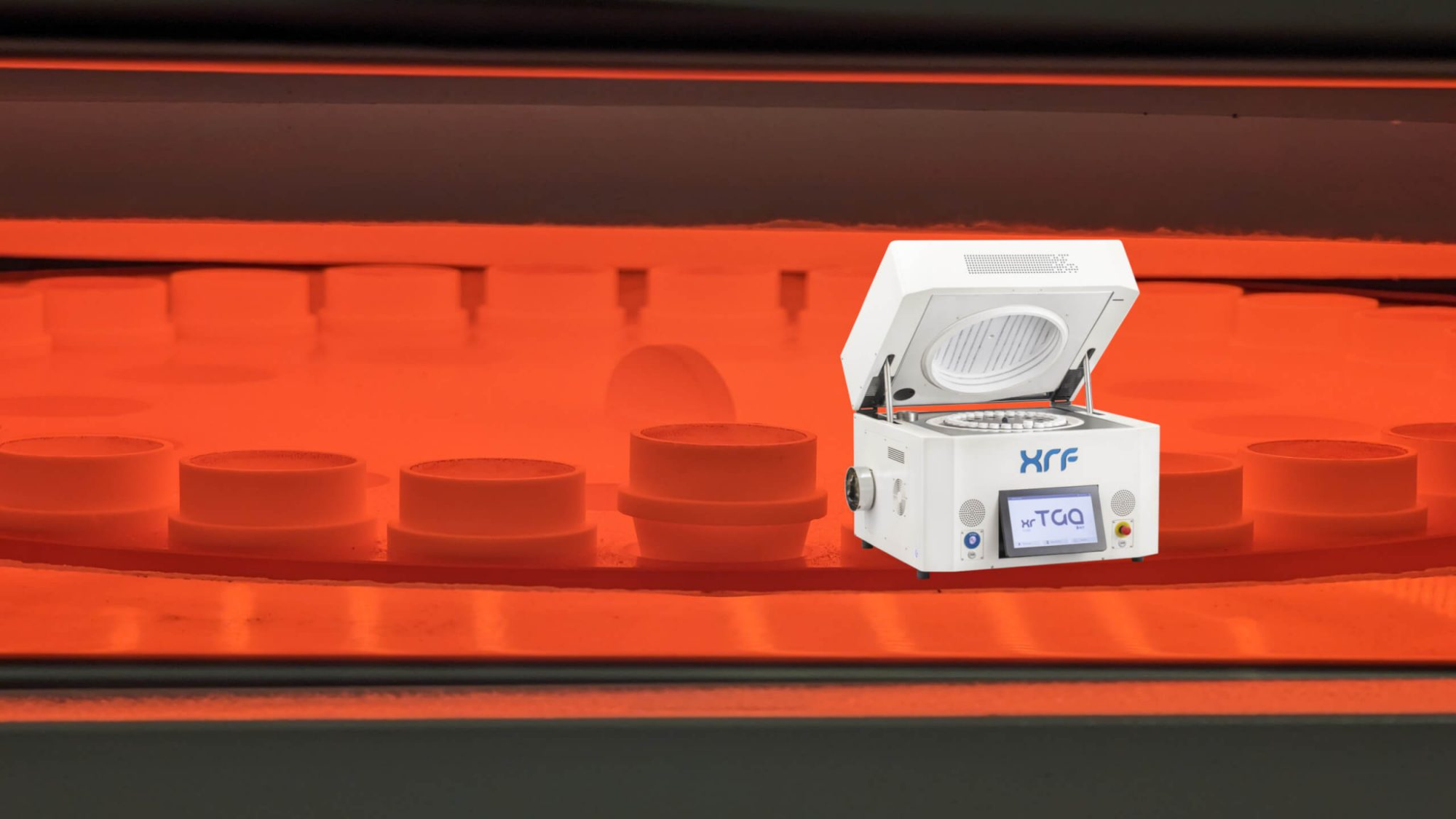
Image Credit: XRF Scientific
Key Considerations of TGA
Accuracy and Replicability
TGA offers rapid, accurate measurement of the ash or total inorganic filler content in plastics. However, it is advisable to run multiple replicates of the sample for enhanced accuracy. This approach ensures that results are consistent and reliable while helping to mitigate any variability.
Inability to Differentiate Inorganic Fillers
One notable limitation of TGA lies in its inability to distinguish between different types of inorganic fillers. TGA provides the total inorganic content, but it does not identify the specific types of fillers present.
Different fillers, such as mineral fillers or glass fibers, may have distinct appearances, however, meaning visual examination of the ash residue post-analysis can offer some insight.
Standards and Protocols
Adherence to standardized protocols underpins reliable and reproducible results. TGA ash testing follows various standards, including ISO 11358 and ASTM E1131. These standards provide guidance on performing TGA of plastics and polymers, ensuring consistency across studies and laboratories by specifying controlled conditions.
TGA Equipment from XRF Scientific
TGA is a robust technique used to gain insights into the inorganic materials found in plastics. These components can be identified by examining their thermal stabilities and noting any reduction in the plastic’s overall weight when exposed to increased temperatures.
The right equipment is key to performing streamlined, accurate TGA; XRF Scientific’s solution is the xrTGA 1100. This powerful instrument offers a high-throughput carousel that can hold 30 materials while enabling testing at temperatures up to 1100 °C, with extremely fast cooling and heating cycles.

This information has been sourced, reviewed, and adapted from materials provided by XRF Scientific.
For more information on this source, please visit XRF Scientific.