Researchers redesigned copper’s local coordination inside Cu/ZIF-8 to tackle the long-standing mismatch between Fenton chemistry and the conditions used to polish chemically resistant 4H-SiC.
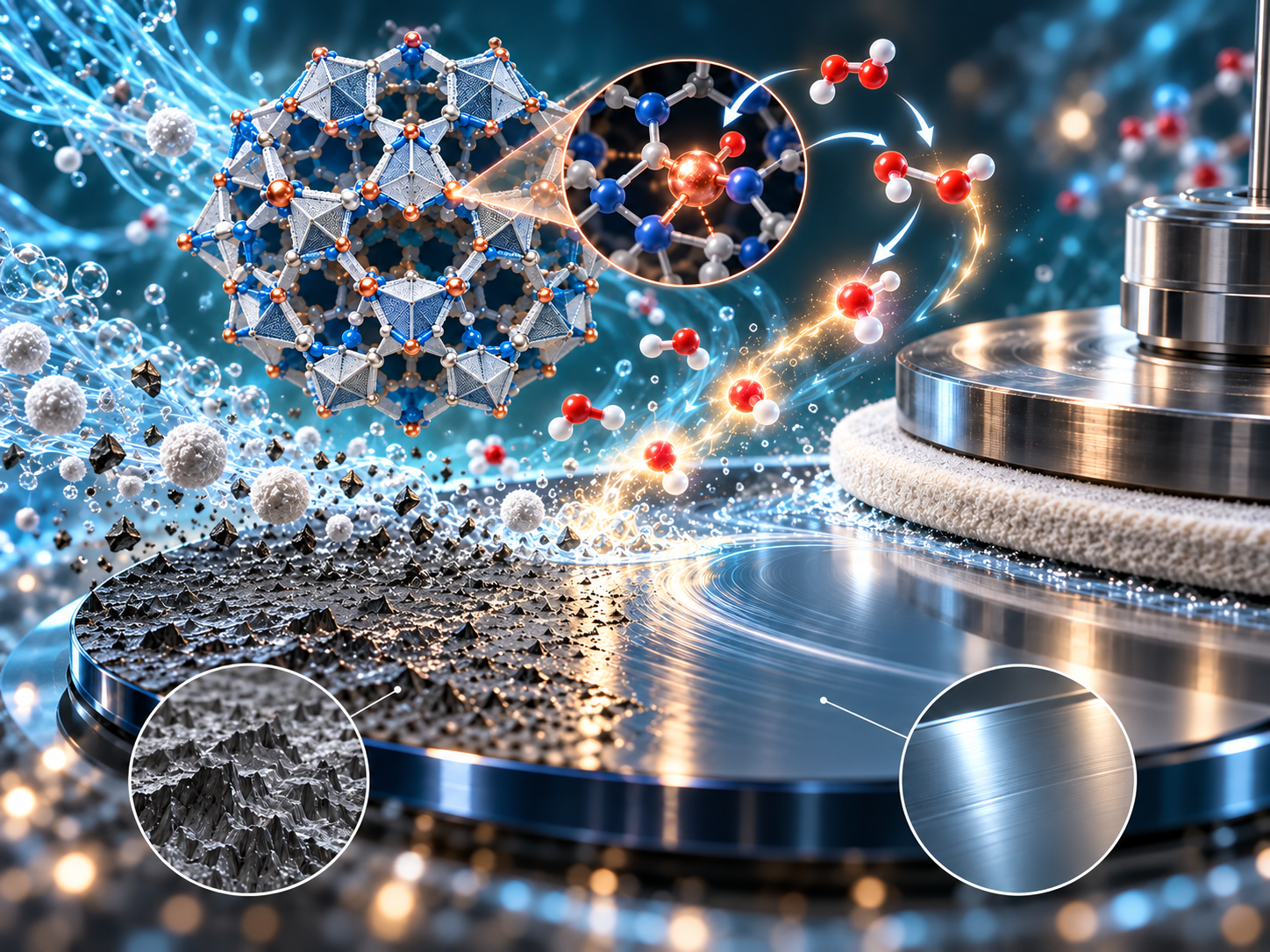
Paper: Orbital engineering of asymmetric Cu sites in MOFs for fenton reaction towards atomic surface manufacturing. AI-generated abstract conceptual image created using ChatGPT/OpenAI
*Important notice: This news reports on an unedited version of an accepted paper and is awaiting final editing. Therefore, the paper should not be regarded as conclusive or treated as established information.
A recent study published in Nature Communications reports an orbital-engineering strategy that uses asymmetric copper sites in the MOF Cu/ZIF-8 to improve Fenton-like reactions under neutral conditions.
The catalyst increases hydroxyl radical generation, speeding silicon carbide oxidation during chemical mechanical planarization.
The findings point to a possible route to faster, high-precision polishing of 4H-SiC, with tests on other hard semiconductor materials still needed.
Challenges in Silicon Carbide Polishing
Single-crystal 4H-silicon carbide (4H-SiC) is important in power electronics and high-frequency devices because of its high thermal conductivity, wide bandgap, and chemical stability.
Those same properties make SiC difficult to polish. Conventional chemical mechanical planarization (CMP) often achieves material removal rates below 10 nm min-¹, increasing processing time and costs while risking scratches and subsurface damage that can compromise device performance.
CMP combines chemical oxidation with mechanical abrasion to remove material from the SiC surface.
Fenton chemistry can speed this process by generating hydroxyl radicals (•OH), which oxidize the chemically resistant surface and form a more removable oxide layer.
Conventional iron-based Fenton catalysts perform best under strongly acidic conditions. SiC CMP has historically favored alkaline slurries because hydrated silicon dioxide dissolves quickly there.
The authors argue that neutral conditions offer a useful compromise among oxidation, oxide dissolution, equipment compatibility, and avoiding pH adjusters.
To overcome this limitation, the researchers developed Cu/ZIF-8, a copper-modified MOF that sustains Fenton-like activity at neutral pH.
By introducing an asymmetric nitrogen-copper-oxygen coordination environment (Nx-Cu-O?), they altered the electronic structure of the copper sites and sped up the Cu(II)/Cu(I) redox cycle. This approach connects atomic-scale catalyst design with the practical challenge of improving SiC polishing efficiency and surface quality.
Designing the Catalyst and Testing Its Performance
The researchers synthesized Cu/ZIF-8 through ion exchange and partial hydrolysis. Copper replaced some zinc sites, while oxygen-containing groups entered the local copper coordination environment. This process established mixed nitrogen and oxygen ligands while preserving the main ZIF-8 structure.
The modification reduced the specific surface area from 1,715 to 1,485 m² g-¹, but the material retained substantial surface area for interactions with hydrogen peroxide.
The team used structural and spectroscopic measurements to determine how copper was incorporated and how its local chemical environment changed.
Diffraction, infrared spectroscopy, electron microscopy, and elemental mapping revealed changes in the lattice, morphology, and copper distribution. Other X-ray-based techniques assessed copper oxidation states and established local Cu-N and Cu-O coordination, including X-ray photoelectron spectroscopy (XPS) and X-ray absorption measurements.
Inductively coupled plasma optical emission spectroscopy (ICP-OES) quantified copper loading and residual dissolved copper. Electron paramagnetic resonance (EPR) measurements quantified hydroxyl radical generation.
The researchers also performed spin-polarized density functional theory (DFT) simulations comparing a zinc-centered ZIF-8 model, a copper-substituted model, and a representative asymmetric copper site with three nitrogen ligands and one oxygen ligand. This comparison separated the modeled effect of replacing zinc with copper from the added effect of asymmetric oxygen coordination.
The simulations examined hydrogen peroxide adsorption, charge transfer, electronic structure, and O-O bond cleavage. The model represents one local Cu site; the material itself contains a range of Cu environments.
To link these atomic-scale changes to polishing performance, the team incorporated Cu/ZIF-8 into a CMP slurry containing hydrogen peroxide, silica abrasives, and a dispersant. Electrochemical measurements and surface analyses evaluated oxidation, while atomic force microscopy (AFM) and white-light interferometry assessed surface roughness.
Asymmetric Copper Sites Accelerate Oxidation and Polishing
Structural analysis revealed that copper was dispersed throughout the Cu/ZIF-8 structure. X-ray absorption measurements identified copper-nitrogen and copper-oxygen coordination, with a total coordination number of 3.9, close to four. This asymmetric environment altered the local symmetry of the copper sites and modified interactions between copper d orbitals and surrounding atoms.
EPR measurements showed that Cu/ZIF-8 generated more hydroxyl radicals than the reference materials. Its radical concentration was 17.9 times that of Fe3O4, 27.1 times that of unmodified ZIF-8, and 131.1 times that of hydrogen peroxide alone.
The DFT results helped explain this performance. Introducing copper and oxygen narrowed the calculated bandgap from 3.67 eV in ZIF-8 to 2.53 eV in Cu/ZIF-8. The models also predicted more favorable hydrogen peroxide adsorption, shifting the calculated adsorption energy from +0.42 eV to -0.66 eV.
The calculated O-O bond dissociation energy fell to 0.47 eV, supporting easier peroxide activation and cleavage. The modeling and post-reaction measurements support a catalytic cycle in which ligand-to-metal charge transfer helps regenerate active Cu(I) sites.
Surface analyses confirmed that Cu/ZIF-8 accelerated 4H-SiC oxidation in the neutral slurry. XPS revealed increased surface oxygen and the conversion of Si-C species into oxidized species. Electrochemical impedance measurements also indicated formation of a thicker oxide layer.
The catalyst-containing slurry achieved a material removal rate of 62.4 nm min-¹, compared with 4.2 nm min-¹ for the catalyst-free slurry.
AFM measured Ra = 0.36 nm over 10 × 10 μm²; white-light interferometry gave Sa = 0.554 nm over 165 × 137 μm², while microscopy showed that scratches were nearly eliminated.
Raman analysis found that polishing removed pre-existing disordered subsurface damage, but mechanical shear introduced a small density of periodic stacking faults.
Control experiments ruled out Cu/ZIF-8 particles acting as extra abrasives, pointing instead to catalytic radical generation by the copper sites. The neutral waste slurry contained just 0.045 mg L-¹ of residual dissolved copper, indicating limited copper release under the tested conditions.
Toward Cleaner, High-Precision Surface Manufacturing
This study shows how engineering copper's local coordination environment can increase catalytic activity in 4H-SiC polishing. In 4H-SiC tests, the resulting Cu/ZIF-8 catalyst raised the polishing rate while maintaining a smooth surface and reducing the need for pH-adjusting chemicals.
The researchers also reported a higher removal rate and lower surface roughness for the titanium alloy Ti-6Al-4V under mildly acidic conditions at pH 5.5, providing a supplementary test of the catalyst outside the main 4H-SiC system. The asymmetric coordination approach could guide the development of Fenton-like catalysts using other transition metals and MOF families.
Longer studies and industrial-scale tests are still needed to assess active-site deactivation from structural degradation or byproduct accumulation, process economics, and compatibility with industrial manufacturing. The study used a single Cu loading, so active-site composition needs further study. Tests are also needed on other hard-to-polish materials, including gallium nitride and diamond.
Overall, this study connects orbital engineering with high-precision surface manufacturing. Under the tested neutral CMP conditions, Cu/ZIF-8 achieved a 62.4 nm min-¹ removal rate on 4H-SiC, with subnanometer roughness and low copper release. Whether the same design works at industrial scale or on other semiconductors remains open.
Disclaimer: The views expressed here are those of the author expressed in their private capacity and do not necessarily represent the views of AZoM.com Limited T/A AZoNetwork the owner and operator of this website. This disclaimer forms part of the Terms and conditions of use of this website.