Ultrasonic thickness (UT) testing is a key component of subsea asset integrity management (AIM), used to monitor corrosion and erosion on pipelines, risers, jacket structures, and subsea processing equipment.
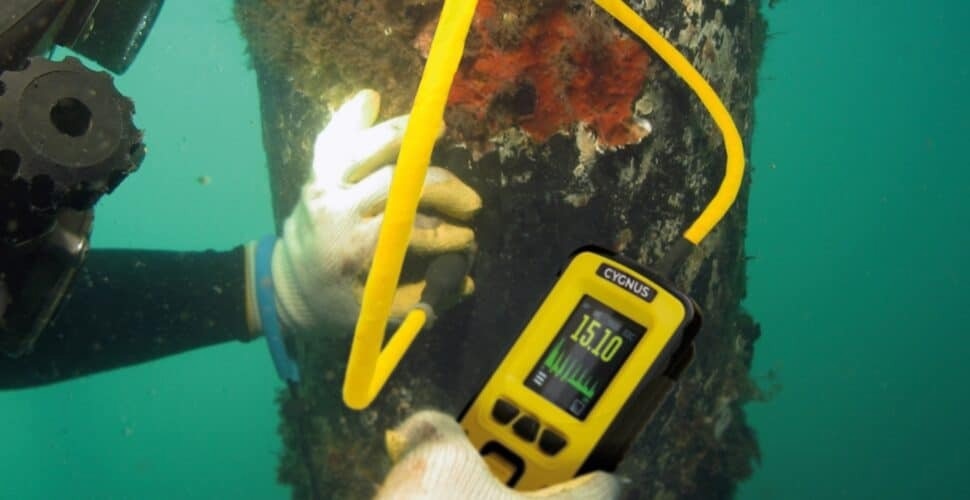
Image Credit: Cygnus Instruments Ltd.
Technically speaking, the physics is identical whether the reading is captured above the surface or on a platform leg 30 meters under the sea.
Practically speaking, though, subsea inspection brings about hurdles that have less to do with acoustics and more to do with where the inspector works. Poor visibility, inconsistent repeatability, and diver fatigue are among the most persistent but least discussed problems affecting subsea UT accuracy.
Visibility
Underwater visibility is often inconsistent. Turbidity from sediment, plankton blooms, current-driven silt disturbance, and even the diver's movements can bring visibility down to almost zero, especially in coastal, harbor, and estuarine settings (where a lot of the world’s important infrastructure is located).
When a diver can’t easily see the surface being assessed, multiple issues come to light.
To begin, surface preparation is more difficult to check. UT readings rely on a clean, sufficiently smooth surface that has no hard marine growth, loose coatings, or corrosion products. This is because debris trapped between the transducer and the substrate contorts the sound path and, in turn, delivers false or unstable readings.
In low visibility, a diver might think a surface has been properly cleaned, even when residual fouling remains.
Second, accurate probe placement becomes challenging. Many subsea integrity programs depend on conducting readings at precise, repeatable grid locations so that it is possible to monitor wall loss over consecutive inspection campaigns.
Finding those points precisely by touch, without clear sightlines to reference marks or structural parts, brings about positional uncertainty that reduces the value of the taken measurement (and the trend data).
The Repeatability Challenge
Repeatability is the ability to return to the same point and obtain a consistent, comparable reading over time. This is arguably the most critical characteristic of a subsea corrosion tracking program. However, it is also among the most difficult to certify for underwater use.
On land, inspectors can mark test points with paint, punch marks, or permanent grids and anticipate those references to be stable between visits. Subsea, however, biofouling can blur or completely coat markers over months; similarly, currents and wave action can slightly move temporary fixtures.
Furthermore, divers who work different rotations, in various conditions, and with varying equipment calibration histories may understand "the same point" a bit differently between inspections.
The differences between successive readings at a nominal test location can come from wall loss, from the diver not landing exactly on the same spot as last time, or from irregular probe angle and contact pressure.
Identifying real degradation patterns from measurement noise brought on by poor repeatability is a frequent headache for integrity engineers looking over subsea data.
Diver Fatigue
The human factor is often the least talked about but most important variable in subsea UT work. Diving takes a significant physical toll even before any inspection task begins. Cold water reduces dexterity and concentration; sea currents force divers to expend effort just to maintain position; constrained bottom time creates pressure to work quickly; and heavy equipment, restrictive suits, and reduced visibility all contribute to cognitive and physical load.
Under such conditions, the fine motor control needed for regular probe contact, such as consistent pressure, correct angle, sufficient coupling, and enough dwell time for a stable reading, is the first thing that suffers.
A tired diver coming to the end of a dive window has a higher likelihood of accepting a marginal or unstable reading than repeating it, especially when decompression constraints or weather windows are on the horizon.
Unlike a topside inspector who can pause for a while, clean a surface again, and take new measurements in seconds, a diver's capacity to iterate is limited by air supply, cold exposure, and mission planning.
Addressing the Obstacles
These challenges are not insurmountable, although deliberate planning is a necessary prerequisite; it is not a case of simply applying topside UT procedures underwater.
Robust, biofouling-resistant marking systems; structured surface preparation protocols that are not just dependent on visual confirmation; realistic dive planning that doesn’t rush measurements close to the end of a bottom-time window; and diver training that prioritizes approach over speed all make it easier to close the gap between theoretical UT accuracy and what is really possible to achieve at depth.
Conclusion
Subsea UT precision does not simply require specifying instruments. Visibility, repeatability of test locations, and the physical and cognitive demands put on divers all affect data quality and how it eventually informs decisions around asset integrity.
Identifying these hurdles as inherent parts of the subsea working environment, as opposed to inconveniences every now and then, is the first step to developing inspection programs that can produce reliable, comparable data for as long as subsea assets are in operation.

This information has been sourced, reviewed, and adapted from materials provided by Cygnus Instruments Ltd.
For more information on this source, please visit Cygnus Instruments Ltd.