A new soft-hard implant design pairs a tough hydrogel with 3D-printed titanium to tackle one of orthopedic engineering’s hardest problems: keeping strong fixation without sacrificing compliant, low-friction motion.
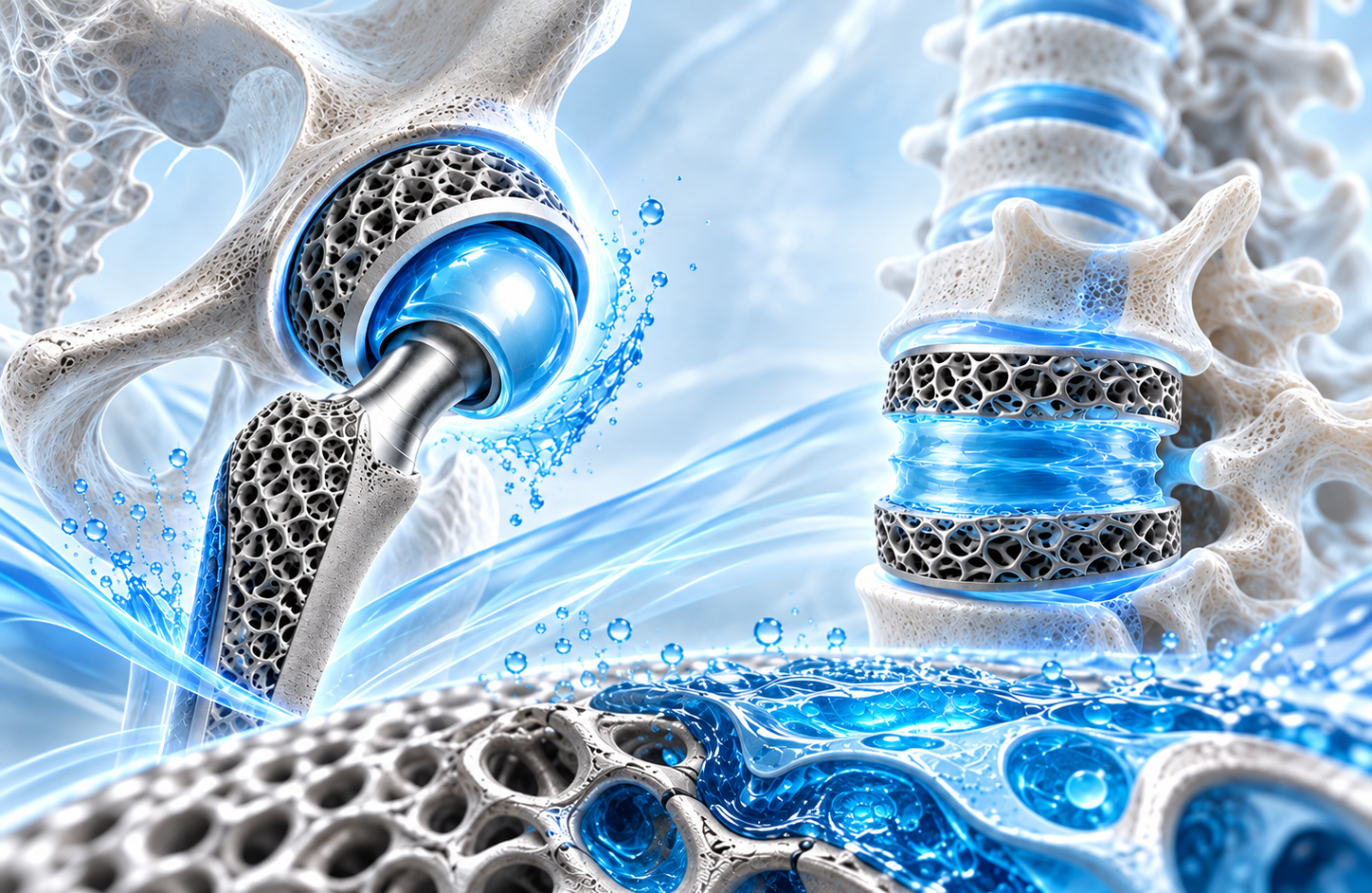
Paper: A versatile titanium–hydrogel platform bridging hard and soft tissue for joint arthroplasty. AI-generated conceptual image created using ChatGPT/OpenAI
*Important notice: This news reports on an unedited version of an accepted paper and is awaiting final editing. Therefore, the paper should not be regarded as conclusive or treated as established information.
A recent study published in Communications Materials reports a titanium–hydrogel platform designed to address the mechanical and functional limits of conventional orthopedic implants. The resulting material system combines high mechanical strength, low friction, strong interfacial adhesion, impact absorption, and favorable in vitro cytocompatibility. The findings show how integrating metallic and hydrogel components can create multifunctional implant materials for load-bearing orthopedic applications under laboratory testing.
Addressing Hydrogel Limitations in Orthopedic Implants
Orthopedic implants must withstand repeated loading while maintaining stable interfaces with surrounding tissues. Conventional metallic implants provide high strength and structural reliability. Some rigid bearing combinations can generate higher friction, and metallic components may be too stiff for soft tissues. By contrast, hydrogels offer low friction, high water content, and tissue-like mechanical properties, but their limited strength and durability restrict their use in load-bearing applications.
The study addresses this challenge by combining Ti6Al4V's structural strength with the compliant, lubricious characteristics of a double-network hydrogel. The researchers selected a PVA/PAAm system because its interpenetrating polymer networks can provide both toughness and mechanical resilience. They also introduced a triply periodic minimal surface (TPMS) gyroid architecture to create a porous titanium structure that can support hydrogel integration.
The metal–hydrogel interface presents a critical challenge because weak bonding can cause delamination, tearing, and premature failure under repeated loading. The researchers refined the interface alongside the individual material components to achieve strong integration between the titanium structure and hydrogel. The interface paired chemical anchoring via the silane coupling agent TMSPMA with mechanical interlocking through the TPMS pores. Together, the chemical and structural anchors integrate the titanium and hydrogel without auxiliary cement or mechanical clamps.
Engineering a Strong and Durable Titanium–Hydrogel Interface
The researchers fabricated Ti6Al4V structures using additive manufacturing and incorporated a PVA/PAAm double-network hydrogel into the porous architecture. They selected the hydrogel composition and processing conditions to balance strength, elasticity, and structural stability. A PVA-to-PAAm ratio of 6:4 provided the most suitable combination of properties, and they selected annealing at 120 °C because it balanced mechanical performance, water content, and appearance. Samples annealed at 160 °C reached the highest mechanical performance but showed greater water loss and visible yellowing.
The hydrogel was further strengthened through mechanical training. Tensile training at 50% strain increased the ultimate tensile strength by 55% and raised the tensile modulus by about three times. Compression training increased compressive strength by 20% and compressive modulus by 48%. The compression-trained hydrogel reached a compressive strength of 29.3 ± 0.3 MPa. These training experiments were performed on hydrogel specimens and were not carried into the implant-scale prototypes.
The titanium–hydrogel interface displayed strong adhesion. For TMSPMA-modified TPMS titanium, the measured interfacial bonding energy reached 1337 ± 279 J m-², compared with 228.46 ± 5.15 J m-² for TMSPMA-modified flat titanium. Peel tests showed predominantly cohesive hydrogel failure at the TPMS interface, indicating that the interface resisted separation strongly enough for failure to occur within the hydrogel itself. The study did not separately quantify how much improvement came from chemical bonding and how much came from TPMS-based mechanical interlocking. This strong interface allowed the composite structure to withstand deformation without the two materials separating prematurely. The researchers evaluated the material system through mechanical, tribological, impact, fatigue, and biological tests. They also incorporated it into prototype orthopedic devices to examine its performance under loading conditions closer to implant use.
Strong Interfaces, Low Friction and Multifunctional Performance
The combined material system demonstrated a useful balance between strength and compliant surface behavior. The hydrogel exhibited a coefficient of friction of only 0.038 ± 0.003 in the tribology test, compared with 0.170 ± 0.016 for titanium. This low-friction response could help reduce wear at articulating implant surfaces. The authors caution that differences in test geometry, loading, sliding conditions, and lubricant composition prevent direct comparisons with conventional bearing materials. The hydrogel also showed strong impact-absorption capability. During drop-tower testing, the material reached 60% compression and absorbed 77% of the impact energy during the first impact. These characteristics are relevant to orthopedic components that experience sudden or repeated loads.
The researchers then evaluated a hip implant prototype during cyclic laboratory testing. The prototype sustained compressive loads above 3000 N and rotational motion of ±12° for 500,000 cycles without delamination, tearing, rupture, progressive increases in torque, or loss of a stable displacement response. The test used an adapted laboratory protocol and ran over 25 days. The authors describe 500,000 cycles as an initial durability assessment compared with the tens of millions of cycles experienced clinically and call for standardized hip-simulator testing to establish longer-term wear performance. Large or readily visible hydrogel wear debris was not seen in the collected lubricant, but smaller particles could not be excluded.
During mechanical characterization, an artificial intervertebral disc prototype reached approximately 1000 N in compression and 200 N in tension. In a separate fatigue test, it completed 10,000 compression–tension cycles without structural failure. Drop-tower impact testing showed that the disc absorbed 84.9% of the initial impact energy. Its axial stiffness had not yet fully matched that of the native intervertebral disc.
Biological testing further supported the material system's potential. Cell viability remained above 95%, indicating good cytocompatibility under the tested conditions. At 100 μg/mL, debris concentration exceeded levels typically reported for long-term implant wear; CD80 expression increased after 24 h but returned toward basal levels by 48 h. The authors say broader inflammatory markers and long-term in vivo studies are needed to characterize the host response. Vancomycin-loaded artificial disc samples reduced the measured bacterial growth area of methicillin-sensitive Staphylococcus aureus by 78.25 ± 4.55% in vitro relative to unloaded controls. The study also demonstrated local release of vancomycin, gentamicin, and ciprofloxacin from PVA-based drug-delivery layers. All three antibiotics showed an initial burst release in the first 24 h followed by continued release over subsequent days. These tests show that the implant design can incorporate local antibiotic delivery.
Toward Multifunctional Orthopedic Implants
The study demonstrates that combining Ti6Al4V with a PVA/PAAm double-network hydrogel selected for load-bearing performance can produce an implant system with complementary structural and functional properties. The titanium structure provides load-bearing capability and geometric stability, while the hydrogel contributes low friction, impact absorption, mechanical compliance, and potential for localized drug delivery.
The metal–hydrogel interface combines covalent bonding with TPMS-based mechanical interlocking, keeping the two materials integrated during applied loading tests. Tests of the hip and intervertebral-disc prototypes showed the system could withstand substantial cyclic loading and complex motion in laboratory testing. The TPMS architecture also provided interconnected spaces for hydrogel infiltration while maintaining titanium support. This approach could be adapted to different implant geometries and loading environments.
The work presents a materials-design strategy for future orthopedic implants. The design combines the strength of additively manufactured titanium with the low-friction, energy-absorbing, and drug-delivery capabilities of hydrogels. The authors identify load-bearing joint replacements, spinal implants, and other devices with compliant soft–hard interfaces as possible applications, while standardized simulator testing and long-term in vivo studies are still needed before clinical performance can be assessed.
Disclaimer: The views expressed here are those of the author expressed in their private capacity and do not necessarily represent the views of AZoM.com Limited T/A AZoNetwork the owner and operator of this website. This disclaimer forms part of the Terms and conditions of use of this website.