eraspec oil is a robust, professional-grade, and portable standalone analyzer designed to perform on-site, laboratory-quality lubricant condition monitoring within an automated workflow that simplifies the testing process.
Its features include an integrated pump for sample introduction, pre-programmed standard test methods, and an automatic reference measurement, removing any need for solvents.
With no complicated sample preparation or programming required, the system rapidly delivers precise evaluations of degradation products, contaminants, and parameters predicted through chemometrics, including total acid number (TAN) and total base number (TBN).
The Austrian technology innovator, eralytics, has expanded the market-leading eraspec oil’s capabilities with three additional features, including:
- A unique triple-cell design to improve detection limits
- An advanced chemometric approach to water content quantification
- Spot-on fingerprinting for rapid product verification
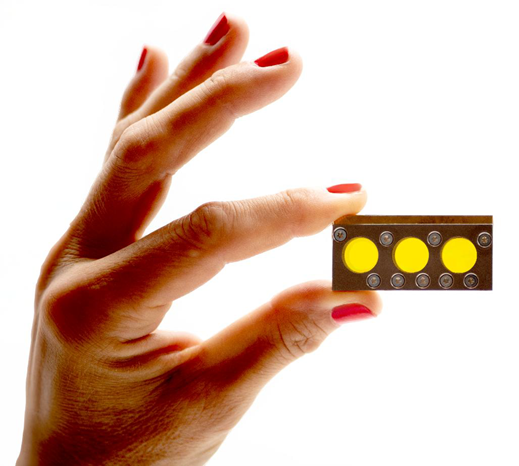
Image Credit: eralytics GmbH
The Triple-Cell Design
There are notable analytical benefits to adding another 500 µm measurement cell alongside the standard 100 µm cell, particularly when measuring substances present only in trace amounts.
This triple-cell design is unique to the eraspec oil. With the built-in reference cell completing the configuration, the main benefits of this technology include:
- Improved limits of detection (LODs): The 500 µm cell has a higher path length than the mandatory 100 µm cell, which improves detection limits for certain trace substances. Examples include antioxidant additives, such as AO Phenol, and contaminants such as water or ester.
- Automatic "smart" evaluation: The eraspec’s software leverages both cells to offer users the most accurate reading possible. For instance, if the concentration measured by the standard 100 µm cell falls below a user’s chosen limit, the system will automatically employ the 500 µm cell to calculate and report a more precise measurement.
- Fully automated workflow: No user input is needed to trigger additional scans through the 500 µm cell, as the eraspec oil performs accompanying spectral evaluations automatically.
The additional 500 µm cell enables the eraspec oil analyzer to dynamically adjust its measurement strategy based on the sample's concentration. Users undertaking work involving low-level detections benefit from both the broad measurement range of the 100 µm cell and the enhanced sensitivity of the 500 µm cell.
Water Content Quantification with Chemometrics
Determining water concentration in lubricants via Fourier transform infrared (FTIR) spectroscopy, as seen in the American Society for Testing and Materials (ASTM) test method E2412, can be affected by spectral overlap in the O-H stretching region caused by the accumulation of oil oxidation products and additives.
Instead, the actual water content is commonly determined using Karl Fischer (KF) titration with an oven accessory that complies with the ASTM D6304-B method.
However, this procedure can take up to an hour to complete and sometimes reports inflated water concentrations in degraded oils. This is because volatile oxidation byproducts can be distilled alongside the water, and anti-wear additives, such as zinc dialkyldithiophosphate (ZDDP), can decompose under heat.
The eraspec oil analyzer addresses these intersecting limitations through a combined approach that integrates sensitive hardware with a highly capable chemometric model.
At the hardware level, the triple-cell design improves the detection of substances present at trace concentrations. The software evaluates spectral saturation using a dynamic algorithm and automatically selects the appropriate measurement cell. If the water regions in the 500 µm spectrum become oversaturated, the eraspec oil uses the 100 µm cell to also provide a broad measurement range.
At the same time, the chemometric model is calibrated against the actual KF reference baseline using a carefully selected set of nine significant mid-infrared spectral regions.
This multivariate method accounts for spectroscopic and chemical interferences as separate variables, enabling water-related absorption bands to be distinguished mathematically from degradation products, including carbonyls, amines, and sulfate byproducts.
By correcting the information inherent in FTIR spectroscopy, the model establishes a reliable correlation between spectroscopic measurements and the reference method. For important water concentrations in lubricant analysis (100 parts per million (ppm) or higher), the combined approach eraspec oil offers can deliver up to twice the analytical performance of the conventional, direct method. It also provides lab-grade precision within two minutes.
A study was conducted to assess the accuracy of FTIR-based water quantification, in which a range of lubricating oils were gravimetrically spiked with water, creating a validation dataset covering concentrations from trace levels below 100 ppm to 2000 ppm.
The study compared conventional direct FTIR measurements with reference values obtained by KF titration in accordance with ASTM D6304-B. The findings showed that the conventional, direct approach had clear limitations when applied to degraded oils, namely due to significant chemical and spectroscopic interferences.
The study concluded that eraspec oil's triple-cell design paired with a chemometric model could successfully mitigate these interferences. The resulting water measurements showed excellent correlation with the KF method and doubled the trace-level analytical performance.
The graph below illustrates the relationship between the reference titration method and the chemometric prediction using FTIR spectroscopy. The results fall well within the reproducibility limits of the reference method, which is 390 ppm at a concentration of 1000 ppm.
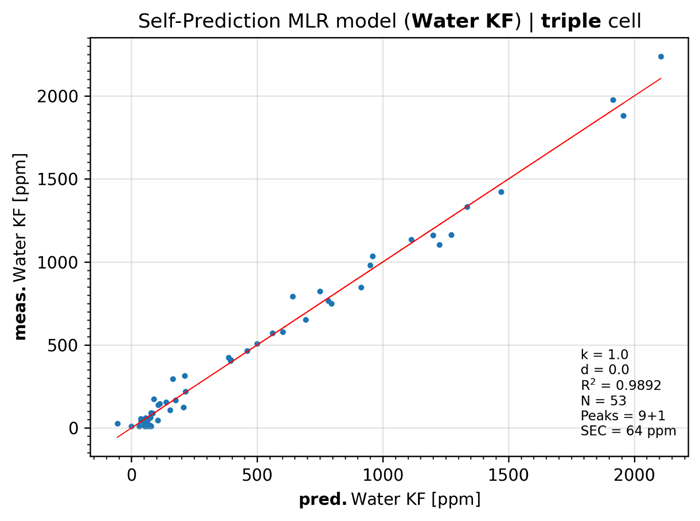
Image Credit: eralytics GmbH
Fingerprinting for Rapid Product Verification
The eraspec oil analyzer also allows users to identify fresh lubricating oils through automated FTIR spectral matching. It verifies a lubricant's unique molecular fingerprint by comparing its spectrum to those contained in an extensive reference database stored in the instrument.
This identification process uses a matching algorithm based on the Pearson correlation coefficient to establish the closest possible match between the sample spectrum and the reference profiles available in the system.
Before the comparison has been completed, the eraspec oil will run raw spectral data through mathematical preprocessing to normalize baseline variances and isolate the most significant spectral regions. The system then evaluates the processed spectrum against the available database and generates a cross-validation similarity score.
The validation study involving 19 different fresh lubricant formulations showed just how effective this matching procedure is, with the analyzer successfully matching 18 of the 19 samples with the correct reference profiles.
The study also showed that the system exhibits excellent analytical robustness to batch-to-batch variations and instrumental noise. The overall measurement repeatability was approximately 0.5%.
In addition, the algorithm achieved an average discrimination safety margin of around 5%, which comfortably exceeds the baseline measurement noise and helps to reduce the risk of false-positive identifications.
The only incorrect match in the study involved two closely related products, sometimes referred to as "sister products". Their chemical matrices were almost identical, with only minor differences in their additive concentrations, making them particularly challenging to distinguish.
Figure 2 highlights the strong correlation observed during the validation study.
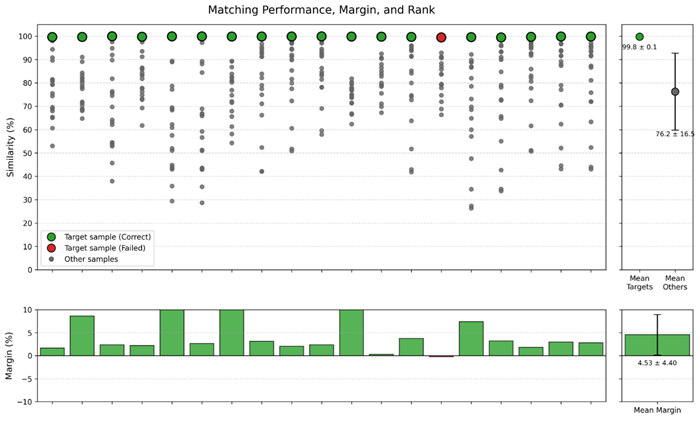
Image Credit: eralytics GmbH
The fingerprinting feature is a particularly valuable tool for supporting incoming goods inspections. It is capable of preventing disruptions in downstream processes and problems that often have cost implications.
Conclusion
The eraspec oil is an established professional FTIR system for lubricant analysis. It now features a unique triple-cell design that significantly lowers detection limits without compromising measurements at higher concentrations.
Beyond detecting additives and contaminants, this triple-cell technology is being used in a new chemometric method to determine water content. Automated spectral fingerprinting for product control further complements this new suite of features.

This information has been sourced, reviewed, and adapted from materials provided by eralytics GmbH.
For more information on this source, please visit eralytics GmbH.