Interpreting thermal analysis measurement curves can require considerable time and expertise, even for highly experienced analysts. To address this challenge, METTLER TOLEDO has introduced an advanced artificial intelligence (AI) solution designed specifically for thermal analysis applications.
The AIWizard™ in the STARe software provides autonomous identification and evaluation of all thermal events detected by TGA and DSC. The new TGA and DSC Combined AIWizard analyzes both signals together, meaning better identification of thermal events by correlating changes in mass with heat flow.
Powered by trained neural networks built on thousands of analyzed datasets, AIWizard autonomously identifies, classifies, and evaluates thermal effects. By taking over much of the time-intensive work, AIWizard reduces analysts' workloads and allows them to focus on interpreting results and making informed decisions from the data.
Features and Benefits of AIWizard
- AI analysis autonomously identifies and evaluates all types of DSC and TGA effects
- Combined TGA/DSC analysis offers improvements in thermal event identification by correlating mass changes with heat flow
- Automation solutions with AI-enabled methods allow you to run experiments automatically and analyze results instantaneously
- AIWizard can be used as an expert opinon to compare to your own evaluation
- Continuous additions of expert data to the neural networks allow users to meet future analytical needs
- Benefit from more than 350 years of combined thermal analysis experience from METTLER TOLEDO
DSC, TGA, and Combined Analysis: AI-Powered Evaluation
Rather than just detecting changes in measurement signals, as conventional, algorithm-based approaches typically do, AIWizard identifies the type of thermal event and provides a detailed evaluation.
The interpretation of thermal analysis measurements can be particularly demanding when thermal events are weak, overlap with other events, or are influenced by measurement artifacts. However, detecting a change in a curve is only part of the task; understanding the thermal process involved is critical.
Analysts often need to determine:
- What type of thermal event is occurring
- Where the event begins and ends
- What the characteristic peak or transition temperature is
AIWizard addresses these questions by automatically identifying, classifying, and evaluating all thermal effects, including glass transitions, crystallization, and melting events.
AIWizard for DSC or TGA Curves
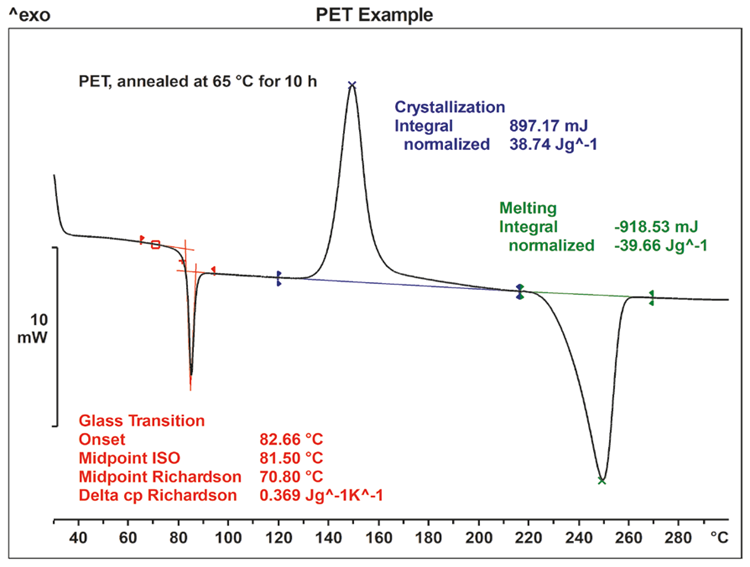
Image Credit: Mettler Toledo - Thermal Analysis
When analyzing a DSC measurement of PET, AIWizard automatically identified the different types of thermal event and quantified their characteristics.
The glass transition, crystallization, and melting events were correctly identified and evaluated. Key measurement parameters, including onset and peak temperatures and enthalpies, were calculated automatically.
These results offer a comprehensive analysis of the DSC measurement curve. The same AI-based evaluation functionality is also available for TGA and TGA/DSC measurements.
AIWizard for Combined TGA and DSC Analysis
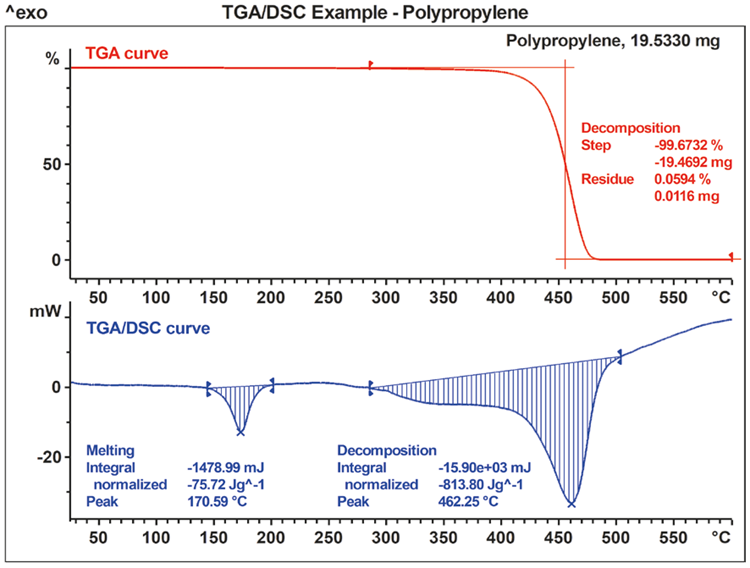
Image Credit: Mettler Toledo - Thermal Analysis
AIWizard Combined™ introduces an integrated approach to evaluating TGA and DSC measurements by interpreting both signals simultaneously. This enhances accuracy and distinguishes thermal events by evaluating changes in sample mass alongside heat flow.
For example, in a polypropylene measurement, the combined analysis identified the first endothermic peak in the DSC curve as melting, taking into account no change in mass in the TGA signal. The second endothermic peak was correctly identified as decomposition, consistent with the loss of sample mass seen in the TGA signal.
The AIWizard Neural Networks
AIWizard is built on neural networks trained on thousands of thermal analysis evaluations reviewed and interpreted by METTLER TOLEDO experts. The underlying AI model is continuously developed as additional expert-validated measurement data becomes available. These regular improvements help enhance the accuracy, reliability, and overall analytical capabilities of the system.
The neural network is trained with real-world thermal analysis measurements obtained from well-characterized samples. Training material also incorporates curves containing realistic measurement challenges, such as common artifacts, baseline drift, and complex thermal events. This enables AIWizard to differentiate genuine thermal effects from irregularities in the measurement signal.
Using AIWizard in Automated Workflows and on Existing Evaluations
AIWizard can be added to the method in automated workflows. Alternatively, it can be used as an evaluation tool on existing measurements when a quick evaluation or an expert second opinion is required.
This makes AIWizard suitable for both fully automated workflows to perform the initial evaluation with no operator intervention, and as an expert reviewer to provide an independant perspective on an existing assessment. In either application, AIWizard supports fast, reliable, and consistent interpretations of thermal analysis data.
AIWizard in Automated Workflows
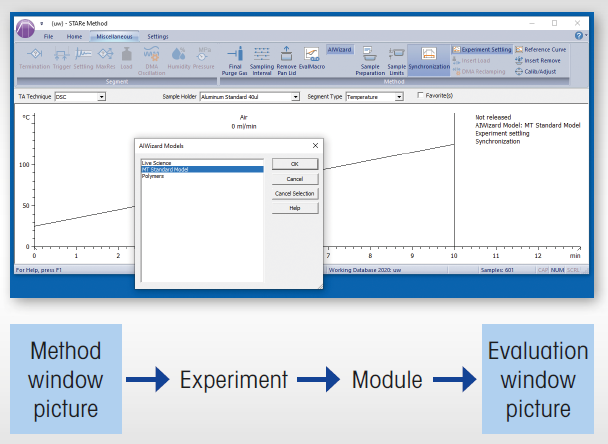
Image Credit: Mettler Toledo - Thermal Analysis
To automate the entire measurement and evaluation process, activate AIWizard directly from the Method Window in the STARe software. Once activated, it automatically identifies and evaluates thermal effects when an experiment finishes, allowing analysts to focus on preparing samples and interpreting results correctly.
AIWizard on Existing Evaluations
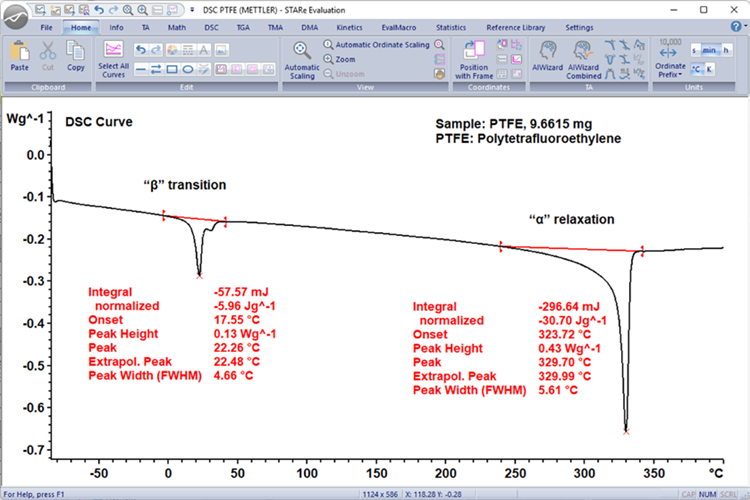
Image Credit: Mettler Toledo - Thermal Analysis
AIWizard also offers a convenient option for performing OneClick™ evaluations or obtaining independent second opinions. When used as a second opinion, AIWizard results are displayed alongside the analyst’s evaluation. This makes it easy to compare the two interpretations and identify similarities and differences.
Providing AI insights alongside an analyst’s interpretations can reduce overall evaluation time, and users can draw more confident conclusions using the combined thermal analysis expertise in the METTLER TOLEDO database.

This information has been sourced, reviewed, and adapted from materials provided by METTLER TOLEDO - Thermal Analysis.
For more information on this source, please visit METTLER TOLEDO - Thermal Analysis.