A modular temperature-controlled flow chemistry platform designed to evolve alongside modern research workflows.
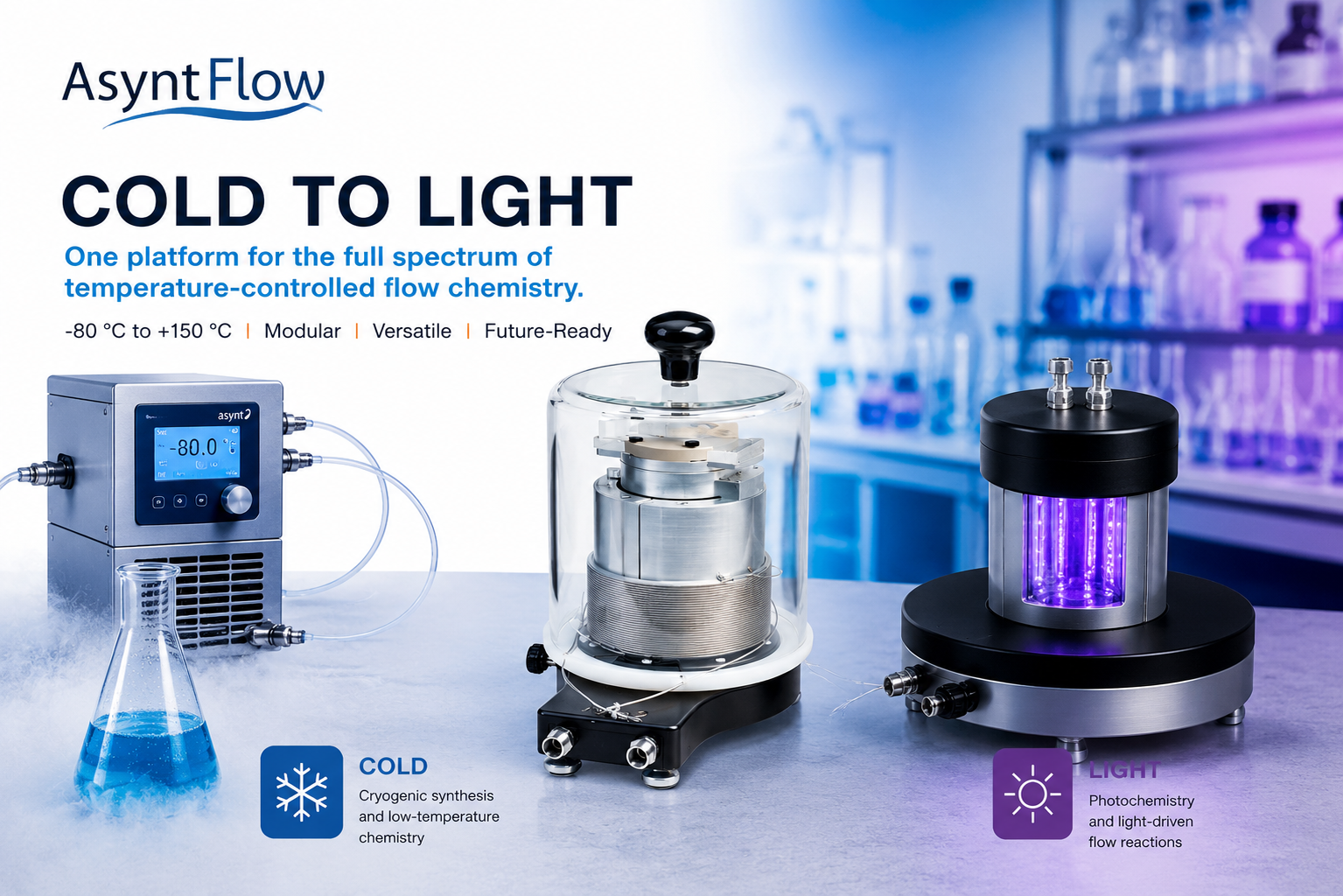 One platform supporting everything from cryogenic chemistry to photochemistry. Asynt Ref: ASY-PR-124. Image Credit: Asynt
Achieving reliable temperature control is critical to the success of many flow chemistry processes. Whether performing cryogenic organometallic reactions, developing photochemical methodologies or optimizing continuous synthetic routes, chemists require precise and dependable thermal management to ensure reproducibility, selectivity and safety.
To support these increasingly diverse research requirements, Asynt has introduced the new ColdCoil - a versatile temperature-controlled flow chemistry module designed to provide exceptional flexibility across a broad range of continuous flow applications.
Building on the proven capabilities of earlier ColdCoil platforms, the new ColdCoil combines a smaller laboratory footprint with enhanced modularity, enabling researchers to configure and expand their flow chemistry workflows around a single thermal control platform.
Designed for connection to a suitable recirculating heater/chiller, ColdCoil delivers stable reaction temperatures from -80 °C to +150 °C (depending upon the recirculators’ capabilities), supporting applications ranging from low-temperature synthesis and exothermic reactions through to elevated-temperature continuous processing. By utilizing standard recirculating thermal control systems rather than consumable cooling media, the platform enables reliable long-duration operation with reduced operator intervention, making it particularly well suited to extended experiments and process development studies.
One of the defining strengths of the redesigned ColdCoil is its modular design. Rather than investing in multiple dedicated temperature-control modules for different applications, chemists can configure a single platform to accommodate a wide variety of flow chemistry formats.
The system supports standard coil reactors, packed-bed column chemistry, static mixing applications, and photochemical flow processes, allowing laboratories to adapt rapidly as projects evolve. This flexibility helps reduce equipment complexity while ensuring researchers retain the freedom to explore new synthetic strategies without replacing core infrastructure.
Applications for ColdCoil range from low-temperature organometallic chemistry and reactive intermediate generation through to temperature-controlled photochemistry, packed-bed catalysis and continuous process optimization. By enabling precise thermal control across diverse reactor formats, the system helps researchers rapidly explore new reaction pathways while maintaining reproducibility and safety.
The ColdCoil is compatible with all Asynt coil reactors ranging from 2 mL to 60 mL capacity and supports a broad range of reactor materials, including PTFE, PFA, FEP, stainless steel and Hastelloy. This allows chemists to select the most appropriate reactor configuration for their process while maintaining excellent thermal performance. A proprietary clamping mechanism ensures effective thermal contact while enabling rapid reactor interchange when workflows change.
A range of accessories further extends the capabilities of the platform. The HotColumn adaptor enables temperature-controlled packed-bed chemistry, while the GSM adaptor incorporates compact glass static mixers for efficient mixing applications. The system can also be integrated with PhotoSyn and Borealis photochemical reactors, allowing researchers to perform temperature-controlled flow photochemistry using the same core platform.
The compact redesign of Asynt’s ColdCoil reflects a growing demand for practical, space-efficient laboratory infrastructure. By consolidating multiple flow chemistry capabilities within a single modular system, laboratories can simplify equipment requirements while maintaining the flexibility needed for increasingly sophisticated synthetic workflows.
ColdCoil has also been developed with the future of laboratory automation in mind. Compatible with many standard recirculating heaters and chillers that support established communication protocols, the system can be readily incorporated into automated flow chemistry environments, automated reaction optimisation platforms, self-driving laboratory workflows and digitally controlled experimentation environments. This enables researchers to integrate precise thermal control into increasingly data-driven and autonomous laboratory environments while preserving the flexibility of an open modular architecture.
Commenting on the launch, Andrew Mansfield, Flow Chemistry Specialist at Asynt, said:
“Flow chemistry projects rarely stand still. Researchers often begin with a straightforward reactor configuration before moving into photochemistry, packed-bed catalysis, automated optimization or entirely new application areas.
We designed ColdCoil to provide a single temperature-control platform that can evolve alongside those changing requirements, helping chemists spend less time reconfiguring equipment and more time developing chemistry.”
By combining broad temperature capability, modularity and compatibility with a wide range of reactor formats, ColdCoil Mark III offers researchers a practical route to expanding their flow chemistry capabilities without unnecessary complexity.
The ColdCoil Mark III is therefore not simply as a reactor accessory, but as a future-ready temperature-controlled flow chemistry module designed to evolve alongside modern synthetic research strategies.
Researchers interested in learning more about the ColdCoil Mark III, discussing specific applications or exploring how temperature-controlled flow chemistry could benefit their work are invited to contact the Asynt team or visit the Asynt website.
Key Features
- Stable thermal control from -80 °C to +150 °C
- Compact footprint for modern laboratory environments
- Supports coil, column, GSM and photochemical flow applications
- Compatible with a broad range of reactor materials
- Continuous low-temperature operation using standard recirculating chillers
- Modular architecture designed for evolving research requirements
- Integration-ready for automated and software-controlled laboratories
- Easily incorporated into existing flow chemistry systems
- Configurable for diverse synthetic and process development applications
Learn More
Whether developing new synthetic methodologies, scaling continuous processes or integrating automated optimisation tools into the laboratory, chemists can discuss their application directly with Asynt's flow chemistry specialists. Visit the Asynt website to explore the full ColdCoil range or contact the team to discuss your specific requirements.