More than 20 m² of blade sections have already been recovered to validate their reuse in applications such as electric vehicles and insulation materials.
The achievement comes as European wind sector’s voluntary landfill ban on decommissioned wind turbine blades enters into force.
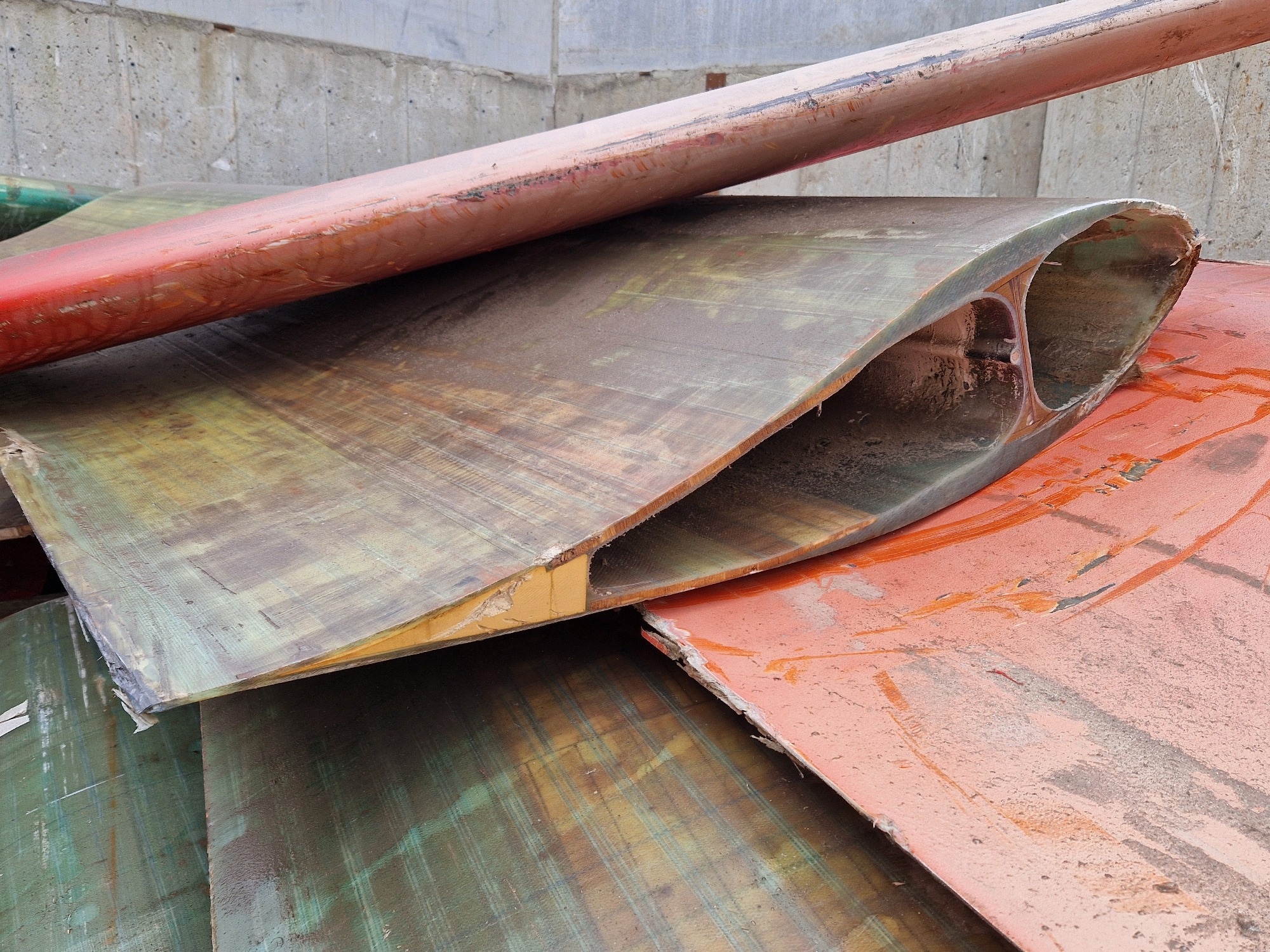 Blade sections for shredding. Image Credit: SUEZ
What until recently was considered one of the most challenging waste streams of the energy transition could become a valuable source of raw materials for new industrial products. More than 20 square meters of recovered wind turbine blade sections – equivalent to the surface area of two-family cars – are being given a second life through the European REWIND project in applications such as electric vehicles and insulation materials. In addition, the consortium has validated a model capable of predicting the mechanical behavior of recovered materials with more than 90% accuracy.
The results achieved by REWIND come at a pivotal moment for the European wind sector, supporting the transition towards a future without landfill disposal of decommissioned wind turbine blades. Since 1 January 2026, the voluntary ban promoted by WindEurope on sending these structures to landfill has been in force across the sector.
By extending the lifespan of composite materials and transforming waste into valuable industrial resources, REWIND is helping to reduce landfill disposal and incineration while advancing a more circular, efficient and sustainable European wind industry.
The project, coordinated by AIMPLAS, the Plastics Technology Centre, brings together research and technology centers, universities, industrial companies, and sector associations from across Europe to develop practical solutions across the full value chain of end-of-life wind turbine blades. Specifically, the following participate: Tekniker, IPC, Miljøskærm, Hochschule Pforzheim, DITF, Alke, Suez, BCircular, Composite Patch, R-Nano, PNO Innovation Italy and AEMAC.
Delivering Results for a Circular Wind Industry
During its first two years, REWIND has successfully achieved its first two technical milestones. The first milestone, led by SUEZ, ensured the availability of undamaged and dismantled end-of-life (EoL) wind turbine blades for repurposing and recycling activities, providing more than 20 m² of blade sections for the initial validation of the project's circular strategies.
The second milestone, led by IPC, validated the robustness of a material model designed to predict the residual mechanical properties of damaged end-of-life (EoL) wind turbine blade components. The model demonstrated excellent accuracy, with less than a 10% deviation between simulated results and the actual mechanical behavior of the tested blade sections.
The consortium will now focus on scaling up the developed technologies, validating industrial demonstrators and accelerating the market uptake of circular solutions for wind turbine composites.
Project Progress
SUEZ has developed and validated safe and efficient dismantling technologies while also implementing advanced non-destructive material identification methods that support the classification, reuse and recycling of composite materials.
TEKNIKER has advanced cutting optimization software and long-fiber delamination technologies capable of producing continuous composite tapes, opening up new possibilities for the direct reuse of large blade sections.
Miljøskærm is developing thermal insulation materials made from recycled glass fibers, combining strong thermal and acoustic performance with structures designed to minimize biological activity.
ALKE is demonstrating the direct reuse of blade components by integrating repurposed composite panels into electric vehicle cargo compartments, while DITF has successfully produced innovative unidirectional fabrics based on recycled glass fiber yarns for future composite applications.
Advanced Recycling Technologies
REWIND is also delivering advances in recycling technologies capable of recovering secondary raw materials.
AIMPLAS is leading the development of mechanical pre-treatment, material separation, catalytic pyrolysis and solvolysis processes to maximize resin recovery while preserving fiber quality.
BCIRCULAR is scaling up its pyrolysis technology and integrating new catalytic systems that will enable the production of high-quality recycled fibers for industrial applications.
R-Nano is characterizing and improving the performance of recovered fibers through advanced surface analysis and innovative sizing strategies, while Composite Patch is defining performance requirements and assessing the environmental and economic sustainability of recycled composite repair solutions.
Supporting Europe's Circular Economy
Beyond technology development, REWIND is generating strategic knowledge to support future circular economy policies and industrial deployment.
Hochschule Pforzheim has quantified the future availability of end-of-life wind turbine blades in Europe and is developing electropulse fragmentation technologies to obtain high-quality secondary materials for advanced recycling processes.
IPC is developing predictive models to evaluate the residual mechanical properties of composite blade sections and leads the project's Sustainability, Circularity and Eco-design activities, providing Life Cycle Sustainability Assessments that help identify the most effective end-of-life strategies.
PNO is leading stakeholder engagement and exploitation activities, analyzing market opportunities, innovation ecosystems and intellectual property strategies to maximize the long-term impact and industrial uptake of the project's results.
Complementing these activities, AEMAC is promoting REWIND's achievements across the European composites and wind energy communities and facilitating the transfer of knowledge between research organizations, industry, policymakers and society.
Together, these achievements demonstrate that end-of-life wind turbine blades can become valuable secondary resources, bringing Europe one step closer to a truly circular wind energy sector.
About REWIND
REWIND (Efficient Decommissioning, Repurposing and Recycling to Increase the Circularity of End-of-Life Wind Energy Systems) is funded by the European Union's Horizon Europe Research and Innovation Programme under Grant Agreement No. 101147226.