Selecting a time zone will update the dates above.
Visual microscopy can reveal where a particle, defect, contaminant, or layer is located - but understanding what it is often requires chemical information.
Join us for an educational webinar exploring how FTIR microscopy can help bridge the gap between visual observations and chemical analysis. We’ll examine approaches for investigating microscopic features and challenging samples, including particles, defects, contaminants, and layered materials, and discuss considerations for selecting sampling modes and analytical configurations for different applications.
You’ll also get an introduction to the new Thermo Scientific™ Nicolet™ RaptIR™ X FTIR Microscope and see how its flexible configurations, intuitive workflows, spatial resolution, and versatile sampling capabilities support a range of FTIR microscopy applications.
Register to explore how FTIR microscopy can help you move from seeing a microscopic feature to understanding its chemical composition.
Join the free webinar with certification of attendance now.
Attend the Webinar to Learn:
- How FTIR microscopy complements visual microscopy with chemical information
- How different sampling approaches can address particles, defects, contaminants, layers, and other microscopic features
- How instrument configuration and workflow choices can help address different analytical needs
- How the Nicolet RaptIR X FTIR Microscope brings these capabilities together in a flexible platform
This Webinar is Ideal For:
- Scientists and Engineers investigating unknown materials and defects
- Microscopists and Spectroscopists
- Failure Analysis Specialists
- QA/QC Professionals
- Laboratory Researchers working with contaminants or layered samples
Meet the Webinar Speaker
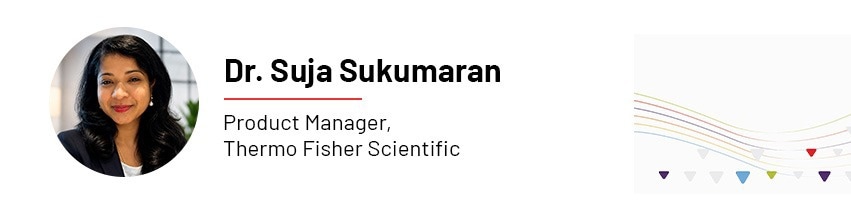
Dr. Suja Sukumaran is a Product Manager at Thermo Fisher Scientific. She earned her PhD in Biophysics from Johann Wolfgang Goethe University in Germany through the International Max Planck Research School. She brings extensive expertise in molecular spectroscopy, fluorescence and visible imaging, as well as protein and lipid biochemistry to her role.