In this interview, industry expert Sabina Kumar discusses how improved powder behavior and process strategies can significantly boost productivity in additive manufacturing while maintaining high part quality and reliable Laser Powder Bed Fusion (L-PBF) performance.
To get started, can you explain why improving productivity in Laser-Powder Bed Fusion (L-PBF) is such an important focus right now?
Improving productivity has become essential because Laser-Powder Bed Fusion is already one of the most mature and widely industrialized additive manufacturing technologies. As shown in AM Power’s industrialization and maturity index, L-PBF is at the top compared to other metal AM processes. Since the technology is well established, the next challenge is making it more efficient and cost-effective. Although L-PBF allows excellent design flexibility and part consolidation, its current build rates still limit large-scale adoption. Faster production directly impacts cost, so finding ways to increase productivity is a major priority.
What makes L-PBF attractive compared to other additive manufacturing technologies?
L-PBF stands out because of its broad material capability and design freedom. We can process steels, nickel alloys, aluminum, cobalt and copper alloys, magnesium, high-entropy alloys, and even specialized compositions. Many of these are already mature and in production across the industry.
The design possibilities are also significant, even though we sometimes face constraints like wall thickness, support structures, or surface quality, the process still enables geometries that are impossible with conventional manufacturing. Because of this versatility, improving productivity in L-PBF has a strong impact across many applications.
What are the main strategies currently being explored to increase L-PBF productivity?
There are three key approaches. One is hardware modification, such as increasing the number of lasers. Some systems move from a single Gaussian laser to four lasers, and others go all the way to 12 or even 24 lasers to multiply throughput.
The second approach involves optimization of the laser parameters, including adjustments to laser power, speed, hatch spacing, and layer thickness. Some OEMs now offer systems with 1.2 kW or even 3 kW lasers, which support the use of thicker layers and faster scanning.
The third approach, which was the focus of my talk, is enhancing the powder feedstock. Since the powder is the first step of the entire process, its characteristics strongly influence spreading, melting behavior, and ultimately productivity.
Why is the powder feedstock so critical for L-PBF performance and productivity?
Powder affects almost every step of the process, from flow through the hopper to spreading each layer to how it interacts with the laser. Characteristics like particle size distribution, morphology, packing density, and flowability determine how efficiently the powder can form a uniform layer.
For example, water-atomized powders tend to have irregular shapes and wide size variations, which makes them spread unevenly. Gas-atomized powders, especially spherical ones, spread much more consistently. Because productivity depends on maintaining high-quality layers at increasingly high speeds or thicknesses, powder quality becomes a fundamental contributor.
What were the three powders you selected for the study, and how do they differ?
We compared three AlSi10Mg powders.
- The regular mono-modal powder served as our baseline. It is a single-distribution powder with generally spherical particles, but also noticeable satellites.
- The enhanced mono-modal powder is also a single-distribution AlSi10Mg powder, but its particles are extremely spherical and very uniform in size. The narrow particle size distribution is one of its key advantages.
- The enhanced bi-modal powder combines fine particles with larger particles, giving it a true bi-modal distribution. The fines fill the gaps between the larger particles, modifying both packing and flow behavior.
Throughout the study, we used consistent color coding: red for regular monomodal, green for enhanced monomodal, and blue for enhanced bimodal.
What powder characteristics did you measure, and why are they important?
We focused on particle size distribution (PSD), packing density, and flowability, as these directly influence layer quality and overall productivity.
For PSD, we used a micro-track instrument to measure D10, D50, and D90. The enhanced mono-modal powder showed a very tight D90/D10 ratio, confirming its narrow distribution, while the bi-modal powder clearly showed two distinct peaks.
For packing density, we used the GranuPack, which provided bulk density, tap density, compaction factor, packing fraction, and the Hausner ratio. These help us understand how efficiently the powder fills space.
For flowability, we used the GranuDrum, focusing on the dynamic angle of repose and cohesive index across speeds from 2 to 80 RPM. These measurements reveal how powders behave at low and high flow speeds, which is critical for recoating.
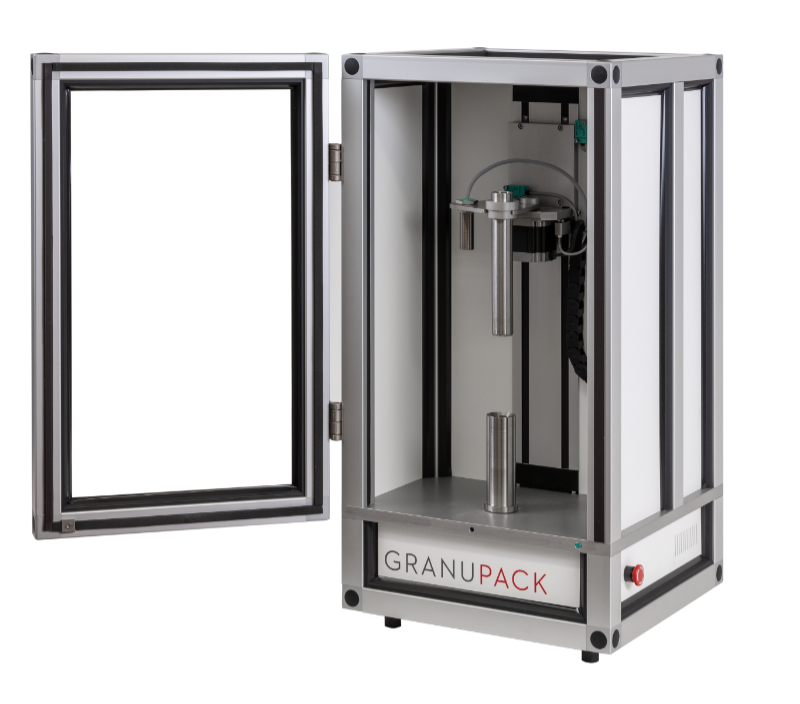
Image Credit: Granutools
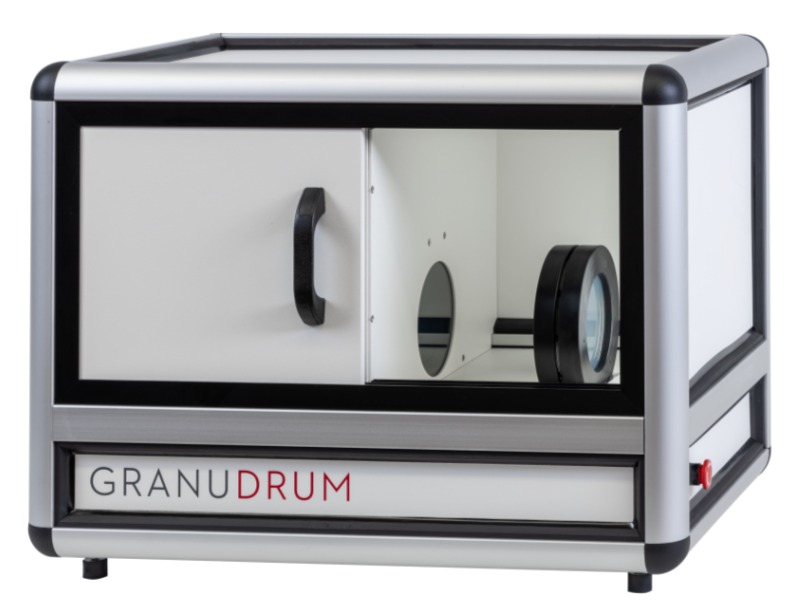
Image Credit: Granutools
What were the main findings from the particle size distribution (PSD), packing, and flowability analyses?
In the PSD measurements, the enhanced mono-modal powder displayed the narrowest spread, while the bi-modal powder showed a clear dual distribution of fines and coarse particles.
In the packing density analysis, the enhanced bimodal powder was packed the most efficiently after rearrangement, as confirmed by microscopy images showing fine particles filling the voids between larger particles. Interestingly, it had the lowest initial bulk density, which is counterintuitive, but we confirmed the result through repeated measurements.
Flowability revealed some of the most important differences. At low speeds, all powders behaved similarly. However, at higher speeds, the regular and enhanced mono-modal powders showed shear-thickening behavior; their dynamic angle of repose and cohesive index increased significantly. The bimodal powder behaved almost like a Newtonian powder, showing a stable angle of repose and cohesive index even at high speeds, indicating extremely stable flow and spreadability.
The bi-modal powder showed a lower initial bulk density than expected. How do you explain this result?
It was indeed counterintuitive because we would typically expect a bimodal distribution to show a higher initial bulk density. When the bimodal powder showed the lowest starting bulk density, I went back and rechecked the measurement, and the result was consistent.
My interpretation is that the way the bimodal powder was atomized and how its particles were initially arranged contributed to the lower starting density. Once the particles begin to rearrange, however, the fine particles fill the voids extremely efficiently, which explains the excellent packing behavior after tapping. So, it appears to be an intrinsic characteristic of how that specific bimodal powder is structured.
How did the powders perform when tested on the EOS M290 L-PBF system?
We built parts on the EOS M290 using identical 370-watt laser power. The layer thickness varied depending on what each powder could handle: 30 to 60 µm for the regular powder, 60 µm for the enhanced mono-modal, and up to 90 µm for the enhanced bi-modal.
The enhanced mono-modal powder showed a 1.3× productivity increase compared to the regular powder at similar layer thicknesses.
The enhanced bi-modal powder enabled layer thicknesses up to 90 µm while maintaining good spreadability and part quality, resulting in nearly a 4× productivity increase on a standard M290 system.
Both enhanced powders produced parts with ≥ 99 % density, which aligns with typical as-printed AlSi10Mg behavior before HIP or heat treatments.
What are the key takeaways from this study for improving L-PBF productivity?
Both enhanced powders demonstrated clear advantages in PSD uniformity, packing efficiency, and flowability. These improvements directly translated to higher feasible layer thicknesses and faster scanning, which led to measurable increases in productivity without compromising part quality.
The study shows that powder engineering is just as powerful as hardware or parameter optimization when it comes to improving L-PBF throughput. As the technology continues to scale, enhanced powders will play an increasingly important role in enabling high-productivity additive manufacturing.
About Sabina Kumar 
Sabina Kumar is a Specialist Engineer at Eaton and a materials scientist with expertise in metal additive manufacturing. Her research focuses on phase stability, thermomechanical behavior, and microstructure–property relationships in titanium alloys, with experience spanning academic research and industrial R&D.

This information has been sourced, reviewed, and adapted from materials provided by Granutools.
For more information on this source, please visit Granutools.
Disclaimer: The views expressed here are those of the interviewee and do not necessarily represent the views of AZoM.com Limited (T/A) AZoNetwork, the owner and operator of this website. This disclaimer forms part of the Terms and Conditions of use of this website.