Scientists have revolutionized the way metals are made by using lower and slower heating of alloys to control how atoms self-organize during material manufacturing.
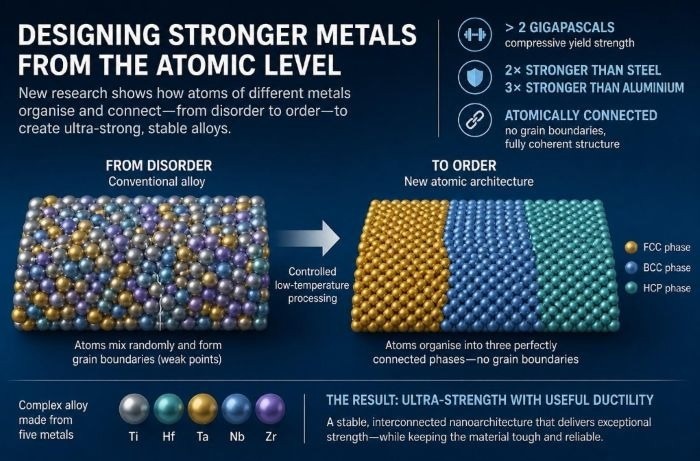 Scientists have manufactured the first large, continuous piece of Refractory High-Entropy Alloy (RHEA), a highly sought-after metallic material known for its exceptional strength and ability to withstand extreme environments. Image Credit: AI generated image
The discovery, published today in Science by Monash University engineers in Australia, essentially rewrites what has been a century-old approach to alloy design.
The study reveals that lower temperatures and a slower heating process can produce an alloy double the strength of steel, three times stronger than aluminium, and around twice as strong as the same alloy produced using conventional methods.
Rather than fully melting metals at extremely high temperatures, researchers used a controlled heating process that allowed atoms to organize themselves into highly ordered, interconnected structures.
This created what they call an “atomic architecture” where different structures form together and connect in a continuous way, without the microscopic defects found in conventional alloys.
They tested the method on an alloy of titanium, hafnium, tantalum, niobium and zirconium, which formed a tightly connected internal nanostructure made up of three distinct components.
The material achieved a compressive yield strength of over two gigapascals while still retaining ductility, meaning it can bend without breaking.
Corresponding author, Professor Jian-Feng Nie, from the Department of Materials Science and Engineering at Monash, said the discovery represents a new paradigm in alloy design.
“For more than a century, alloy development has focused on composition and processing. Our work suggests that how atoms organize during manufacturing may be just as important,” Professor Nie said.
“The real significance is not just this particular alloy, but the demonstration that atoms can self-organize into defect-free structures in a bulk metallic material, meaning a large, continuous piece of metal, not a thin coating, film or microscopic sample.
“If this concept can be applied more broadly, it could open the door to materials with properties that were previously considered unattainable, with implications for alloy design that could be applied across many systems and industries.”
Associate Professor Yu Zhang from Chongqing University, who completed his PhD at Monash University, said the results demonstrate a fundamentally different approach to designing high-performance metals.
“By carefully controlling how the atoms organize during processing, we were able to create a highly connected structure with exceptional strength and stability,” Associate Professor Zhang said.
Professor Nie said the findings also suggest a new way of thinking about alloy chemical composition.
“Instead of increasing alloy content to achieve better performance, we may be able to design internal structures that deliver superior properties with fewer alloying elements,” Professor Nie said.
“That could lead to more efficient, sustainable and cost-effective alloy production.”
The researchers are now investigating the atomic-scale interactions that drive the formation of these structures and determine how materials evolve during processing.
“At an even smaller scale, these interactions determine how materials form, evolve and perform,” Professor Nie said.
The work builds on a long-term research program led by Monash in collaboration with Chongqing University and The Ohio State University.