This article outlines the key variables for efficient analysis of cleanliness in automotive and electronics manufacturing; Even the smallest amount of particulate contamination on components or parts can have an impact on performance and longevity.
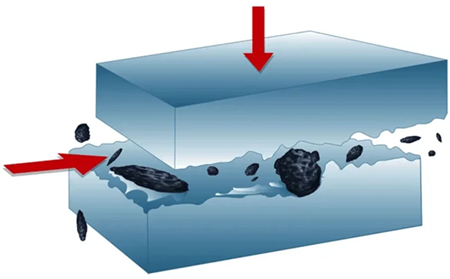
Particulate contamination between moving metal plates. Image Credit: Leica Microsystems GmbH
Automobile filter systems are particularly sensitive. In electronics, for example, contamination on printed circuit boards (PCBs) can result in short circuits, leading to system failure. Cleanliness is essential.
The following are discussed herein:
Introduction
Many automotive and electronics items require components and parts to remain dust-free throughout the manufacturing and assembly process. Particulate contamination can cause defects in components, lowering their performance and longevity.
When using components from different vendors, contamination of essential components for a vehicle or equipment could cause the entire system to fail. Effective cleanliness analysis processes must begin at the supplier level.
As a result, it is not surprising that both industries devote significant effort and resources to detecting and removing particles during component and product manufacturing. However, inefficient methods of maintaining technical cleanliness raise manufacturing costs.
In the automobile industry, residual contamination in fuel injection systems, filter systems for fuels, lubricants, and urea (selective catalytic reduction for emissions), pumps, engine and transmission control units, hybrid drive components, and other micromechanical components can have a significant impact on reliability and service life.1
In the electronics sector, component cleanliness is critical as small particles can raise the risk of failure for components with high power density. Components, such as printed circuit boards (PCBs), frequently have sub-micrometer gaps and nanoscale features.
Conducting particles, for example, can create shorts in PCBs by creating a direct conduction path between two contacts or by shortening the distance between them, increasing the likelihood of dielectric breakdown. 2,3
Electric cars (e-mobility) include both mechanical and electronic components, requiring technical cleanliness from both industries.4
This article will examine the essential criteria for successful cleanliness analysis and how to optimize the entire procedure.
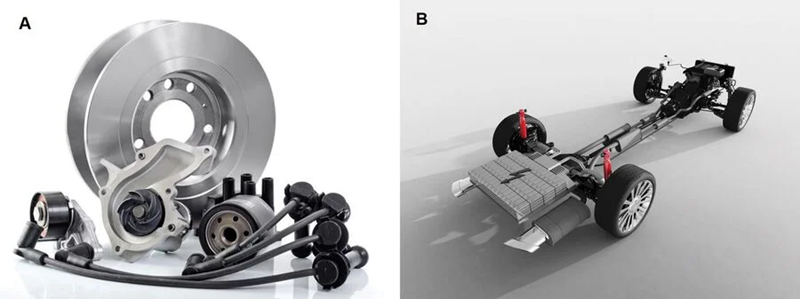
Figure 1. Technical cleanliness is important for parts and components used in the automotive and electronics industries: A) Various automotive parts, including a hub, filter cannister, pump, sparkplug cables, etc., and B) engine, drivetrain, suspension, wheels, and batteries of a hybrid vehicle showing both electronic and automotive components. Image Credit: Leica Microsystems GmbH
Specifications for Efficient Cleanliness Analysis
To achieve efficient, cost-effective cleanliness analysis, all parties engaged in production, i.e., component suppliers and product manufacturers, must agree on clearly defined parameters, which vary based on the product requirements.
Those engaged must determine what should be assessed, which criteria and norms are followed, and how results are best documented, among other things.1
Automated particle analysis is critical to developing an efficient cleanliness process. Optical microscopy is the widely used standard method for performing rapid automated analysis of extracted particles to evaluate their number, size, and other characteristics.1,5,6
Other techniques, such as particle counting or scanning electron microscopy, can produce results that differ from those obtained with optical microscopy because they use entirely different detection methods.5,6
Which Measurement Parameters are the Most Useful?
Particles are divided into various categories based on their dimensions (length, breadth, and height) and material properties. In general, particles made of carbides, metals, or ceramics, such as corundum (Al oxide), are hard and abrasive, but those made of plastics and other organic materials are soft and far less abrasive.
Metallic and semiconducting ceramic particles are also electrically conductive, posing a significant risk to electronic components.
Because of their grinding and abrasive character, hard particles (e.g., carbides, metals, ceramics, etc.) with a significant height are more likely to cause damage to vehicle components than long, soft plastic fibers.
Metallic particles have the highest conductivity in the electronics sector, and those larger than 200 µm are more likely to cause circuit board shorting.2
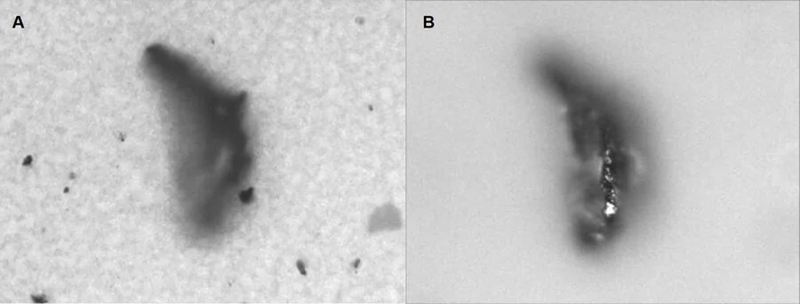
Figure 2. Particle height measurement with optical microscopy by focusing on the A) lower filter background and B) top of the particle. Image Credit: Leica Microsystems GmbH
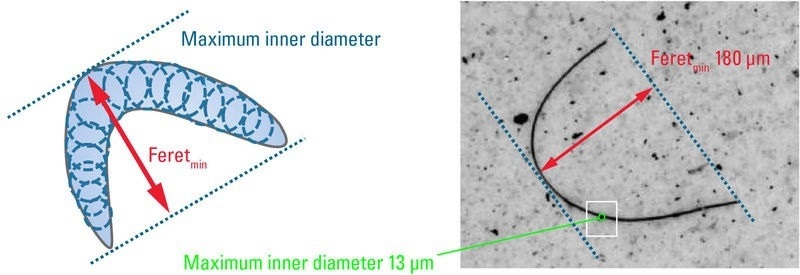
Figure 3. Width or length measurement of a curved fiber with optical microscopy. A more realistic assessment of its potential to cause damage is made using the maximum circular diameter, which can be imposed inside the fiber (13 µm). For this case, the minimum Feret diameter (Feretmin = 180 µm) is not appropriate, as it greatly overestimates the damage potential. Image Credit: Leica Microsystems GmbH
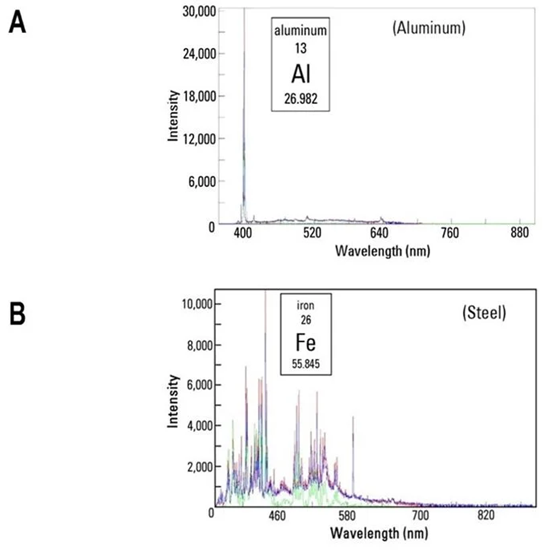
Figure 4. LIBS spectrum acquired during cleanliness analysis for a particle composed of: A) mainly aluminum (Al) and B) steel (mainly Fe). Image Credit: Leica Microsystems GmbH
International and Regional Cleanliness Standards
Standardized processes and methods enable producers and consumers to achieve consistent, dependable, and comparable cleanliness results.
In the automotive industry, the main standards are VDA 19.1 and ISO 16232, which provide accepted definitions and ranges of common parameters, such as particle class in terms of size and composition or threshold values for particle identification, used for cleanliness analysis.5,6
The VDA 19.1 standard states that, in addition to optical microscopy, other procedures such as SEM, energy dispersive spectroscopy (EDS), and laser-induced breakdown spectroscopy (LIBS) are required to accurately and definitely determine the source of particle contamination.5,7
LIBS is performed directly on the sample in air using an optical microscope, eliminating the need for time-consuming sample preparation and transport to other equipment for analysis.5,7
As a result, LIBS can detect particle composition faster than SEM/EDS, enabling more efficient identification of the contamination source.7
The ZVEI Guideline (ZVEI = German Electrical and Electronic Manufacturers' Association) titled "Technical Cleanliness in Electrical Engineering"3 is a popular source for cleanliness requirements in the electronics sector.
Optimal Cleanliness Analysis Workflow
The cleaning workflow for automotive components or parts consists of five major steps:5,6
- Cleaning/washing components.
- Filter cleaning solution to extract particles.
- Analyze particles on filters.
- Document particles based on their size and properties.
- Assess the potential risk to cause damage and identify contamination sources.
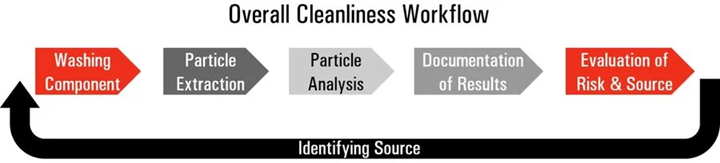
Figure 5. Cleanliness analysis workflow for automotive components. Image Credit: Leica Microsystems GmbH
For some sensitive electronic components, an acceptable level of technical cleanliness can only be achieved when production and cleaning take place in a clean room to reduce air pollution.2
For components less susceptible to contamination, a cleaning process can be performed at the end of production.2 Liquid spraying or solution washing removes residual particles from the component's surface. The liquid or solution is then filtered, dried, and the particles on the filter are examined.
The cleaning workflow for electronic components is similar to that of automobiles, with five basic steps:2,3
- Washing components with liquid sprays or solutions.
- Filtering sprayed liquids or cleaning solutions to extract particles
- Particle analysis on filters.
- Document particles depending on their size and properties.
- Assess the potential risk to cause problems.
Summary
Particulate contamination of automotive and electronics components or parts can be damaging, resulting in poor performance or early failure. Engine parts and filtration systems are two examples of automotive components.
In electronics, contamination on a printed circuit board (PCB) can result in short circuits. The demand for electric vehicles (e-mobility) has increased in recent years. Both industries must adhere to cleanliness practices when manufacturing them.
Technical cleanliness is obviously critical for quality control in current production processes. If several suppliers provide components or parts for production, an efficient and cost-effective cleanliness procedure must begin at the supplier level.
This article discusses the most significant aspects for efficient cleanliness analysis and workflow optimization.
References
- N. Ecke, Webinar: Basics in Component Cleanliness Analysis, Science Lab (2017) Leica Microsystems. Available at: https://www.leica-microsystems.com/fileadmin/academy/videos/webinars/2017-03-Basics_in_Component_Cleanliness_Analysis/LMS_Webinar_Basics_in_Component_Cleanliness_Analysis.pdf
- M. Kövi., J. Ji. (2020). Technical Cleanliness in Electronics Manufacturing. (online) Available at: https://ieeexplore.ieee.org/abstract/document/9273873.
- Technical Cleanliness in Electrical Engineering. Available at: https://www.zvei.org/fileadmin/fileadmin/user_upload/Presse_und_Medien/Publikationen/2020/Februar/ZVEI_Technische-Sauberkeit-in-der-Elektrotechnik_dt_engl/ZVEI_Guideline_Technical-Cleanliness-in-Electrical-Engineering_second-edition_Version-2020.pdf.
- VDA. (2022). VDA - German Association of the Automotive Industry (online). Available at: https://www.vda.de/en/topics/automotive-industry/standardization-and-technical-standards/Electromobility.
- VDA (2015) VDA 19.1: Inspection of Technical Cleanliness, Volume 19, Part 1, Particulate Contamination of Functionally Relevant Automotive Components, 2nd Revised Edition. Available at: https://webshop.vda.de/QMC/en/Volume-191.
- ISO 16232:2018, Road vehicles - Cleanliness of components and systems, International Organization of Standardization. (online) ISO. Available at: https://www.iso.org/standard/70267.html.
- J. DeRose, K. Scheffler, Cleanliness Analysis with a 2-methods-in-1 solution: See the particles and know their composition at the same time, Science Lab (2019) Leica Microsystems.
This information has been sourced, reviewed, and adapted from materials provided by Leica Microsystems GmbH.
For more information on this source, please visit Leica Microsystems GmbH.