High-performance polymers are widely used across a range of applications, from medical implants in the human body to satellites in orbit.
These durable polymers are specifically designed to retain their desirable mechanical, chemical, and thermal properties, even when subjected to harsh environments such as corrosive chemicals, high temperature, and high pressure.1,2,3
These highly beneficial characteristics have led to the use of high-performance polymers in an array of demanding applications, including defense, aerospace, renewable energy, electronics, and throughout the oil and gas industries.
High-performance polymers offer excellent strength-to-weight ratios and economic advantages over traditional materials such as aluminum and other metals, making them an ideal choice for many applications.
High-performance polymers must be customized to suit their specific use case; however, this must be done without causing polymer degradation.
Polymer degradation is an unwanted change in the polymer’s properties under the influence of one or more environmental factors, for example, chemicals, heat, light radiation, or applied force. Degradation typically occurs as the result of a change in the polymer’s chemical and/or physical structure, which in turn leads to a decrease in its desired properties.
A range of analytical methods can be used to test polymer products and their raw materials, with physical, thermal, rheological, and mechanical testing regularly utilized to ensure that materials meet quality requirements and comply with industry specifications.
The same analytical methods are applied to assess the stability and lifetime of high-performance polymers under conditions similar to, or even harsher than, those encountered in their applications.
Thermogravimetric Analysis (TGA) is a proven and respected method for the accelerated lifetime testing of polymers, with short-term experiments able to predict in-use lifetime by evaluating materials’ thermal and oxidative stability.
The combination of TGA with spectroscopic or chromatographic analysis of the decomposition products provides a more detailed understanding of the degradation mechanisms.
Standard TGA is generally performed at ambient pressure, using air or an inert atmosphere. High-performance polymer materials are especially suitable for applications under harsh conditions; however, this means that these materials must be tested under their respective service conditions to effectively evaluate their stability and durability. Example conditions could include flammable, explosive, and corrosive atmospheres as well as high pressures and steam.
Experimental
The experiment presented here used a Discovery HP-TGA 75 high-pressure TGA instrument. The HP-TGA 75 is suitable for the thermogravimetric analysis of up to 500 mg of sample material, offering a weighing resolution of 0.1 µg.
It is possible to control sample temperature from room temperature to 1100 °C, with heating or cooling rates of up to 200 K/min applied as required.
All Discovery HP-TGA series instruments feature the additional capability to control the reaction atmosphere’s pressure from vacuum to 80 bar (1160 psi). Users can switch between three reaction gases during a measurement, enabling them to study reactivity under different gas atmospheres.
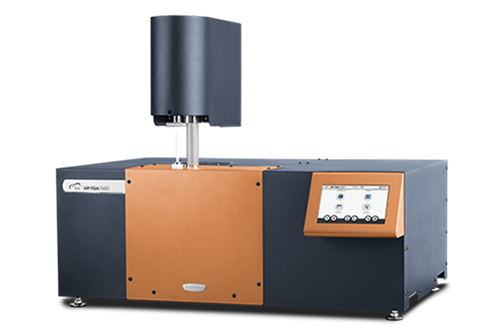
Figure 1. TA Instruments fully integrated benchtop HP-TGA instrument Discovery HP-TGA. Image Credit: TA Instruments
In this case, an argon atmosphere was used for thermal degradation testing at various pressures. An argon gas cylinder with purity grade 4.5 (>99.995 %) (Linde Gas) was utilized as reaction gas, while hydrocarbon-free synthetic air (21 % O2 in N2) was used as reaction gas for measurement of oxidative stability.1,2,3
Results and Discussions
FKM is a family of fluorocarbon-based fluoroelastomer materials that is outlined in the ASTM International standard D1418.1 FKMs were originally developed by DuPont but are now produced by many different companies.
Fluoroelastomers offer improved heat and chemical resistance versus neoprene or nitrile rubber elastomers. Every FKM contains vinylidene fluoride as a monomer,2 and FKMs can be divided into classes based on their chemical composition, cross-linking mechanism, or fluorine content.
Polymers of this type are considered relatively temperature-resistant and chemically inert, making them widely used in the automotive, aerospace, chemical, and energy industries.
Diaphragms, hoses, accumulator bladders, gaskets, O-rings, and seals are all made from FKMs, many of which are required to operate in particularly harsh environments.3
FKMs’ typical service temperature ranges from -20 °C to 230 °C, but they can withstand 300 °C for a short time. FKMs are weak at high service temperatures; however, the design must prevent any high loads.
FKMs have been in use for decades, so the material’s thermal and chemical stability has already been extensively tested. The influence of pressure on the material’s degradation has not been well studied thus far, however.
This article looks at the use of a high-pressure TGA in studying the impact of pressure on the thermal stability and oxidative stability of a commercial FKM.
Influence of Pressure on FKM’s Thermal Stability
Approximately 20 mg of FKM sample material housed in an alumina (Al2O3) sample cup with 90 µl volume was placed in the Discovery HP-TGA. The reaction atmosphere was argon, and the samples’ thermal stability was tested by heating to 1100 °C at a linear rate of 5 K/min.
An identical temperature profile was employed in three tests to study the influence of pressure on the decomposition. These different pressures were 1 bar (= ambient pressure), 40 bar (580 psi), and 80 bar (1160 psi).
Figure 2 plots the TGA weight data for the three tests as a function of sample temperature. The FKM material decomposes in three steps at all pressures, with the steps’ decomposition temperatures dependent on the pressure of the inert argon atmosphere.
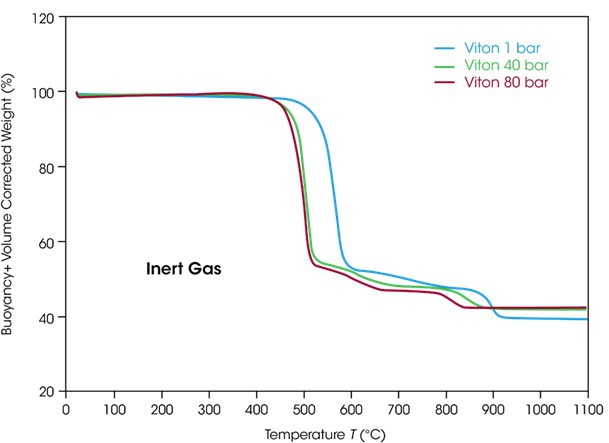
Figure 2. TGA analysis of the thermal decomposition of FKM in argon at three different pressures. Image Credit: TA Instruments
Table 1 summarizes the temperatures of the decomposition steps for each pressure. It was observed that FKM decomposition occurred at lower temperatures as pressure increased from ambient to 40 bar.
Temperature differences ranged from 7 % to 11 % across the different decomposition steps. It was also noted that the decomposition temperatures did not change significantly from 40 bar to 80 bar.
Table 1. Onset temperatures of FKM decomposition in argon atmosphere at different pressures. Source: TA Instruments
| Pressure |
1 Bar |
40 Bar |
80 Bar |
| Step 1 |
515 ºC |
457 ºC |
453 ºC |
| Step 2 |
654 ºC |
556 ºC |
544 ºC |
| Step 3 |
822 ºC |
773 ºC |
743 ºC |
A common finding in high-pressure thermal stability testing is that decomposition temperatures vary across the different steps. For example, the temperature of the first step is 7 % lower at high pressure than at ambient pressure, but the change in the second step is 10 % and the change in the third step is only 4 %.
A further typical finding in high-pressure TGA is that the material’s residual weight following decomposition is higher at higher pressure. This is due to the higher resistance of volatile components in the sample as they evaporate into the higher-pressure gas atmosphere.
One notable insight from high-pressure TGA testing of FKM’s thermal decomposition behavior is that the material degrades at lower temperatures as pressure increases. This finding is especially relevant to applications where FKM is applied as a sealing material at high pressures.
Influence of Pressure on FKM’s Oxidative Stability
Approximately 20 mg of FKM sample material in an alumina (Al2O3) sample cup with 90 µl volume was analyzed in the Discovery HP-TGA to test FKM’s oxidation stability. The reaction atmosphere was synthetic air, and the sample’s thermal stability was tested by heating to 1100 °C at a linear heating rate of 5 K per minute.
An identical temperature profile was utilized in three tests at different pressures to study the influence of pressure on the oxidative decomposition. These pressures were 1 bar (= ambient pressure), 40 bar (580 psi), and 80 bar (1160 psi).
Figure 3 plots the TGA weight data for the three tests as a function of sample temperature. It was noted that decomposition at ambient pressure in air is similar to that in argon, confirming FKM's stability against oxidative decomposition.
The decomposition changes, however, when the pressure is elevated. At 40 bar and 80 bar, it was observed that the oxidative decomposition of FKM in air took place at much lower temperatures than in argon. FKM’s oxidative stability was determined to be lower in cases where the pressure was higher.
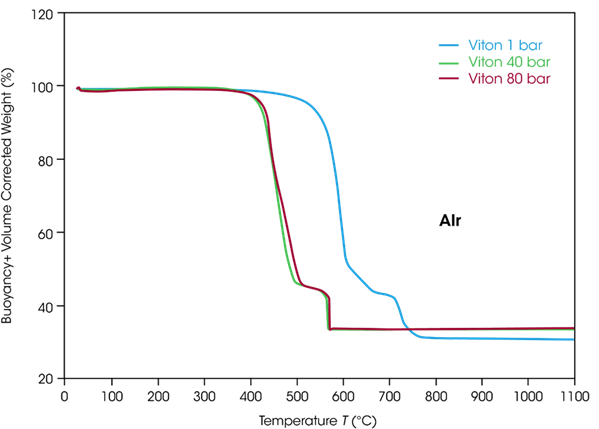
Figure 3. TGA analysis of the thermal decomposition of FKM in air at three different pressures. Image Credit: TA Instruments
There is a 7 % difference between the decomposition temperature for the first step in argon at low and both of the higher pressures. In air, however, the temperature difference at 40 bar is already 13 % while at 80 bar this is 17 %.
Oxidation appears to be more accelerated than thermal decomposition as pressure increases, and there is also a difference between the oxidative decomposition at 40 bar and at 80 bar. This was also the case when investigating thermal decomposition in argon.
High-pressure TGA testing revealed FKM’s oxidative decomposition behavior, showing that the material degrades at lower temperatures if the pressure is increased, with this trend continuing when pressure is further increased. It is important to consider this if FKM is to be applied as a sealing material in high-pressure oxidative applications.
Conclusions
A commercial FKM material’s thermal and oxidative stability was determined to be highly dependent on the pressure of the applied reaction atmosphere.
For example, thermal decomposition begins at elevated pressures at temperatures of up to 10 % lower than ambient pressure, while oxidative degradation begins at higher pressures at up to 17 % lower temperatures than ambient pressure.
These findings highlight the importance of testing high-performance polymers destined for use under harsh conditions for lifetime and stability against thermal and oxidative decomposition, ensuring that these tests match application-relevant conditions.
If the material is expected to be subjected to high pressure, its stability must also be tested under high pressure to ensure adequate performance without unwanted decomposition.
Discovery HP-TGA is an easy-to-use, powerful high-pressure TGA designed to perform these tests with minimal additional effort compared to running a standard TGA experiment.
References and Further Reading
- ASTM. (2021). Standard Practice for Rubber and Rubber Latices - Nomenclature. (online) Available at: https://store.astm.org/d1418-21.html.
- Jiri George Drobny (2016). Fluoroelastomers Handbook : The Definitive User’s Guide. Amsterdam Elsevier. (online) Available at: https://shop.elsevier.com/books/fluoroelastomers-handbook/drobny/978-0-323-39480-2.
- Plastics Technology. Plastics Technology. (online) Available at: https://www.polymerdatabase.com/.
Acknowledgments
Produced from materials originally authored by Dr. Thomas Paschke, Product Marketing Specialist at TA Instruments, Inc.

This information has been sourced, reviewed and adapted from materials provided by TA Instruments.
For more information on this source, please visit TA Instruments.