Ever wondered what molecules stick around in your breath after eating candy? Ionicon’s applied science team recently took a closer look at the flavor chemistry behind its merchandise gummy bears – known as "Ioni-bears" – by analyzing the compounds in breath samples after chewing different colors and flavors.
With their high-tech tool, the Fusion-PTR-TOF 10, the scientists closely assessed the volatile organic compounds (VOCs) released into breath. Their aim was to understand which exact molecules produce each bear’s distinct fruity flavors, and how to track them in real time.
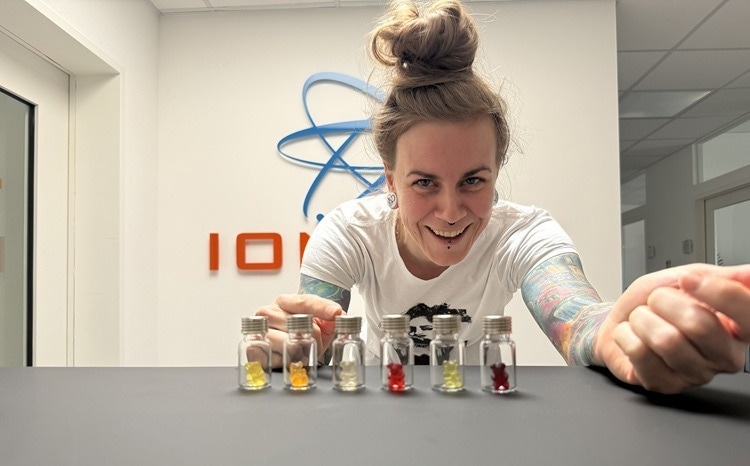
Image Credit: IONICON Analytik
The Sweet Lineup
Ionicon Analytik’s Ioni-bears are available in six vivid colours, each equipped with a distinct flavor profile. The experiment adhered to a carefully designed protocol: participants initially provided three blank breath samples to generate a baseline.
They then chewed one Ioni-bear and exhaled five times for their breath to be analyzed. After rinsing their mouth with water (verified via two additional blank measurements), they chewed an Ioni-bear of a different flavor and once again, provided five breath samples. This cycle – chew, assess, rinse, and repeat – was continued until all flavors had been assessed.
The measurement ultimately identified key molecular ions that make each Ioni-bear flavor distinct from others. These ions are the flavor molecules’ protonated form, seen in the participant's breath.
Below are some of the chemical signatures for certain bears:
- Yellow Bear (Lemon): C3H6O2·H+, C7H6.H+, C7H6O.H+
- Red Bear (Raspberry): C6H12O2.H+, C7H14O2.H+, C8H16O2.H+, C10H10O2.H+
- Orange Bear (Orange): C6H8.H+, C7H6.H+, C6H12O2.H+, C10H16.H+
- Black Bear (Grape): C2H6O.H+, C4H6O.H+, C5H4O2.H+
- Clear (Pineapple): C2H6O.H+, C7H6.H+, C5H4O2.H+, C10H16.H+
- Green Bear (Apple): C2H6O.H+, C4H6O.H+, C4H8O2.H+, C5H4O2.H+
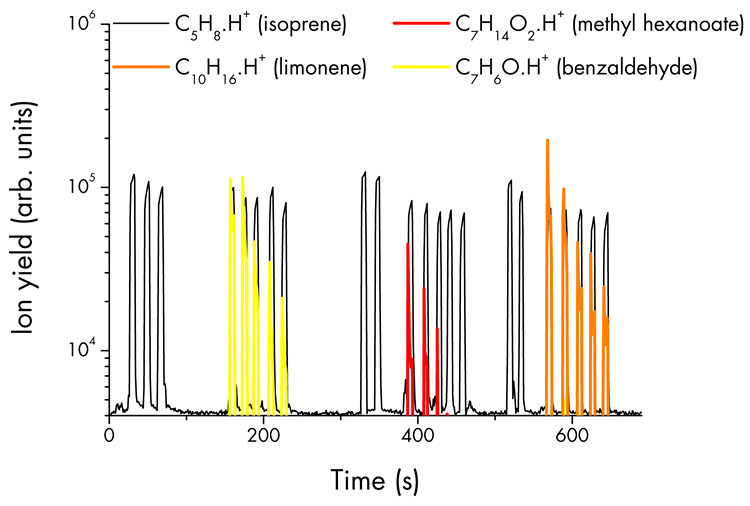
Figure 1. Excerpt of the breath-profile curves showing exhaled air after consuming three different Ioni-bears (yellow, red, and orange). Image Credit: IONICON Analytik
Interpreting the Molecular Fingerprints
The detected molecules provide insights into the ingredients that give the candy its flavor. These results demonstrate how the Ioni-bears’ unique flavors translate directly into chemical signatures in breath.
The analysis provides great insight into how these treats are formulated, showing how flavor chemists make use of specific molecules, from fruity esters and monoterpenes to added acidifiers, to generate the most enticing flavor profile.
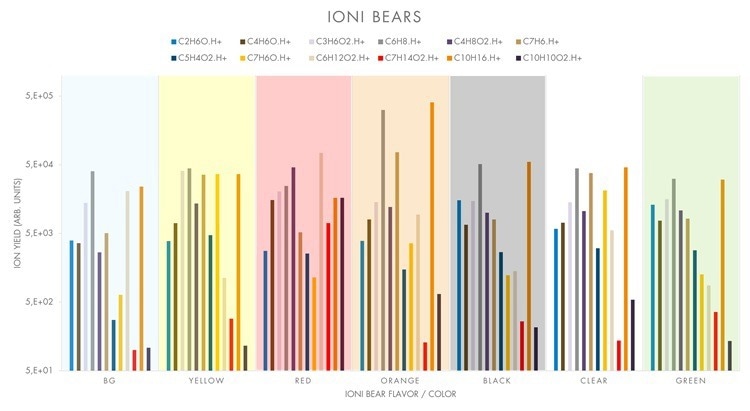
Figure 2. Key markers and characteristic differences among the various Ioni-bear flavors (mean values averaged over 5 breath cycles). Image Credit: IONICON Analytik
Food, Flavor, and Fragrance
Ionicon Analytik’s FUSION PTR-TOF tools are ideal for the food, flavor, and fragrance industries, where advanced scientific insights are critical.
PTR-MS with high mass resolution enables precise separation of isobaric compounds. This makes it ideal for assessing the complex aromas of food, beverages, and other products. This technology enables the non-invasive detection of trace compounds without extensive sample preparation, something crucial for understanding subtle variation in quality, authenticity, and sensory impact.

This information has been sourced, reviewed, and adapted from materials provided by IONICON Analytik.
For more information on this source, please visit IONICON Analytik.