The amount of space debris littering the Earth’s orbit is nearing critical mass. To mitigate collision risk with this space pollution, orbital operations depend on Space Situational Awareness (SSA).
However, current propagation models, which rely on Two-Line Element (TLE) sets, are facing a major data deficit.
Satellites are tracked using TLE, a standardized data format that tracks the orbital position and velocity of space objects at a particular moment in time. While TLEs are useful for general tracking, they lack the ability to accurately identify an object’s specific physical characteristics.
Precision orbit prediction necessitates accurate modelling of non-gravitational forces, particularly atmospheric drag and solar radiation pressure.1 These forces are non-linear and, to a large extent, depend on the object’s size, shape, and orientation. These parameters remain typically unknown for space debris and non-functional satellites.2
Without precise “characterization” data, tracking a satellite’s position can be extremely difficult as it veers from its predicted path.
The Physics Problem: Why Adaptive Optics is Mandatory
The Earth’s atmosphere is an ever-changing, turbulent system. Ground-based optical telescopes go some way to helping characterize space debris, but the Earth’s atmosphere can be a limiting medium for making observations.
Even with the placement of telescopes in high altitude areas to counter atmospheric turbulence, they still have to contend with the upper atmospheric layers. Fluctuations in temperature and wind shear generate variable pockets of air with distinct refractive indices for each.
As light emissions from a satellite travel through these turbulent pockets, distortions in the wavefront occur.
This turbulence effectively destroys the theoretical resolution of a large aperture telescope (e.g., one meter). While the telescope is in theory “diffraction-limited” (resolution characterized by λλ/DD ), the atmosphere reduces it to the “seeing limit” (characterized by the Fried parameter, rr0 ).1
In practice, a complex, multi-panel satellite is reduced to a blurry, inconsistent blob, making precision identification unworkable.
The Solution: Recovering the Diffraction Limit
Adaptive Optics (AO) systems resolve this issue by correcting the measured wavefront distortion in real-time thanks to deformable mirrors.2 The AO system runs at extreme speeds due to atmospheric changes that occur millisecond by millisecond.
To “freeze” and correct the turbulence, a closed-loop function, which runs at kilohertz (kHz) rates, is absolutely necessary.
The Enabling Technology: OCAM2K as the WFS Engine
The sensitivity and speed of the Wavefront Sensor (WFS) camera in an adaptive optics system determine overall performance. In SSA applications, where targets are typically fast-moving and faint (magnitude 10 or dimmer), the WFS camera must function efficiently without introducing latency or noise in a photon-starved regime.
Some of the world’s foremost research institutions, including the Korea Astronomy and Space Science Institute (KASI) and the Australian National University (ANU), have been able to solve this particular engineering challenge by introducing standardization on the Andor OCAM2K.
By leveraging three of the OCAM2K’s unique capabilities, KASI and ANU have been able to transform their telescopes into precision instruments:
- Speed for “freezing” turbulence: by outpacing the Greenwood frequency of the atmosphere, the OCAM2K is able to measure distortion through a controlled loop before it changes, thanks to a frame rate of 2,067 Hz.1,2 The Greenwood frequency determines the optimal correction for an AO system and takes into consideration wind speed and atmospheric drift.
- Sensitivity for faint targets: Using EMCCD technology, the camera is able to achieve sub-electron readout noise (< 0.3 e-). This facilitates the tracking of faint debris that would otherwise be lost in the noise floor of conventional CCD or CMOS sensors.2
- Zero-latency feedback: the OCAM2K optimizes the error rejection bandwidth owing to its latency of just 43 µm, which ensures the Deformable Mirror correction is applied immediately.2
Use Case 1: KASI Geochang Observatory
Benefit: Precision Orbit Prediction via Sharper Imaging
The Korea Astronomy and Space Science Institute (KASI) designed an AO system that was developed for its 100 cm telescope, which is used for the imaging of space objects at altitudes up to 1,000 km.
KASI’s main objective was to clearly identify the “size, shape, and orientation” of debris to enhance ballistic coefficient estimation.2
KASI saw measurable operational improvements using the OCAM2K to guide the object itself in Natural Guide Star mode.
Notes on Natural Guide Star Mode: Conventional AO typically depends on the close proximity of a bright star or, alternatively, a laser beacon to measure atmospheric distortion. However, when put in “Natural Guide Star” mode, the system leverages the sun’s natural light bouncing back off the target satellite itself as the reference point. This means the system can track objects even if there is a dearth of nearby stars.
- 5x resolution improvement: When compared to uncorrected images, the system enhances stellar profile sharpness (Full Width at Half Maximum) by a factor of 5.2
- Diffraction-limited performance: The system captured images close to the telescope’s diffraction limit, transforming a blur into a resolved point source.2
- Operational impact: With the capacity to determine the geometry of debris, KASI can enter accurate physical parameters into dynamic models, significantly boosting the predictability of collision warnings.2
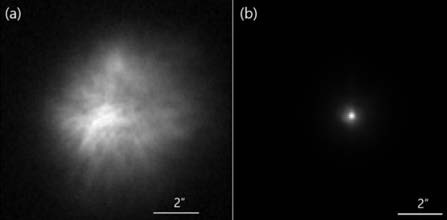
Figure 1. Comparison of stellar object imaging.2 (a) Without AO correction. (b) With AO correction enabled. The stellar object appears to be better resolved in the image thanks to the AO system. Image Credit: Hyung-Chul Lim et al., KASI / ANU
Use Case 2: ANU “AOI” System
Benefit: Object Identification and Characterization
The Australian National University (ANU) used its “Adaptive Optics Imaging” (AOI) system on a 1.8 m telescope to characterize LEO and GEO satellites. The ANU research team believed that the OCAM2K would be the “ideal choice” for the WFS, noting that “no other camera is capable of the same performance.”1
The system demonstrated its worth when imaging Cosmos 1656, a defunct Tselina-2 satellite:
- From “blob” to “structure”: In an open loop, the satellite was deemed unrecognizable. Using OCAM2K to close the loop, the system was able to resolve specific features, including the satellite’s body, gravity boom, and panel array.1
- Precision tracking: The system demonstrated a reduction in image jitter by a factor of 5 (from 43 to 0.08 arcseconds). This allowed for astrometric tracking of the object’s location.1
- Enhanced post-processing: OCAM2K’s high frame rate gave the team the ability to capture thousands of frames per second, allowing for Multi-Frame Blind Deconvolution (MFBD). This computational technique enhanced the image further. The team were then able to measure the satellite’s panels within meters of its presumed proximity.1
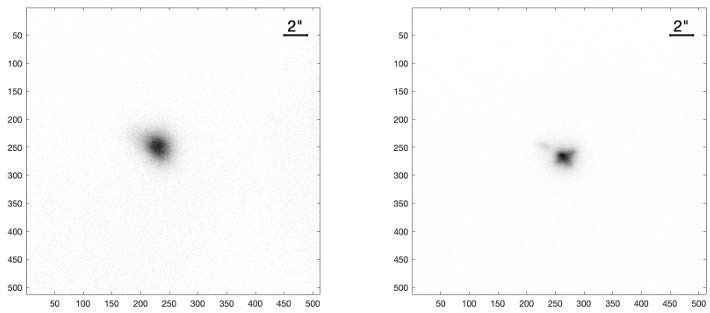
Figure 2. Adaptive Optics Correction of the Cosmos 1656 satellite1. Left: Uncorrected open-loop image. Right: Closed-loop image using the OCAM2K-driven WFS, resolving the solar panel array and body structure. Image Credit: Michael Copeland, ANU
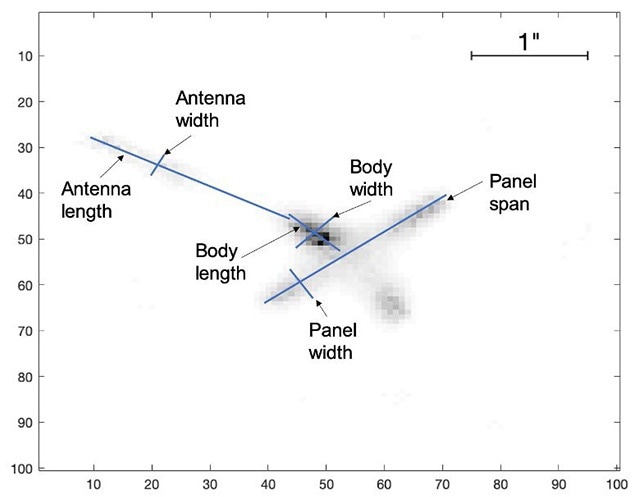
Figure 3. Cosmos 1656 image: shape and angular/physical size analysis. Image Credit: Michael Copeland, ANU
Conclusion
For Space Situational Awareness (SSA), the difference between a common alert and a precise collision avoidance maneuver comes down to the capacity to resolve a satellite’s geometry. As both KASI and ANU’s use cases have demonstrated, Andor’s OCAM2K can be considered the leading technology for facilitating high-bandwidth Adaptive Optics. By combining 2 kHz speed, near-zero latency, and sub-electron noise, SSA systems are now able to beat the Earth’s atmosphere by reducing distortion while protecting key space assets.
References and Further Reading:
- Copeland, M. (2020). Satellite and Debris Characterisation with Adaptive Optics Imaging. (online) Australian University . Available at: https://openresearch-repository.anu.edu.au/items/e41713ca-a9a0-426d-93ac-81dd90a4ba5b.
- Lim, H.-C., et al. (2024). Development of Adaptive Optics System for the Geochang 100 cm Telescope. Journal of Space Technology and Applications, (online) 4(3), pp.185–198. DOI: 10.52912/jsta.2024.4.3.185. https://www.jstna.org/archive/view_article?pid=jsta-4-3-185.

This information has been sourced, reviewed, and adapted from materials provided by Oxford Instruments Physics.
For more information on this source, please visit Oxford Instruments Physics.