The most recent jet fuel specifications, ASTM D1655 and D7566, now permit flash point determination using eralytics’ eraflash flash point testers.
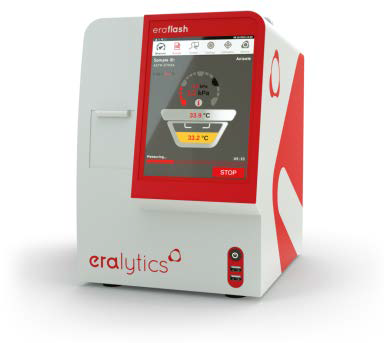
Image Credit: eralytics GmbH
Introduction
Since the early attempts of the Wright Brothers around 1900, aviation has developed substantially. Today's society depends heavily on modern aviation, with countless aircraft performing a broad range of applications in freight, passenger travel, and national defense.
Regardless of their specific size or application, most aircraft are powered by gas turbine engines. These engines operate on aviation turbine fuel, also known as jet fuel, which is generally traded for civil use under the names "Jet A" or "Jet A-1." In recent years, synthetic fuels have also been utilized, either pure or in blends coming from various production processes based on biogenic or crude oil-based raw materials.
Standardization
Product quality and compliance with guidelines and standards are essential for these critical products. The ASTM D1655 – 25a standard is one of the most relevant product specifications for Jet A/A-1. The main technical difference between the more popular Jet A-1 and Jet A, which is primarily used in the United States of America, is their freezing points. Jet A-1 has a lower freezing point of -47 °C compared with Jet A. On the other hand, fully or partially synthetic aviation fuels are specified according to ASTM D7566 – 25a.

Image Credit: eralytics GmbH
In addition to technically relevant parameters, safety is fundamental in the aviation sector. This includes the flash point, which must not fall below 38 °C (100 °F) in either standard. The limit value of 38 °C was established for aviation to ensure safe handling, fire safety, and proper combustion.
In the guidelines for the transport of dangerous goods (ADR) and the GHS classification and labeling system, this value has no direct equivalent and does not correspond to a typical limit value. As a result, Jet A/A-1 is classified as UN 1863, defined as a flammable liquid (Class 3) with a flash point ≤ 60 °C and is labeled accordingly with GHS02.
Flash Point Determination
The reference test technique for flash point determination according to these specifications is the ASTM D56 Tag Closed Cup (TAG). This technique is similar in apparatus and measurement procedure to the Pensky-Martens (PM) flash point tester according to ASTM D93.
The TAG technique is typically employed for flash points below the PM measurement range, which applies to Jet A/A-1 with 38 °C (100 °F). With the latest version "25a" of ASTM D1655 and ASTM D7566, published in mid-January 2026, all eraflash flash point testers from eralytics can now also be utilized for jet fuel specification. These advanced flash point testers adhere to ASTM 7094 Flash Point by Modified Continuously Closed Cup (MCCCFP) Tester.
Unparalleled Measurement Precision
As part of standardization efforts and preparation for this significant normative enhancement, the high measurement precision of ASTM D7094 was once again confirmed through the inclusion of aviation turbine fuels.
Conducted in 2022 (RR-D02-2086), the most in-depth flash point interlaboratory study (ILS) to date involved 20 labs and 1000 measurements across a wide variety of materials, including aviation turbine fuels, diesel, biodiesel blends, lubricants, and chemicals. The results depicted in Figure 1 demonstrate that ASTM D7094 delivers superior reproducibility across all tested materials and temperature ranges.
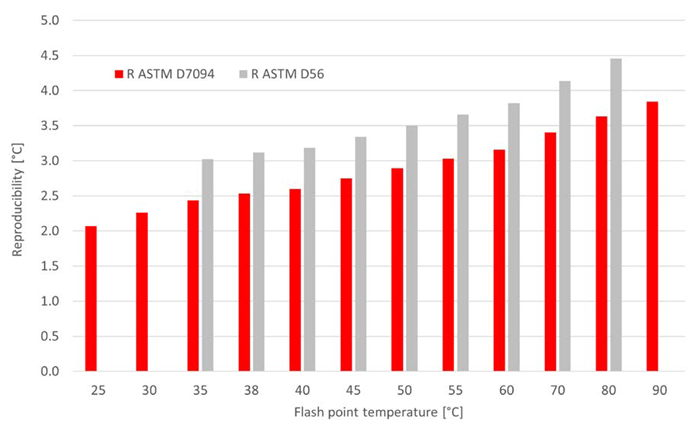
Figure 1. Reproducibility for ASTM D7094 as reported in the research report RR-D02-2086. The corresponding values for ASTM D56 were obtained from ASTM D56-22. Image Credit: eralytics GmbH
| Material |
Flash Point [°C] |
ASTM D7094 R [°C] |
ASTM D93 R [°C] |
ASTM D56 R [°C] |
| Jet fuels |
40 |
2.6 |
2.8 |
3.1 |
Figure 2. Summary of reproducibility (R) for jet fuel according to typical standards. Image Credit: eralytics GmbH
Conclusion
The recently updated ASTM specifications now permit the alternative use of measuring instruments from the eraflash family for specifying the flash point of jet fuel. These analyzers, which are superior in multiple respects, enable modern flash point determination for all user groups. The eraflash flash point testers, in accordance with ASTM D7094, combine the advantages of this advanced technique:
- Superior accuracy across the full temperature range, including for contaminated samples
- Inherent safety due to the absence of open ignition sources, removing fire hazards
- Measurement times twice as fast as ASTM D56 through the use of eralytics PBT® - Peltier Boost Technology
- Minimal sample volume (only 2 mL), reducing hazardous waste and minimizing follow-up time
References and Further Reading
- ASTM D56 – 22 Standard Test Method for Flash Point by Tag Closed Cup Tester. (online) Available at: https://store.astm.org/d0056-21a.html.
- ASTM D93 – 25 Standard Test Methods for Flash Point by Pensky-Martens Closed Cup Tester. (online) Available at: https://store.astm.org/d0093-20.html.
- ASTM D1655 – 25a Standard Specification for Aviation Turbine Fuels. (online) Available at: https://store.astm.org/d1655-25a.html.
- ASTM D7094 – 25 Standard Test Method for Flash Point by Modified Continuously Closed Cup (MCCCFP) Tester. (online) Available at: https://store.astm.org/standards/d7094.
- ASTM D7566 – 25a Standard Specification for Aviation Turbine Fuel Containing Synthesized Hydrocarbons. (online) Available at: https://store.astm.org/d7566-25a.html.
- RR-D02-2086 Research report: Interlaboratory study was conducted by 20 laboratories testing 25 samples to establish an updated precision statement for test method D7094

This information has been sourced, reviewed and adapted from materials provided by eralytics GmbH.
For more information on this source, please visit eralytics GmbH.