Viscosity is considered the most important physical property for lubricants, irrespective of their origin, use, or technical purpose. Viscosity is the measure of internal friction of a liquid or the resistance to flow at a certain temperature.
Viscosity classes play a major role in lubricants for technical reasons and during the purchasing process. For example, industrial lubricants are identified by their ISO viscosity grades, with an ISO VG 46 featuring a nominal kinematic viscosity of 46 mm2 per second at 40 °C with a typical tolerance of ±10 %.
The kinematic viscosity specification is expected to be understood by industry professionals. For instance, an engineer discussing an "SN 100" is referring to mineral base oil with a kinematic viscosity of 100 mm2 per second at 40 °C.
The Differential Pressure Capillary Method
Viscosity is a fundamental and widely used property, which means there are a number of different viscosity measurement devices currently available on the market. The majority of these devices used the ‘glass-capillary’ method, which the ASTM D445 standard considers the classic approach.
Z-shaped capillaries are also often used. According to ASTM D7279, these devices operate on a similar principle and are also known as Houillon viscometers.
The key measurement obtained by these devices is the time required for a specified volume to flow out of the capillary under gravity. Kinematic viscosity is derived due to the resulting viscosity also being influenced by the sample’s mass.
In contrast, a rotational measurement principle can be used to measure dynamic viscosity. This method is outlined in the ASTM D7042 method, and is known as the ‘Stabinger principle’ after its inventor. An attached density tube also allows the sample density to be determined at the measurement temperature. This is the linking factor between dynamic and kinematic viscosity.
A newly developed technique was recently introduced. This technique also employs a capillary, but the driving force is a small differential pressure that pushes the sample out.
The capacity to precisely and high-resolution determine pressure drop over time has enabled this innovative new method, which can be summarized as the “differential pressure capillary method.” This physical principle results in the kinematic and dynamic viscosity.
An independent density cell is connected in parallel with the viscosities. This approach delivers a 5-digit density value at an individual temperature between 15 °C and 100 °C and is used to optimize the measured precision of kinematic viscosity. This is important because current measurements lead to an overdetermined parameter set that can be used in this optimization.
It is possible to characterize the techniques described here as representative examples of precise, automated viscometers. All these principles offer specific advantages and disadvantages, however.
Eralytics, a laboratory analysis device manufacturer based in Vienna, Austria, has launched its ERAVISC X kinematic viscometer. This is the first device on the market to leverage the novel differential-pressure capillary method.
Professionals typically require a combination of the highest measurement precision, flexibility in measurement temperature, and applicability across different products.
The table below summarizes these key properties:
Source: eralytics GmbH
|
Differential pressure capillary |
Glass
capillary |
Houillon (S-flow capillary) |
Stabinger principle |
| Standard |
ongoing |
ASTM D445 |
ASTM D7279 |
ASTM D7042 |
Fundamental measured
properties |
Kinematic & dynamic
viscosity & density |
Kinematic viscosity |
Kinematic viscosity |
Dynamic viscosity &
density |
| Precision |
High |
Highest |
Moderate |
High |
Flexible measurement
temperature |
Yes |
No |
No |
Yes |
| Measurement speed |
High |
Moderate |
Highest |
High |
| Combined density |
Yes |
No |
No |
Yes |
| Sample volume |
Low |
Moderate |
Lowest |
Low |
Comparison Study
Questions understandably arise regarding new measurement methods’ precision and comparability with existing methods. These questions prompted a comparability study completed in partnership with an industry partner and an independent research institute.
A total of 42 representative oil samples were compared in this study. This involved a mix of gear oils, engine oils, and hydraulic fluids, both mineral oil and ester-based, and with a maximum kinematic viscosity at 40 °C up to 500 mm2 per second. The sample matrix was comprised of in-service oils, fresh oil samples, and artificially aged oil samples.
The chart below highlights the correlation between kinematic viscosities at 40 °C measured with the ERAVISC X and those measured in accordance with ASTM 7042.
These measurement results are clearly comparable, with a maximum statistical difference of 1.2 % and an average absolute difference of just 0.4 %. There is obvious positive confirmation when comparing these figures with the typical reproducibility outlined in current standards.
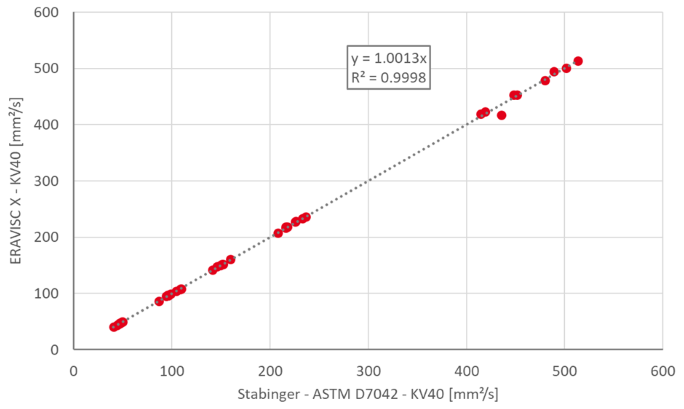
Image Credit: eralytics GmbH
Conclusion
Various measurement technologies are available in the field of lubricant viscometry, with most delivering highly precise results. These technologies are typically inflexible in terms of their ability to perform measurements at changing measurement temperatures, however.
The ERAVISC X viscometer uses a new technical approach, the differential pressure capillary method, to combine the established methods’ capacity for direct, highly accurate measurement of kinematic viscosity.
This novel approach enables laboratories to use a contemporary alternative for the flexible analysis of viscosity and density when working with base oils and lubricants.
Acknowledgments
Produced from materials originally authored by eralytics GmbH.

This information has been sourced, reviewed, and adapted from materials provided by eralytics GmbH.
For more information on this source, please visit eralytics GmbH.