Olive Oil Quality and Fraud Screening Using Near-Infrared Spectroscopy (NIRS)

The quality of olive oil depends on various factors, such as the olive variety, the production process, and the time spent processing olives after harvest. Due to its high price point, virgin olive oil is a particularly vulnerable target in food fraud. A myriad of parameters are used to determine oil quality, including iodine value, refractive index, fatty acid composition, free fatty acids (FFA), and aging indicators such as peroxide value (PV), K232, and induction time.

Legacy analysis techniques for testing olive oil, such as gas chromatography (GC) and titration, often require hazardous solvents, which can pose health risks and increase laboratory costs. In contrast to these traditional methods, analyzing olive oil using near-infrared spectroscopy (NIRS) helps reduce costs and increase productivity, providing quick results for olive oil quality control.

Experimental Equipment

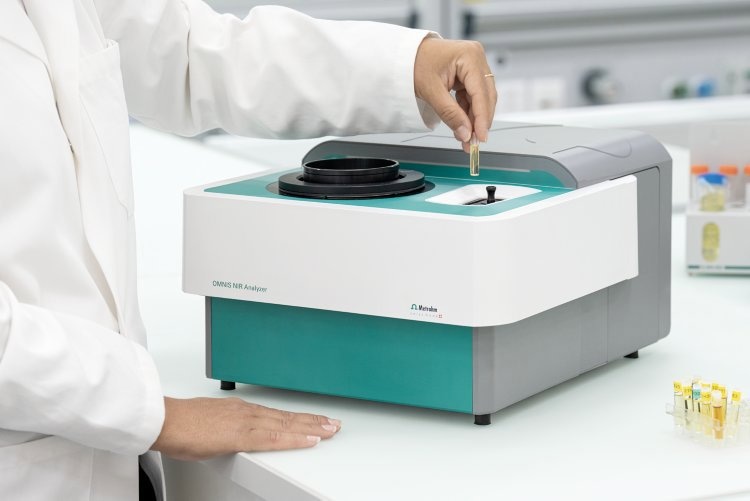
The OMNIS NIR Analyzer and a sample filled in a disposable vial

Figure 1. The OMNIS NIR Analyzer and a sample filled in a disposable vial. Image Credit: Metrohm Middle East FZC

A total of 137 olive oil samples of varying quality were measured using the OMNIS NIR Analyzer Liquid (Figure 1) in transmission mode (1000–2250 nm), using 8-mm disposable vials.

The vial temperature was set at 40 °C and monitored with the built-in vial sensor to ensure consistent measurement performance. All data acquisition and prediction model development was gathered using the OMNIS software.

Results

The acquired NIR spectra (Figure 2) were employed to develop a prediction model for quantifying all parameters: FFA, iodine value, K232, PV, refractive index, induction time, stearic acid (C18:0), oleic acid (C18:1), palmitic acid (C16:0), linoleic acid (C18:2), and alpha-linolenic acid (C18:3).

The quality of the prediction models was evaluated using correlation diagrams (Figures 3–8), which showed high correlation between NIR predictions and the standard reference methods for all parameters.

Of the 137 samples measured, 75% were selected as the calibration set and 25% as the validation set. The respective figures of merit (FOM), shown for the following figures and in Table 1, show the expected precision, confirming its feasibility during routine analysis.

NIR spectra of olive oil samples analyzed on an OMNIS NIR Analyzer Liquid with 8 mm vials

Figure 2. NIR spectra of olive oil samples analyzed on an OMNIS NIR Analyzer Liquid with 8 mm vials. Image Credit: Metrohm Middle East FZC

Result Iodine Value

Correlation diagram and the respective FOMs for the prediction of iodine value in olive oil. Lab values were evaluated using GC

Figure 3. Correlation diagram and the respective FOMs for the prediction of iodine value in olive oil. Lab values were evaluated using GC. Image Credit: Metrohm Middle East FZC

Source: Metrohm Middle East FZC

Parameter SEC (mg/100 g) SECV (mg/100 g) SEP (mg/100 g) R2CV
IV 0.38 0.40 0.38 0.974

Result K232

Correlation diagram and the respective FOMs for the prediction of K232 in olive oil. UV analysis was used to obtain the lab values

Figure 4. Correlation diagram and the respective FOMs for the prediction of K232 in olive oil. UV analysis was used to obtain the lab values. Image Credit: Metrohm Middle East FZC

Source: Metrohm Middle East FZC

Parameter SEC SECV SEP R2CV
K232 0.067 0.086 0.090 0.864

Result C16:0 Fatty Acid Content

Correlation diagram and the respective FOMs for the prediction of C16:0 content in olive oil. Lab values were evaluated using GC

Figure 5. Correlation diagram and the respective FOMs for the prediction of C16:0 content in olive oil. Lab values were evaluated using GC. Image Credit: Metrohm Middle East FZC

Source: Metrohm Middle East FZC

Parameter SEC (%) SECV (%) SEP (%) R2CV
C16:0 0.32 0.38 0.48 0.962

Result C18:1 Fatty Acid Content

Correlation diagram and the respective FOMs for the prediction of C18:1 content in olive oil. Lab values were evaluated using GC

Figure 6. Correlation diagram and the respective FOMs for the prediction of C18:1 content in olive oil. Lab values were evaluated using GC. Image Credit: Metrohm Middle East FZC

Source: Metrohm Middle East FZC

Parameter SEC (%) SECV (%) SEP (%) R2CV
C18:1 0.63 0.69 0.75 0.980

Result C18:2 Fatty Acid Content

Correlation diagram and the respective FOMs for the prediction of C18:2 content in olive oil. Lab values were evaluated using GC

Figure 7. Correlation diagram and the respective FOMs for the prediction of C18:2 content in olive oil. Lab values were evaluated using GC. Image Credit: Metrohm Middle East FZC

Source: Metrohm Middle East FZC

Parameter SEC (%) SECV (%) SEP (%) R2CV
C18:2 0.32 0.38 0.43 0.985

Result Induction Time

Correlation diagram and the respective FOMs for the prediction of olive oil induction time. Lab values were evaluated with a Rancimat

Figure 8. Correlation diagram and the respective FOMs for the prediction of olive oil induction time. Lab values were evaluated with a Rancimat. Image Credit: Metrohm Middle East FZC

Source: Metrohm Middle East FZC

Parameter SEC (h) SECV (h) SEP (h) R2CV
Induction time 0.30 0.35 0.34 0.908

Table 1. Figures of merit for the parameters of stearic acid, α-linolenic acid, FFA, peroxide value, and refractive index in various olive oils. Source: Metrohm Middle East FZC

Parameter SEC SECV SEP R2CV
Stearic acid (C18:0) 0.12 % 0.22 % 0.22 % 0.778
α-linolenic acid (C18:3) 0.05 % 0.05 % 0.05 % 0.633
FFA 0.03 % 0.04 % 0.04 % 0.746
Peroxide value 0.72 meq/kg 0.83 meq/kg 1.01 meq/kg 0.719
Refractive index 0.00011 0.00012 0.00012 0.998

Conclusion

This article highlights the benefits of olive oil analysis using near-infrared spectroscopy. Compared to time-consuming traditional analysis methods, measurements with NIRS require no sample preparation. Ultimately, this causes a reduction in workload (Table 2) and lower costs.

Aside from the parameters shown in this article, additional olive oil quality parameters, such as moisture content or sterol content, can also be determined using NIRS.

Table 2. Time to result overview for the measurement of iodine value, FFA content, refractive index, K232, induction time, and fatty acid composition in olive oils by standard analytical methods. Source: Metrohm Middle East FZC

Parameter Method Time to result
Iodine value Gas chromatography ∼30 minutes per sample
FFA content, Peroxide value Titration ∼15 minutes per sample
Refractive index Refractometer ∼5 minutes per sample
K232 UV absorption ∼5 minutes per sample
Fatty acid composition Gas chromatography ∼30 minutes per sample
Induction time Rancimat ∼1–15 hours per sample

This information has been sourced, reviewed and adapted from materials provided by Metrohm Middle East FZC.

For more information on this source, please visit Metrohm Middle East FZC.

Citations

Please use one of the following formats to cite this article in your essay, paper or report:

  • APA

    Metrohm Middle East FZC. (2026, March 03). Olive Oil Quality and Fraud Screening Using Near-Infrared Spectroscopy (NIRS). AZoM. Retrieved on March 03, 2026 from https://www.azom.com/article.aspx?ArticleID=25014.

  • MLA

    Metrohm Middle East FZC. "Olive Oil Quality and Fraud Screening Using Near-Infrared Spectroscopy (NIRS)". AZoM. 03 March 2026. <https://www.azom.com/article.aspx?ArticleID=25014>.

  • Chicago

    Metrohm Middle East FZC. "Olive Oil Quality and Fraud Screening Using Near-Infrared Spectroscopy (NIRS)". AZoM. https://www.azom.com/article.aspx?ArticleID=25014. (accessed March 03, 2026).

  • Harvard

    Metrohm Middle East FZC. 2026. Olive Oil Quality and Fraud Screening Using Near-Infrared Spectroscopy (NIRS). AZoM, viewed 03 March 2026, https://www.azom.com/article.aspx?ArticleID=25014.

Ask A Question

Do you have a question you'd like to ask regarding this article?

Leave your feedback
Your comment type
Submit

While we only use edited and approved content for Azthena answers, it may on occasions provide incorrect responses. Please confirm any data provided with the related suppliers or authors. We do not provide medical advice, if you search for medical information you must always consult a medical professional before acting on any information provided.

Your questions, but not your email details will be shared with OpenAI and retained for 30 days in accordance with their privacy principles.

Please do not ask questions that use sensitive or confidential information.

Read the full Terms & Conditions.