Sponsored by Vitrek, LLCReviewed by Maria OsipovaMar 4 2026
As growth across the business and regional aviation sector continues, MRO providers (maintenance, repair, and overhaul) are struggling to keep pace with the demand.
Portable engine-balancing technology grants maintenance teams the ability to conduct precise vibration assessment and rapid, one-shot balancing onsite. This tech is so intuitive, it can be used by all staff members – even the less experienced.
Business Jet Fleet Growth Outpaces MRO Infrastructure
Unprecedented growth has been observed across the business aviation market in recent years, with progressively more private owners and companies investing in small business jets for both personal and corporate travel.
Growth is also driven by an increase in both fractional ownership models and charter services.
Recent industry reports project a compound annual growth rate (CAGR) of 3.4 % through 2034 in the global business jet fleet, while during the same period, a lower CAGR of 3.2 % is forecast across the Maintenance, Repair, and Overhaul (MRO) market.
Even if jet usage plateaus, compared to pre-pandemic levels, fleet sizes are now greater in number as aircraft are flying many more hours per year. These increases have brought about structural and cyclical changes in the MRO industry.
Faced with heavier workloads and labor shortages, providers are having to leverage stronger pricing power to meet the expected levels of service and turnaround times.
On-Site Balancing vs Engine Removal and Shop Work
One of the most common maintenance issues is engine imbalance, which can be caused by blade erosion, foreign object damage, and normal wear. Engine imbalance leads to excessive vibration, increasing component wear, and, if left unaddressed, can accelerate part failure and lead to costly repairs.
Current maintenance protocols are long-winded as engines must be removed, transported to an MRO facility, balanced on specialized test stands, and then reinstalled. This can take several weeks, costing tens of thousands of dollars in labor, logistics, and lost revenue.
Compact, portable balancing systems allow MRO providers to directly conduct accurate balancing tests on the small-frame turbofan and turboprop engines traditionally found on business and regional jets. These include the most popular engine platforms, such as the Williams FJ44, PWC PT6A, etc.
Using intuitive vibration software paired with precision sensors, MRO technicians can quickly run guided vibration analysis and one-shot balancing in as little as two engine runs.
Conventional balancing procedures can be carried out on-site in just hours rather than weeks, keeping aircraft available.
Limiting excessive downtime is a significant advantage in the current climate, where each minute an aircraft is grounded can mean lost revenue and operational deficiencies.
Reducing MRO Bottlenecks and Maintenance Costs
There is an urgent need for portable maintenance solutions as fleet growth outpaces current MRO capacities.
The construction of maintenance facilities takes years of development and significant capital investment, while business aviation activity is expanding right now in regions where infrastructure remains limited.
Portable equipment eliminates costs associated with engine removal for balancing. With no need for special lifting equipment, transportation logistics, and handling risks, charter operators and fleet managers are able to maintain service levels without investing in fixed infrastructure or more permanent staff.
Moreover, easy-to-use balancing systems mean both less experienced and specialized MRO staff can operate them. On-site balancing also grants access to immediate feedback on the condition of an engine during scheduled inspections, addressing minor issues before they escalate into costly failures.
Onsite Solution: MTI PBS eXpress with Trim Balance Wizard
Vitrek’s MTI PBS eXpress system consolidates decades of vibration analysis expertise into a field-portable package.
This system requires minimal training as it incorporates intuitive analysis software, precision sensors, and guided workflows that enable less- and more-experienced technicians alike to perform measurements and corrections.
Operators are also able to track engine condition over given time periods, as data from each balancing procedure is stored for trend analysis, which optimizes maintenance procedures.
Features & Benefits
Reduced Aircraft Downtime
- Eliminates engine removal for on-site engine balancing
- Balancing takes hours, not weeks
Increased MRO Throughput and Capacity
- Shop-based test stands were eliminated for several balancing events
- Opens up hangar slots and dedicated resources
- MRO providers can service an increased number of aircraft with existing staff and facilities
Significant Cost Savings
- Prevention of engine removal, transport, and reinstallation costs
- Minimizes labor hours and logistics expenses
- Reduces lost revenue from grounded aircraft
Precision Balancing with Minimal Training
- Built on MTI’s proven PBS 4100+ technology
- Guided vibration analysis with Trim Balance Wizard
- Easy-to-use preconfigured settings make it as simple as connecting cables and start testing
Conclusion
Accelerated and forecast growth across the global business jet fleet is putting MRO capacity under strain due to the limitations of shop-based maintenance.
Portable solutions like the MTI PBS eXpress system allow MROs to conduct rapid, precision on-aircraft balancing with improved access, reducing the dependence on specialized labor and facilities.
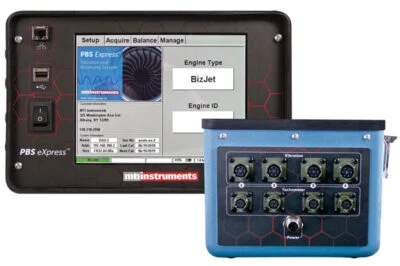
Image Credit: Vitrek, LLC
This is achieved by eliminating engine removal, which reduces costs while supporting reliable data-driven maintenance. Portable balancing is a practical solution to the demands being placed on MRO providers while delivering stronger returns on investment (ROI) to companies and private individuals.

This information has been sourced, reviewed, and adapted from materials provided by Vitrek, LLC.
For more information on this source, please visit Vitrek, LLC.