In this interview, AZoMaterials speaks with experts from Micromeritics and Malvern Panalytical about how particle size, surface area, and porosity measurements contribute to a more complete understanding of material properties. By combining multiple analytical techniques, researchers can better characterize particulate systems and predict how materials will behave in real-world applications.
Jack Saad, Application Scientist at Micromeritics; Jason Exley, Product Manager for Physisorption and Chemisorption Instruments at Micromeritics; and Dr. Anne Virden, Product Manager at Malvern Panalytical, discuss the principles behind particle characterization, the analytical methods used to measure particle size and surface area, and the key considerations when selecting the most appropriate measurement technique.
Can you introduce yourselves and describe your roles?
Jack Saad: My name is Jack Saad, and I am an Application Scientist at Micromeritics. My work focuses on supporting particle characterization technologies used for particle size and surface area analysis.
I began my career at Micromeritics as a particle size analyst in the contract laboratory services group. I later spent several years in the pharmaceutical industry working in formulation-related roles, including raw material testing, research and development, manufacturing support, and quality control. I eventually returned to Micromeritics, where I now help customers apply particle characterization technologies to better understand and optimize their materials.
Jason Exley: I am the Product Manager for the physisorption and chemisorption family of instruments at Micromeritics. I originally joined the company in 2007 as an undergraduate working in the applications and testing laboratory.
After completing my degree in chemical engineering, I began working full time as a research engineer supporting gas adsorption and flow reactor product lines. I later worked as a sales engineer helping customers apply these technologies in research and industrial environments. Today, my role focuses on product development and supporting researchers using physisorption techniques to characterize materials.
Dr. Anne Virden: I am a Product Manager within the micromaterials group at Malvern Panalytical, based in our Malvern office. My role focuses on technologies for measuring particle size, shape, and chemical composition in the micron range, including laser diffraction, analytical imaging, and Raman spectroscopy.
I have over 15 years of experience analyzing particles across a wide range of applications, and my work focuses on helping customers select the most appropriate particle characterization methods for their materials and processes.

Image Credit: Celic Boris/Shutterstock.com
What is meant by particle characterization, and why is it important in materials science?
Jason Exley: Traditionally, particle size has been one of the most commonly measured properties because it strongly affects material performance. However, particle size alone does not provide the full picture.
Many materials are not perfectly spherical and may contain surface roughness or internal pores. These features significantly influence how particles interact with their environment. As a result, particle characterization often includes measurements of surface area, pore structure, and morphology in addition to particle size.
Understanding these properties allows researchers to better predict how materials will behave in applications ranging from catalysis and pharmaceuticals to energy storage and filtration.
What exactly is a particle, and how broadly does this concept apply?
Dr. Anne Virden: A particle is typically defined as a discrete portion or fragment of matter. While this sounds simple, the concept applies to a wide range of systems.
Particles may exist as solid materials in dry powders or suspensions, but they can also appear as liquid droplets in emulsions or sprays, or even gas bubbles in liquids. Particle analysis is therefore relevant to many material types, including powders, granules, suspensions, slurries, aerosols, and emulsions.
Because of this broad definition, particle characterization techniques are widely used across industries such as pharmaceuticals, chemicals, food production, advanced materials, and environmental technologies.
Why is surface area such an important parameter when studying particulate materials?
Jack Saad: Specific surface area represents the exposed surface of a material per unit mass. This includes both the external surface of the particles and, in many cases, the internal surface associated with pores.
Surface area is particularly important because many physical and chemical processes occur at the surface of particles. Reactivity, catalytic activity, and interactions with binders or coatings are all strongly influenced by the amount of available surface area.
For example, when working with powders, the total surface area can determine how much additive or coating material is required to fully cover the particles.
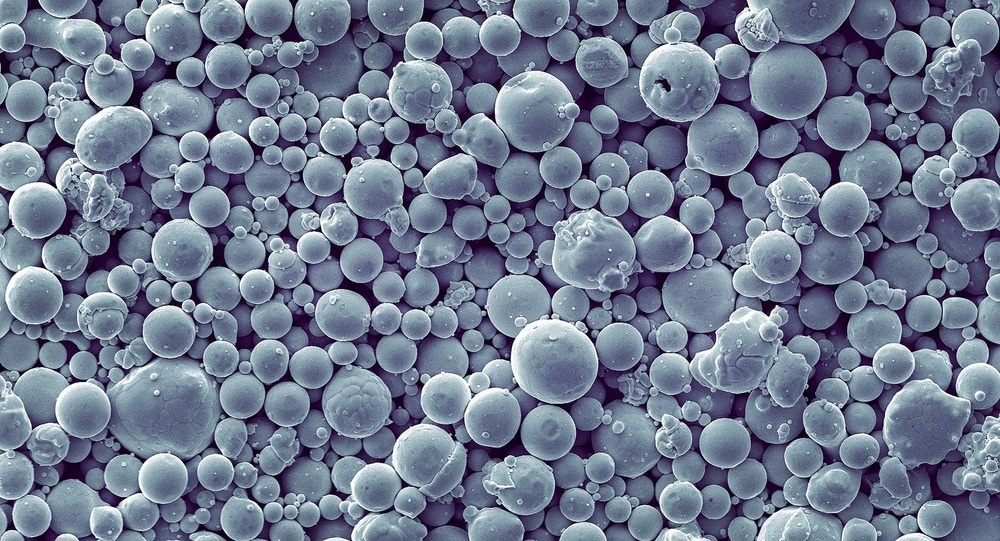
Image Credit:KKobjuv/Shutterstock.com
How are particle size and surface area mathematically related?
Jack Saad: The relationship between particle size and surface area can be described using basic geometric principles.
For a spherical particle, the ratio of surface area to volume equals six divided by the particle diameter. When density is included, this relationship allows researchers to convert between particle size and specific surface area.
As particle size decreases, the surface area per unit mass increases significantly. This inverse relationship means that small particles can exhibit dramatically higher surface areas than larger particles made from the same material.
How do pore size and porosity influence material performance?
Jason Exley: Pore structure strongly influences how substances move into and out of materials. Pore diameter and distribution determine whether molecules, liquids, or gases can access internal surfaces.
Pores are generally classified into three categories:
- Micropores: smaller than two nanometers
- Mesopores: between two and 50 nanometers
- Macropores: larger than 50 nanometers
Each pore size range contributes differently depending on the application. Microporous materials are often used for gas adsorption and carbon capture. Mesoporous materials are commonly used in catalysts and drug delivery systems where controlled diffusion is important.
How is surface area measured using gas adsorption techniques?
Jason Exley: Surface area is commonly measured using physisorption techniques, which involve the physical adsorption of gas molecules onto a material’s surface.
During analysis, the sample is first evacuated under vacuum to remove contaminants and previously adsorbed gases. A known quantity of gas is then introduced, and the amount that adsorbs onto the surface is measured.
By analyzing how adsorption varies with pressure, researchers can calculate the total surface area. One of the most widely used models for this calculation is the Brunauer–Emmett–Teller, or BET, method.
How does laser diffraction contribute to particle size analysis?
Jack Saad: Laser diffraction is one of the most widely used techniques for measuring particle size distribution.
In this method, particles are illuminated by a laser, and the scattered light is measured at different angles. Larger particles scatter light at smaller angles, while smaller particles produce wider scattering patterns.
Mathematical models such as Mie theory are used to interpret the scattering pattern and calculate particle size distributions. Laser diffraction provides rapid and reliable measurements across a wide particle size range.
Image Credit:Vink Fan/Shutterstock.com
What factors should researchers consider when selecting a particle size measurement technique?
Dr. Anne Virden: Selecting the correct particle size measurement technique depends on several key factors.
One of the most important considerations is the particle size range. Different techniques are optimized for different size ranges, from millimeter-scale particles down to nanometer-scale materials.
Researchers must also consider the sample form, such as whether the material is a dry powder, suspension, or emulsion. Other important factors include particle shape, dispersion behavior, measurement speed, and the type of particle size distribution produced by the technique.
For example, image analysis methods typically provide number-based distributions because they count individual particles, while laser diffraction produces volume-based distributions.
Why is particle shape important when interpreting particle size measurements?
Dr. Anne Virden: Many particle sizing techniques assume that particles behave as spheres when calculating size. As a result, measurements are often reported as a spherical equivalent diameter.
However, real-world particles are frequently irregular in shape. They may be elongated, plate-like, or rough. These variations can influence the measured particle size depending on the technique used.
When particle shape information is important, image-based methods can provide additional parameters such as particle length, width, and aspect ratio.
Why is it beneficial to combine multiple particle characterization techniques?
Jack Saad: Combining multiple analytical techniques provides a more complete understanding of particulate materials.
Particle size analysis reveals size distributions and particle populations, while surface area and porosity measurements provide insight into exposed surfaces and internal structures. When density measurements are also included, researchers can connect particle geometry with material performance.
Jason Exley: By integrating particle size, surface area, and pore structure measurements, researchers gain a more accurate picture of how materials behave during processing and in their final applications.
This comprehensive approach to particle characterization enables improved material design, better quality control, and more reliable product performance across many industries.
About the Experts
Jack Saad
Jack Saad is an Application Scientist at Micromeritics, specializing in particle size analysis and surface area characterization. His background includes experience in pharmaceutical formulation, raw material testing, and particle characterization technologies used in materials research and industrial applications.
Jason Exley
Jason Exley is Product Manager for physisorption and chemisorption instruments at Micromeritics. With a background in chemical engineering, he focuses on gas adsorption technologies used to measure surface area and pore structure in advanced materials.
Dr. Anne Virden
Dr. Anne Virden is a Product Manager at Malvern Panalytical, specializing in particle characterization technologies. With more than 15 years of experience in particle analysis, she supports the development and application of techniques used to measure particle size, shape, and composition across multiple industries.

This information has been sourced, reviewed, and adapted from materials provided by Malvern Panalytical.
For more information on this source, please visit Malvern Panalytical.
Disclaimer: The views expressed here are those of the interviewee and do not necessarily represent the views of AZoM.com Limited (T/A) AZoNetwork, the owner and operator of this website. This disclaimer forms part of the Terms and Conditions of use of this website.