Sponsored by InterpowerReviewed by Olivia FrostApr 20 2026
A module is a component that supplies various functions at the point where AC power enters an electrical system. Deciding which components will be appropriate – and the specific arrangement of capacitors, resistors, and inductors that an appliance needs – should begin in the initial design phase rather than through trial and error.
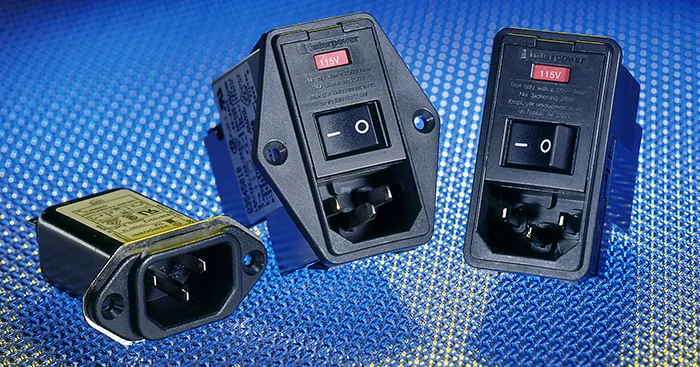
Image Credit: Interpower
The functions and components available in power entry modules are access outlets, circuit breakers, fuses, power inlets, switches, and voltage selectors as well as RFI/EMI filters (mA), or medical filters RFI/EMI (two to five µA).
Hospital-Grade Power Entry Modules
The components required for a module will differ across industries. The industry is likely to determine where capacitors, inductors, and resistors are added, removed, and placed.
In the medical industry, the module will undoubtedly require an RFI/EMI filter in accordance with worldwide medical standards. This may necessitate the medical filter’s leakage current to be measured in microamps (two to five µA), rather than milliamps (mA). This ensures minimal current leakage as patient safety is crucial inside a medical facility.
Most equipment in a patient’s vicinity must limit its leakage current below 100 mA to prevent human fatality. However, it is impossible to determine an exact and universal current as age, heart condition, and overall health are also key factors. The best advice is to ensure that there is as much distance between the patient and electrical current as possible.
“There’s always a trade-off with using filters,” explains Dan Ford, Technical Support Specialist at Interpower.
In medical, you want less leakage current, so you would want capacitors removed since they add to the leakage current. Simply put, a filter provides “clean” electricity to the equipment.
In regard to medical equipment, if you go beyond the 12–15 feet length for medical cords, it becomes much more difficult to meet the equipment standard requirements for emissions testing and leakage current for the entire system. You don’t want high levels of EMI/RFI or elevated levels of leakage current in equipment attached to the patient.
Dan Ford, Technical Support Specialist, Interpower
Inductors, resistors, and capacitors are among the main circuit components found in medical-grade filters: “The difference between a standard filter and a medical-grade filter is that in the medical version, the capacitors between the circuit conductors have been removed to decrease leakage current values,” Ford explains.
To achieve low leakage in modules with medical-grade filters, y-capacitors (Cy) are removed from between the two signal paths (L and N) and ground, and inductor values are resized. With the capacitors removed, the leakage current is dramatically reduced; however, the overall filter performance suffers a negative result (insertion loss). Medical-grade modules will always demonstrate less effective filtering compared with standard filters, but that is the compromise for lower leakage currents.
Also, the arrangement of inductors, capacitors, and resistors play a vital role in decreasing unwanted EMI as it is shunted away to ground. This is especially important in medical equipment where leakage current values are tightly controlled by country-specific or international safety standards to ensure patient safety.
Dan Ford, Technical Support Specialist, Interpower
Filter performance specifications are usually founded upon an industry-standard 50-ohm test circuit, and any specific aspects of an application’s design may impact how a filter performs when connecting the circuits together.
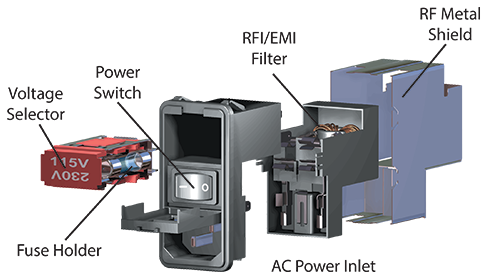
Image Credit: Interpower
Considerations for a power entry module:
- A detailed understanding of compliance protocols in relation to country-specific/ international standards to determine leakage current measurement in milliamps 1/ 1000 (mA), or microamps 1/ 1,000,000 (µA).
- The module should be housed in an RF-shielded metal box to limit noise at the source (many of the Interpower modules are pre-constructed inside the metal box).
- To determine the arrangement of inductors, capacitors, and resistors that best suit the needs of a specific electrical design, acquire appropriate samples of filters to test within their applications to ensure that they transmit the current values expected.

This information has been sourced, reviewed, and adapted from materials provided by Interpower.
For more information on this source, please visit Interpower.