The aerospace and defense sector is undergoing rapid material transformation.
Additive manufacturing, high-temperature superalloys, advanced aluminum systems, multilayer coatings, and emerging hydrogen-compatible materials are expanding design possibilities while simultaneously increasing the complexity of qualification. In parallel, certification requirements remain stringent, safety margins are uncompromising, and supply chain resilience is under growing scrutiny.

Image Credit: Thermo Fisher Scientific – Electron Microscopy Solutions
In this environment, detailed microstructural and chemical characterization plays a central role in linking processing routes to long-term component performance. A variety of analytical techniques come into play across the manufacturing process to help you capture minute details that affect overall quality.
The Influence of Microstructure on Lifecycle Performance
For aerospace components, performance is governed not only by bulk composition but also by microstructural architecture. Grain size and orientation, precipitate morphology, porosity distribution, and interfacial chemistry directly affect fatigue resistance, creep performance, corrosion behavior, and fracture toughness.
In nickel-based superalloys used for turbine blades, for example, fatigue cracks frequently initiate at microstructural features well below 10 µm. Localized oxidation, carbide morphology, and grain boundary character can significantly alter high-temperature durability. Similarly, in precipitation-strengthened aluminum alloys such as AA2024 or 2099, mechanical strength depends on nanoscale precipitate distribution, which evolves during aging and thermal exposure.
Understanding these relationships requires high-resolution imaging and analytical techniques capable of resolving structural and compositional variations across multiple length scales.
Multiscale Characterization of Additively Manufactured Alloys
Additive manufacturing (AM) lets you create lightweight parts with complex shapes, but the layer-by-layer process can introduce issues like lack-of-fusion defects, keyhole porosity, uneven grain growth, and material segregation.
A comprehensive assessment of AM alloys typically brings together several complementary techniques. Scanning electron microscopy (SEM), combined with energy-dispersive X-ray spectroscopy (EDS), is used to identify pore morphology and elemental inhomogeneity. Electron backscatter diffraction (EBSD) then provides insight into crystallographic texture and grain boundary character, both of which influence crack propagation.
At the nanoscale, transmission electron microscopy (TEM) reveals fine precipitates, dislocation structures, and phase boundaries that govern yield strength and fatigue response. To extend this into three dimensions, approaches such as focused ion beam (FIB) serial sectioning enable volumetric analysis, allowing reconstruction of interconnected porosity networks and subsurface crack initiation sites.
Correlating these structural features across scales aids in refining process parameters, optimizing post-build heat treatments, and reducing conservative safety overdesign.
Surface Engineering and Coating Integrity
Surface treatments and protective coatings play a critical role in ensuring corrosion resistance and thermal stability in aerospace systems. Thermal barrier coatings (TBCs), anodized aluminum layers, and thin metallic films must retain their structural integrity under cyclic loading and extreme temperature gradients.
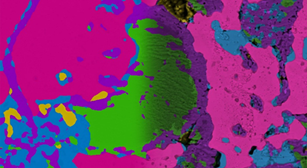
Image Credit: Thermo Fisher Scientific – Electron Microscopy Solutions
Cross-sectional SEM imaging is used to measure coating thickness, porosity, and interface adhesion. Backscattered electron imaging improves phase contrast, making it easier to assess oxide scale formation and track degradation pathways. When paired with EDS mapping, it also provides a clear view of elemental distribution across coating–substrate interfaces.
For chemical-state analysis at the nanometer scale, X-ray photoelectron spectroscopy (XPS) enables quantitative evaluation of oxidation states and contaminant species. Non-destructive depth profiling further supports analysis of thin film uniformity and oxide layer growth without damaging the sample. These techniques are particularly useful for assessing surface discoloration, passivation quality, and thin gold layers used to reduce contact resistance in fuel cell separators.
Failure Analysis and Fatigue Behavior
Failure analysis in aerospace components often focuses on linking crack initiation to specific microstructural features. High-throughput EBSD mapping has become increasingly important for identifying grain boundary types and local misorientation associated with early-stage fatigue damage in superalloys.
In titanium alloys such as additively manufactured Ti-6Al-4V, SEM-based fracture surface analysis helps pinpoint crack nucleation sites, assess the role of surface roughness, and distinguish between brittle and ductile fracture modes. Integrated EDS also supports contamination detection and inclusion analysis.
For more complex material systems, correlative workflows that combine SEM, TEM, EBSD, and surface-sensitive spectroscopy offer a more complete picture of degradation mechanisms under service-like conditions.
Characterization of Emerging Aerospace Energy Systems
The shift toward electrified and hydrogen-powered platforms introduces new material challenges. In aerospace applications, lithium-ion battery performance depends on maintaining microstructural stability under thermal cycling and vibration. Multiscale imaging workflows that combine micro-computed tomography (microCT) with FIB-SEM make it possible to visualize electrode swelling, particle cracking, and the evolution of pore networks.
Hydrogen storage materials and solid oxide fuel cell devices also depend on carefully controlled porosity and stable interfaces. Three-dimensional microstructural reconstruction provides quantitative insight into pore connectivity and degradation pathways that directly affect long-term efficiency.
In each case, nanoscale structural information feeds into predictive modeling and helps accelerate the qualification of next-generation energy technologies.
The Role of Material Characterization in Aerospace Manufacturing
As aerospace systems evolve toward lighter structures, higher operating temperatures, and alternative energy platforms, the demand for precise, multiscale materials characterization continues to increase. Electron microscopy and complementary analytical techniques provide the structural and chemical resolution required to connect microstructure with performance, shorten development cycles, and strengthen certification confidence.
A collection of aerospace case studies, including additive manufacturing, thermal barrier coatings, aluminum alloy aging, predictive maintenance workflows, and advanced energy systems, is available in the eBook Engineering Confidence.
To learn more about how advanced materials characterization supports aerospace innovation, explore the eBook Engineering Confidence.
The eBook brings together a range of application examples showing how Thermo Scientific™ electron microscopy and surface analysis technologies help researchers and engineers investigate microstructures, evaluate coatings, analyze failure mechanisms, and optimize advanced materials used in aerospace and defense systems.
Read the eBook Here

This information has been sourced, reviewed and adapted from materials provided by Thermo Fisher Scientific – Electron Microscopy Solutions.
For more information on this source, please visit Thermo Fisher Scientific – Electron Microscopy Solutions.