Sponsored by InterpowerReviewed by Ify IsiborApr 14 2026
While many countries outside the continental US use North American plugs, and some beyond Europe adopt European plug types, the majority of countries maintain their own proprietary plug designs. These typically align with national standards and the requirements of their respective safety authorities. Complicated? In some ways, yes – but also manageable once the underlying standards are understood.
Image Credit: Interpower
A country’s standards typically define key aspects of mains power, including voltage, amperage, frequency, plug types, and related design requirements.
In parallel, safety agency standards establish criteria for electrical components, covering types of plastics used in plugs and sockets, their flame-retardant properties, thermal performance under load, and the characteristics of conductor insulation and cord jackets, including dimensions and material composition.
A useful example of such agency standards can be found on UL’s iQ platform. These standards are generally published by regional or global safety organizations such as UL and VDE and are essential for manufacturers of power cords and related components seeking country-specific approvals and certifications.
They also provide clarity on which materials (such as approved resins) have passed safety testing.
For manufacturers, this offers a significant advantage, enabling more efficient resource allocation and ensuring products are designed to meet precise specifications and dimensional requirements within defined tolerances. This includes components such as plugs, sockets, blade and pin lengths, and even details like conductor crimp height.
While plugs and sockets adhere to national and regional standards, most are also designed to meet international requirements, as many manufacturers export their products globally.
Image Credit: Interpower
To do so, they must comply with standards such as IEC 60320, which governs power cord sets.
While many safety agencies publish standards along with testing methodologies and certification results, the IEC focuses on developing standards and test procedures rather than conducting product testing itself. Certification and testing are instead carried out by organizations such as UL, VDE, and JET.
Plugs are typically classified as either Class I (grounded) or Class II (ungrounded), which are the most common categories. Class III applies to very low-power devices operating at safety extra-low voltage (SELV), generally not exceeding 50 V AC or 120 V DC, and is commonly used for devices such as electric shavers, toys, and other small appliances.
In addition, plugs may be either molded or rewirable.
Molded plugs are permanently formed and cannot be modified once removed from the molding process. In contrast, rewireable plugs can be opened by removing screws, allowing for inspection, repair, or reattachment to new or existing cables.
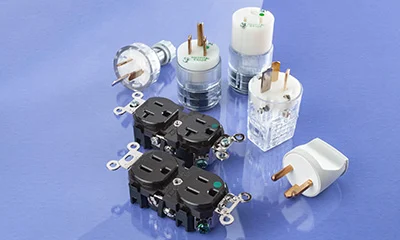
Image Credit: Interpower
Plugs, Sockets, and the LEGO Effect
As noted earlier, IEC 60320 accessory components are essential for exporting power cords, particularly when aiming to minimize the number of country-specific cord sets required or when wall sockets are limited or inconveniently located.
The IEC 60320 range includes inlets, outlets, plug connectors, connectors, and jumper cords, all designed to simplify international compatibility while conserving the use of country-specific plugs.
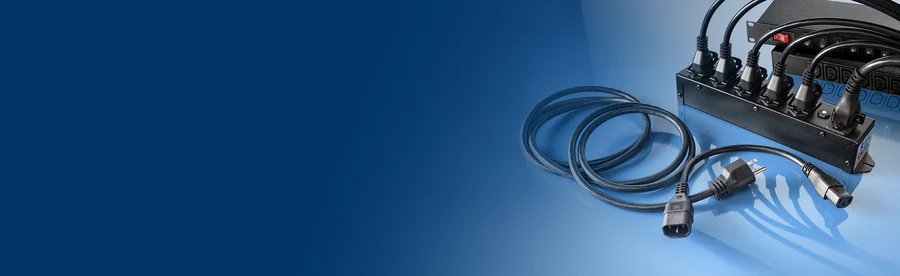
Image Credit: Interpower
By combining a single country-specific power cord with a 4–12 outlet accessory power strip (APS), users across a wide range of industries can power up to 12 devices from a single primary connection.
In a fast-paced world where both business and leisure operate at near-instant speeds, power cord users expect a simple, ready-to-use solution – unbox, plug in, and operate without additional configuration.
A typical setup works as follows: a country-specific plug is connected to the wall socket (mains power), while the opposite end – terminated with an IEC 60320 C13 connector – is inserted into a C14 inlet on an accessory power strip (APS), which typically features 4–12 Sheet F outlets.
From there, IEC 60320 jumper cords equipped with Sheet E plug connectors are connected to the APS’s row of Sheet F outlets. The opposite ends of these jumper cords, terminated with C13 connectors, are then plugged directly into equipment via their built-in C14 inlets.

This information has been sourced, reviewed and adapted from materials provided by Interpower.
For more information on this source, please visit Interpower.