Sponsored by InterpowerReviewed by Ify IsiborApr 16 2026
Universal sockets introduce serious safety issues and are widely considered an unsafe solution when seeking a single source able to accommodate the wide range of plug types worldwide.
This article discusses the different reasons why a universal socket is considered unsafe.
National and International Standards
National and international electrical standards specify requirements for the dimensions of plugs and sockets. The construction of a universal socket does not meet these requirements.
For example, the IEC 60884-1 international standard provides specific dimensional requirements, while national standards like North America’s UL 498 and CSA C22.2 no. 42, Germany’s DIN VDE 0620-2-1, the United Kingdom’s BS 1363, and Australia’s AS/NZS 3112 must also be accounted for.
Several safety organizations have also issued warnings around the use of universal sockets.
For instance, the Electrical Safety Council in the UK contracted an independent test and certification body for electrical and electronic products, Nemko Ltd., to look at “the safety implications of the installation of universal socket-outlets in the UK for domestic and commercial use, using reference standards BS 1363-2:1995 +A4:2012 and BS 5733:2010.”
The ‘Conclusions and Observations’ section at the end of the resulting test report stated:
“From the test results, it is clear that as well as the legal implications of installing these universal socket-outlets in the UK for domestic and commercial use, there are also serious potential hazards, including risk of electrocution and risk of fire.”
The report recommended that “electricians are alerted to the potential hazards detailed in this report, in case they are requested to fit such socket-outlets in domestic or commercial installations (for example, in hotels).”
SPRING Singapore, the Safety Authority in Singapore, issued guidance titled ‘Safety Alert: Risks of Using Universal Portable Socket Outlet’ highlighting two main safety risks in the form of an electric shock hazard and a fire hazard.
This document stated that “The Universal Portable Socket Outlet (UPSO) falls under the PSO (Portable Socket Outlet) category. However, it is NOT approved for use in Singapore.”
Voltage
Voltage is another key factor in why a universal socket is not considered safe to use. Different mains voltages are used globally. Most regions use 230 V, while North America uses 120 V and Japan uses either 110 V or 120 V.
Dan Ford, Technical Support Specialist at Interpower, highlights that “a NEMA 5-15 rated at 125 V is not allowed to be plugged into a socket that is connected to 230 V or vice versa. The fear is that if a device that is intended for only 120 V is plugged in, the higher voltage will cause overheating and a fire.”
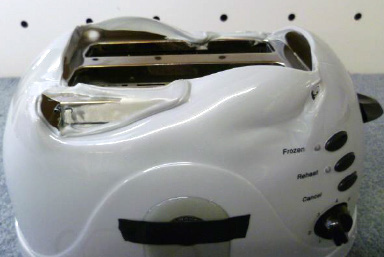
Photo of a 110 V toaster after connection to a 240 V supply. Image Credit: Electrical Safety First
Plug and Socket Design
The sheer range of plugs and sockets used globally is another major concern for the safety of universal sockets.
For instance, plugs used in the UK and some parts of the world have a fuse, with the neutral and line contacts incorporating shutters to prevent foreign objects from being pushed into the socket.
The Continental European plug used throughout Europe requires the plug to be inserted into a recessed socket, whereas the NEMA 5-15 plug used in North America differs significantly from this.
It is not possible for a universal socket to accommodate all these dimensions and features in one receptacle.
Amperage Ratings
It is important to note that different plugs and sockets also feature different amperage ratings. For instance, the amperage rating in North America is 15 A, in the UK it is 13 A, in Germany it is 16 A, and in Australia it is 10 A.
A plug must be used in a socket with the same amperage rating, as exceeding that rating poses a significant fire risk. A universal socket is generally built to meet minimum current ratings, which can make it highly unsafe when used under normal loads.
Grounding
UK plugs, NEMA plugs, and many others use a third pin in order to ensure a safe ground connection. The Continental European plug features grounding clips on the sides of the plug body, however.
This presents a significant issue because the Continental European plug’s contacts are not included in the universal socket, meaning the universal socket remains ungrounded even when plugged into it. This could be potentially fatal in the event of a short circuit.
Polarization
Electrical polarization refers to the use of a designated method for wiring the line, neutral, and ground wires to the plug or socket. Pin polarization refers to the dedicated alignment of the pins.
Both concepts are important because while some countries have polarized plugs, others do not. A universal socket cannot, therefore, accommodate these variations appropriately or safely.
Pin Contact
The pins of a plug must be in full contact within the socket to operate reliably and safely. This requirement is another reason a universal socket is not advised, as it is extremely challenging to develop one that maintains full contact with the pins, given the diverse nature of plug patterns.
Design differences lead to safety compromises, including the risk of arcing and fire, because the pins are not properly touching. Not ensuring that pins make proper contact within the socket can also lead to plugs being inserted incorrectly or not staying in place securely.
Ron Barnett, Product Development Manager at Interpower, explains how both of these actions can cause serious safety concerns: “In addition to the seriousness of a plug pin not making proper connection to the socket contacts, it’s possible that the plug may not have the proper retention to remain in place in the socket during use.”
Major Safety Issues
It may be challenging or frustrating to accommodate the various plugs and sockets found in different countries, but trying to create a universal socket that fits all these configurations poses major safety risks, some of which are potentially life-threatening.
The world’s diverse electrical connections are incompatible with one another, meaning it is not possible to use a single socket to accommodate them all.
It is advisable not to use or purchase a universal socket from any company or source, regardless of any claims made about safety. A universal socket is not safe, and no national or international electrical standard approves its use.
Sourcing Power Cords and Supplies from Interpower
Sourcing reliable, affordable products from Interpower allows customers to lock in a specific quantity price break with a blanket or scheduled order.
Blanket Orders
Ordering a specific quantity of an Interpower product (for example, 1,000 cord sets) allows the company’s customers to lock in a price and request shipments as needed over a one year period. This allows quantities and delivery dates to differ in line with the company’s specific requirements.
Scheduled Orders
It is also possible to place an order with pre-determined quantities and delivery dates over a 1-year period. For example, a customer can place an order for 1,000 cord sets and request that 250 be delivered on January 15, April 15, July 15, and October 15.
No Minimum Order Requirements
Interpower has no minimum order or dollar requirements and offers same-day shipments on in-stock products. It is possible to purchase every manufactured or sold part individually, with most shipping from the company’s manufacturing facilities in Iowa, USA.
Interpower’s comprehensive portfolio of power system components is supported by an extensive inventory, enabling the company to supply any ordered part from stock or manufacture it as required.
References and Further Reading
- Electrical Safety First. Universal socket outlets. Available at: https://www.electricalsafetyfirst.org.uk/mediafile/100015221/Universal_Socket_Outlets.pdf
Acknowledgments
Produced from materials originally authored by Interpower.

This information has been sourced, reviewed, and adapted from materials provided by Interpower.
For more information on this source, please visit Interpower.