Sponsored by InterpowerReviewed by Olivia FrostApr 9 2026
Though the CEE 7 standard has been replaced by the IEC 60083 standard, many plugs and sockets have altered little in design – but possibly more in material – since the last CEE 7 update was released.
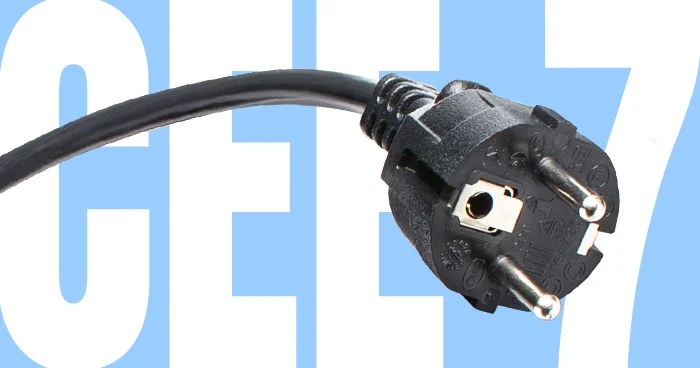
Image Credit: Interpower
Despite the fact that the very first CEE 7 plugs and sockets are now mostly outdated, a few of them can still be found indoors in a few countries, notably CEE 7/1 and 7/2, which were not grounded (earthed) plugs and sockets.
The 7/3 German Type F socket, which appeared shortly after the 7/1 and 7/2, was the first grounded socket in the CEE 7 series.
The CEE 7 standard and its extensive selection of electrical plugs and sockets remain immensely popular, not just in Europe, but in many other nations as well.
The CEE 7 standard, first issued in 1951 by the erstwhile International Commission on the Rules for the Approval of Electrical Equipment (IECEE), continues to crash parties at archives around the world – a second edition was produced in 1963, and another in 1983.
Supplements to these publications were created expressly for plugs and sockets. However, there were numerous CEE publications, such as Publication 17 on Plugs and Socket-Outlets for Industrial Purposes, or Polyvinyl Chloride Insulated Cables and Flexible Cords in CEE Publication 13, etc.
The following versions of plugs and sockets cover a wide range that is only briefly discussed here; odd numbers correspond to sockets and even numbers to plugs. For example, CEE 7/1 is the socket and CEE 7/2 is the plug (as previously stated, this combination lacks grounding protection).
This combination was considered a shock hazard, and while it has been practically phased out totally, 7/1s can still be found in indoor "dry" locations; country-specific restrictions on its uses or outright obsolescence vary by country.
Other dates include CEE 7/3, 7/4, 7/5, and 7/6. The CEE 7/7 plug is a little different, accommodating Type E sockets (Belgium/French 7/5) and Type F sockets ("Schuko" German 7/3). Notably, the 7/5 socket features an earthing pin that extends 23 mm beyond the live contacts.
As a result, the 7/6 French plug has a slot or round contact opening that accepts the grounding pin.
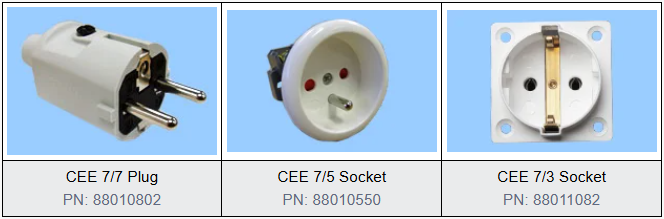
Image Credit: Interpower
In German, the term "Schuko" from "Schutzkontakt" means "protective contact" in relation to the grounding ability. The Schuko plug and socket system originated in Germany during the 1920s.
The German Type F variants 7/3 and 7/4 were the first to include two grounding clips on the recessed sides of the socket, ensuring that the plug is always grounded when placed into the 7/3 socket. The 7/7 also accepts a Type K (Danish) socket, although without grounding.
A modification to the 1951 standard, released in June 1962, featured the 7/16 "Europlug," a flat plug with 4 x 19 mm pins and a 2.5A rating; it is used for Class II applications. There is also a CEE 7/16 "Alternative I" plug that fits into 7/3 and 7/5 sockets, but is rarely used.
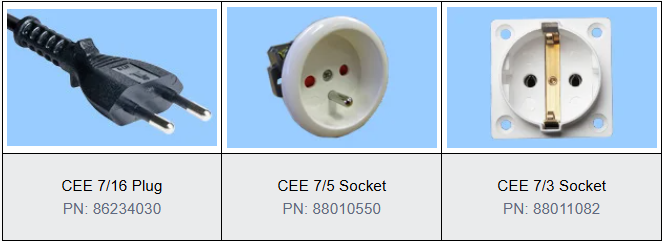
Image Credit: Interpower
The CEE "Alternative II Europlug" is a flat two-pin plug that supports more sockets than its predecessor: the 7/1, 7/3, 7/5, as well as Israeli, Italian, Danish, and Swiss sockets – the Europlug's pins flex a minimal amount to accept a variety of sockets.
Finally, there is a round, unearthed CEE 7/17 plug. It has 10 A or 16 A ratings and is suitable for uncovered Class II appliances. The plug also appears in the Italian standard (CEI 23-50). It also appears in the Russian standard.

Image Credit: Interpower
It is also crucial to note that there is no EU legislation for country-specific plugs and sockets, and the Low Voltage Directive of 2014 expressly excludes local plugs and sockets. EU countries rely on their own, country-specific legislation and national standards, which are enforced by several safety organizations, such as VDE, DIN, DEMKO, OVE, and others.
The CE designation does not apply to plugs and sockets. However, one recurring element in the regulations for the aforementioned plugs over the years has been the 19 mm space between the two rounded pins.
Unlike the norms in North America, the plugs in Europe discussed in this article do not have established medical cord standards. A few European hospitals have "preferences," such as cord set color, although they will still use standard domestic cord sets in hospitals and clinics.

This information has been sourced, reviewed, and adapted from materials provided by Interpower.
For more information on this source, please visit Interpower.