Around 400 million tons of plastic are produced worldwide per annum.1 Dealing with this volume of plastic garbage is already a tremendous challenge, but the discovery of microplastics in isolated natural areas, the food chain, and even the human body,2,3 has prompted new environmental concerns about plastic use.4
Microplastics are plastic particles that range in size from 1 µm to 5 mm.5 To understand the impact of microplastics on the environment and human health, scientists require measurement methods capable of identifying the size, shape, and chemical composition of a wide range of microplastics.
The smaller the microplastic, the more readily they circulate through the environment, and even enter the human bloodstream.6
It's this ability that makes them so concerning. Unfortunately, existing measurement techniques lack the spatial resolution needed to identify and image particles smaller than 20 µm, making them difficult to analyze.
This dilemma is at the heart of current microplastics research. Addressing it demands a more integrated analytical approach rather than piecemeal changes.
Multimodal Measurements
Infrared (IR) and Raman spectroscopy are among the most widely used techniques for identifying microplastics.
Both are effective for polymers because they are non-destructive and reasonably rapid, and they capture information about the material's unique chemical structure, allowing for unique identification.
IR and Raman spectra operate as chemical fingerprints, allowing us to confidently differentiate one polymer from another.
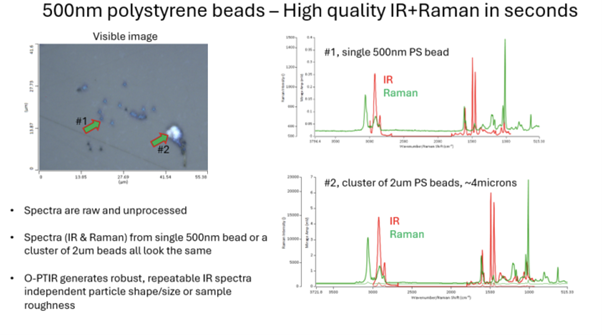
Image Credit: Photothermal Spectroscopy Corp.
Things are not always straightforward. Each approach has its limits, particularly when particle size and composition are taken into account.
Colored and weathered microplastics, for example, can produce interfering signals, such as autofluorescence, when analyzed by Raman spectroscopy, and long carbon-chain molecules, such as lipids and fats, can be misidentified as polyethylene (PE), one of the most common microplastic types.
Using classic IR spectroscopy techniques, such as FTIR and direct QCL-based systems, can significantly underestimate particles smaller than 20 μm.7
This is primarily owing to the diffraction limit associated with the longer infrared wavelengths used in classical IR spectroscopy, which sets a fundamental resolution limit.
Multimodal methods, which use multiple spectroscopic modalities simultaneously, improve both identification accuracy and particle sizing. Resolution is the most important problem here.
Smaller particles (<10 µm, extending into the submicron and nanoplastic range) represent the greatest health concerns and are the most difficult to assess. A new method for measuring microplastics is needed.
This is where the groundbreaking super-resolution technique of Optical Photothermal Infrared (O-PTIR) Spectroscopy addresses a critical current gap in the analytical toolkit. It accomplishes this by overcoming critical IR spatial-resolution limitations, enabling robust, accurate, and true submicron microplastic identification.8
High Spatial Resolution
O-PTIR operates on a pump-probe method, in which a pulsed and extensively tunable (3000-800 cm-1) IR pump laser (Quantum Cascade Laser, QCL) excites the sample, and a second visible short wavelength laser probes the excited sample.
The excitation mechanism results in localized modulated heating in any location that absorbs infrared light. These tiny thermally induced changes affect the intensity of the reflected visual probe beam, allowing chemically specific regions to be mapped and identified on a particle-by-particle basis using infrared absorption.
One major feature of O-PTIR is its spatial resolution. Traditional infrared spectroscopy has inadequate resolution due to the longer wavelength (about 20 μm). In O-PTIR, however, resolution is dictated by the visible probe laser wavelength (usually 532 nm) rather than the infrared pump.
This leads to a 30-fold increase in spatial resolution over previous IR approaches. As an extra bonus, thanks to a 532 nm visible probe beam, the probe laser can also serve as a Raman excitation laser, enabling a unique and valuable combination of true simultaneous submicron IR and Raman spectroscopy from the same location, at the same time, and with the same resolution.
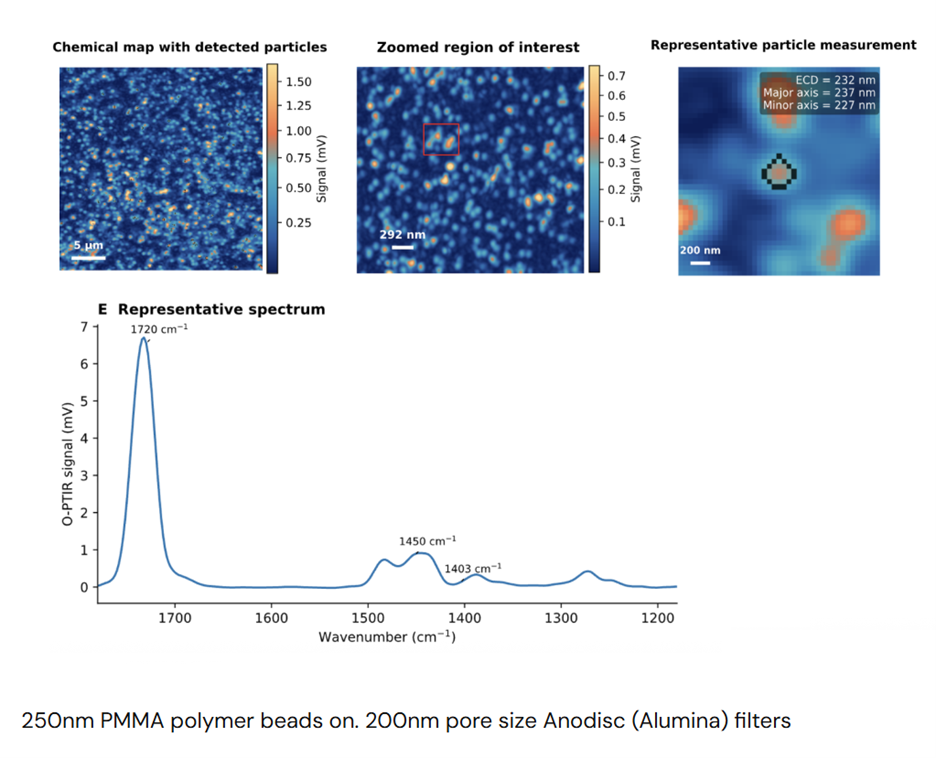
Image Credit: Photothermal Spectroscopy Corp.
Similar experimental setups can be used for multimodal measurements, such as combining infrared and Raman or fluorescence microscopy. This property has been very valuable in microplastic applications.9
Detecting <10 µm particles in aerosol droplets with diameters of > ∼0.8 μm, the usual size of atmospherically significant microplastics, has been made possible by the combination of Raman and O-PTIR.10
Many of these multimodal approaches can be easily applied to biological tissues. In vivo studies between O-PTIR and infrared reveal that O-PTIR has a superior signal-to-noise ratio in complex biological matrices and can detect microplastics as small as 200 nm particles.11
O-PTIR measurements can also be utilized for uptake studies to better understand transport and degradation processes in biological environments because they are label-free and non-destructive.12,13
Automated Microplastic Sizing
While spatially mapping samples using several experimental approaches yields valuable information, such observations can be difficult to analyze, especially when thousands of particles are being examined.
To overcome this issue and enable automated chemical identification and microplastic scaling, Photothermal Spectroscopy Corp. created featurefindIR, an automated image analysis software that seamlessly integrates with O-PTIR and multimodal data.14
featurefindIR Software
Many microplastic measurements are performed on complicated samples that may contain varying particle sizes and kinds, as well as pollutants. featurefindIR increases measurement productivity by using powerful image recognition techniques to identify particle locations and composition.
It can distinguish between organic particles of interest even when embedded in an inorganic matrix.
The software can use co-located fluorescence microscopy with cross-polarizers to improve optical contrast and facilitate particle localization. O-PTIR offers exceptional spatial resolution for identifying microplastics smaller than 1 µm, unlike traditional infrared microscopy.
Advantages of O-PTIR and featurefindIR Software
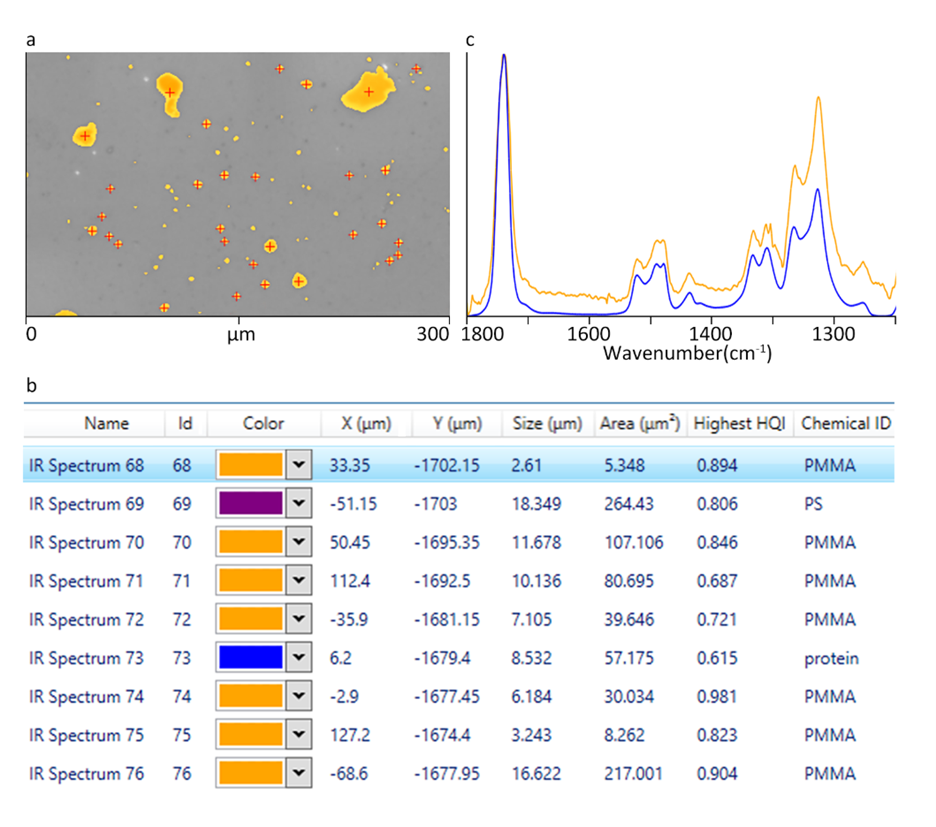
Image Credit: Photothermal Spectroscopy Corp.
Source: Photothermal Spectroscopy Corp
| . |
. |
| Spatial Resolution |
< 1 µm |
| Chemical Identification |
IR + multimodal techniques such as Raman, fluorescence, etc.
Suitable for all common microplastics |
| Overall Measurement Times |
A few seconds per particle – Additional use of laser-scanning for >30x chemical imaging |
| Data Processing |
A fully automated, extensive compound library is provided with software
Provides 2D (IR+Raman) search results with Hit Quality Index (HQI) |
| Sample preparation requirements |
None |
The software also provides an integrated database with many reference spectra. For users, this means that any new measurements are immediately compared to the reference database, and a hit quality index is computed to indicate both the best chemical match and the match quality.
For microplastic applications where the range of polymer types is generally well known, this comparison approach is invaluable for sample screening and can also aid in detecting the presence of additives or other absorbed substances.
For simultaneously acquired IR+Raman data, spectral search can yield both IR and Raman spectra for each particle, providing additional confidence and confirmatory analysis.
featurefindIR is an important tool for environmental and health investigations of microplastics, especially in areas where tiny particles predominate. The ability to perform automated analysis using multiple approaches increases confidence in chemical identification, while the streamlined workflow enables rapid screening of large sample regions.
For more information about featurefindIR or Photothermal Spectroscopy Corp's integrated multi-modal spectroscopy solutions for microplastic applications, please contact a member of the team.
References and Further Reading
- PlasticsEurope (2025) Plastics: The Facts 2025. Available at: https://plasticseurope.org/knowledge-hub/plastics-the-fast-facts-2025/.
- Hale, R.C., et al. (2020). A Global Perspective on Microplastics. Journal of Geophysical Research: Oceans, (online) 125(1). DOI: 10.1029/2018jc014719. https://agupubs.onlinelibrary.wiley.com/doi/10.1029/2018JC014719.
- Leslie, H.A., et al. (2022). Discovery and quantification of plastic particle pollution in human blood. Environment International, (online) 163(107199), p.107199. DOI: 10.1016/j.envint.2022.107199. https://www.sciencedirect.com/science/article/pii/S0160412022001258.
- Lamoree, M.H., et al. (2025). Health impacts of microplastic and nanoplastic exposure. Nature Medicine, (online) pp.1–15. DOI: 10.1038/s41591-025-03902-5. https://www.nature.com/articles/s41591-025-03902-5.
- Frias, J.P.G.L. and Nash, R. (2019). Microplastics: Finding a consensus on the definition. Marine Pollution Bulletin, 138, pp.145–147. DOI: 10.1016/j.marpolbul.2018.11.022. https://www.sciencedirect.com/science/article/abs/pii/S0025326X18307999?via%3Dihub.
- Käppler, A., et al. (2016). Analysis of environmental microplastics by vibrational microspectroscopy: FTIR, Raman or both? Analytical and Bioanalytical Chemistry, (online) 408(29), pp.8377–8391. DOI: 10.1007/s00216-016-9956-3. https://link.springer.com/article/10.1007/s00216-016-9956-3.
- Böke, J.S., Popp, J. and Krafft, C. (2022). Optical photothermal infrared spectroscopy with simultaneously acquired Raman spectroscopy for two-dimensional microplastic identification. Scientific Reports, 12(1). DOI: 10.1038/s41598-022-23318-2. https://www.nature.com/articles/s41598-022-23318-2.
- Li, Y., et al. (2023). Potential Health Impact of Microplastics: A Review of Environmental Distribution, Human Exposure, and Toxic Effects. Environment & Health, (online) 1(4), pp.249–257. DOI: 10.1021/envhealth.3c00052. https://pubs.acs.org/doi/10.1021/envhealth.3c00052.
- Parham, R.L., et al. (2025). Identifying Microplastics in Laboratory and Atmospheric Aerosol Mixtures via Optical Photothermal Infrared and Raman Microspectroscopy. PubMed. DOI: 10.1021/acs.analchem.5c02968. https://pubs.acs.org/doi/10.1021/acs.analchem.5c02968.
- Belontz, S.L., et al. (2025). Combining Submicron Spectroscopy Techniques (AFM-IR and O-PTIR) To Detect and Quantify Microplastics and Nanoplastics in Snow from a Utah Ski Resort. Environmental Science & Technology. DOI: 10.1021/acs.est.4c12170. https://pubs.acs.org/doi/10.1021/acs.est.4c12170.
- Duswald, K., et al. (2025). Detection of Unlabeled Polystyrene Micro- and Nanoplastics in Mammalian Tissue by Optical Photothermal Infrared Spectroscopy. Analytical Chemistry, 97(31), pp.16714–16722. DOI: 10.1021/acs.analchem.4c05400. https://pubs.acs.org/doi/10.1021/acs.analchem.4c05400.
- Macairan, J.-R., et al. (2025). Label-Free Identification and Imaging of Microplastic and Nanoplastic Biouptake Using Optical Photothermal Infrared Microspectroscopy. Environmental Science & Technology, 59(30), pp.15612–15622. DOI: 10.1021/acs.est.4c14367. https://pubs.acs.org/doi/10.1021/acs.est.4c14367.
- Sofield, C.E., et al. (2026). Label-free non-destructive spectroscopic detection of mixed microplastic uptake and differential effects on intestinal epithelial cells. Journal of Hazardous Materials, 504, p.141283. DOI: 10.1016/j.jhazmat.2026.141283. https://www.sciencedirect.com/science/article/pii/S030438942600261X?via%3Dihub.
- Photothermal Spectroscopy Corp (2026) FeaturefindIR. Available at: https://www.photothermal.com/products/featurefindir/

This information has been sourced, reviewed, and adapted from materials provided by Photothermal Spectroscopy Corp.
For more information on this source, please visit Photothermal Spectroscopy Corp.