The stRAMos Photothermal Stimulated Raman Microscope uses PhotoThermalSRS™ (PT-SRS) techniques to provide the utmost measurement sensitivity and spatial resolution for chemical imaging within a single system. It is characterized by high imaging speeds and sophisticated microscopy characterization features.
The stRAMos microscope stands out by combining a wide range of optional multimodal capabilities in a single system. It supports the combination of PT-SRS with Optical Photothermal Infrared Spectroscopy (O-PTIR), widefield Epi Fluorescence imaging, and spontaneous Raman spectroscopy, resulting in comprehensive chemical characterization of a sample.
With these multimodal features, stRAMos provides extensive chemical imaging and spectroscopy characterization for a diverse array of life science applications. These encompass both dry and live cell imaging as well as the biomolecular dynamics of proteins, lipids, and other biomolecules.
- Maximum sensitivity detection: 10× improvement on SRS
- Raman chemical imaging resolution: ≤300 nm spatial precision
- Rapid chemical imaging: For live-cells and molecular dynamics
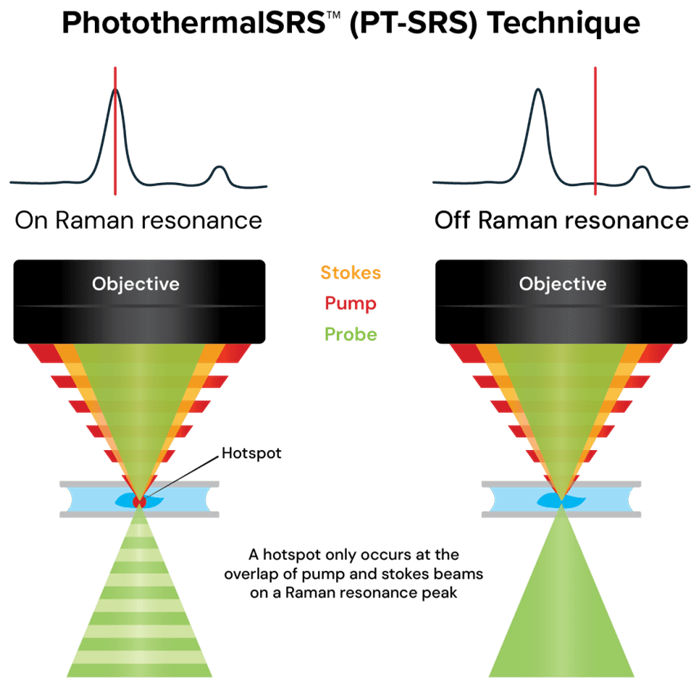
Image Credit: Photothermal Spectroscopy Corp.
Download the Brochure for More Information
stRAMos Key Capabilities
The following videos demonstrate the stRAMos system applied to yeast cells cultivated in sugar, where this environment has resulted in enhanced lipid production. PT-SRS facilitates the rapid imaging of lipids and proteins within the cells.
Hyperspectral Chemical Imaging in Live Cells
PT-SRS enables comprehensive hyperspectral imaging in both the C-H and fingerprint regions, delivering rich chemical contrast without the need for labels. By capturing spectra at each pixel, researchers can identify subtle yet significant molecular differences within live cells.
This ability surpasses that of single-wavelength imaging, enabling the mapping of chemical fingerprints across entire cell populations. The outcome is an extensive understanding of cellular composition and dynamics, uncovering heterogeneity, metabolic states, and molecular organization that would otherwise remain uncovered.
Hyperspectral imaging of live yeast cells from 2800 cm-1 to 3017 cm-1. Video Credit: Photothermal Spectroscopy Corp.
High Speed, Label Free Imaging for Molecular Dynamics
stRAMos aids researchers in examining biologically and chemically important molecular events, allowing imaging at various frame rates compared to traditional techniques. Numerous biomolecular dynamics, like lipid transport, protein conformational alterations, or membrane reorganization, occur on timescales where standard imaging methods offer a restricted understanding.
With its distinctive capability to sensitively detect vibrational signals without the need for labels, stRAMos effectively addresses this gap, uncovering dynamic processes that occur over milliseconds to seconds. This advancement creates new possibilities for monitoring molecular reorganization, tracking metabolic activity, and exploring functional changes in living systems with unparalleled clarity.
High-speed single-wavelength imaging of cells. Imaging of lipids measured at 2850 cm-1. Video Credit: Photothermal Spectroscopy Corp.
Volumetric Chemical Sectioning with Submicron Resolution
stRAMos can chemically map cells in 3D with exceptional clarity. In contrast to traditional volumetric techniques, which frequently sacrifice resolution, stRAMos offers genuine submicron sectional imaging. This capability enables researchers to distinguish between intricate structural and biochemical details within cells, uncovering organization and molecular composition layer by layer. By integrating chemical specificity with high-resolution sectioning, stRAMos provides a powerful new approach to examining cellular architecture and molecular distribution in three dimensions, without labels or staining.
3D Volumetric imaging of lipids and proteins in a yeast cell. Video of biomolecules measured at multiple depths at the fixed wavenumber of 2850 cm-1. Image depth varies down to 17 µm. Image slightly sped up. Video Credit: Photothermal Spectroscopy Corp.
Download the Brochure for More Information
Multimodal Imaging with Correlative O-PTIR and Fluorescence Microscopy
The stRAMos system uniquely integrates optional multimodal functionalities into a single platform. Within this integrated system, the stRAMos conducts PhotoThermalSRS alongside Optical Photothermal Infrared Spectroscopy (O-PTIR), Widefield Epi Fluorescence microscopy, and spontaneous Raman spectroscopy.
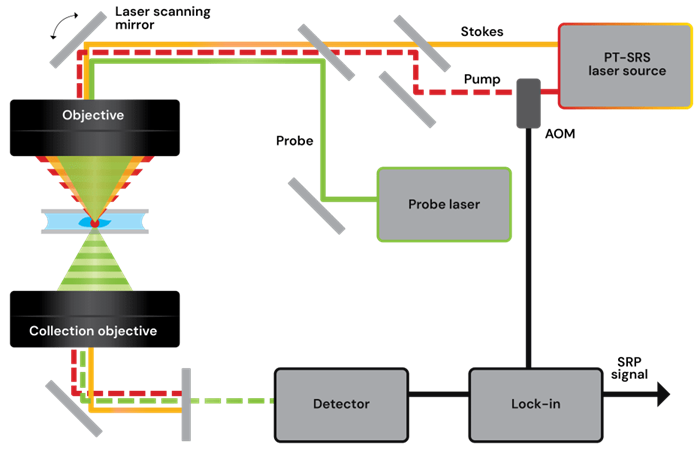
Image Credit: Photothermal Spectroscopy Corp.
Applications