Homogenizers play an important role in a variety of industries, including pharmaceuticals, cosmetics, food, drinks, and biotechnology. These useful instruments can decrease particle size or mix two or more immiscible liquids uniformly to produce stable, high-quality products.
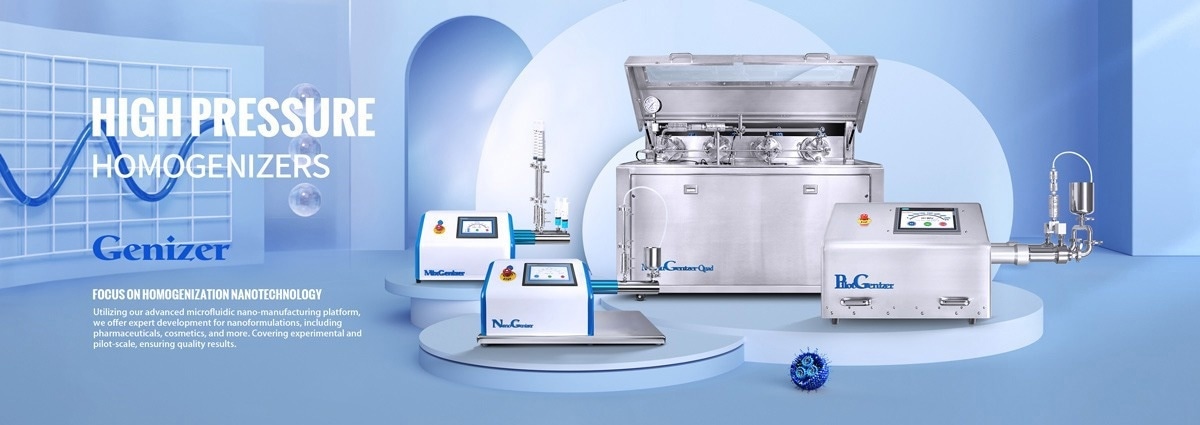
Image Credit: Genizer LLC
This article describes the many types of homogenizers and their applications.
Mechanical Homogenizers
Mechanical homogenizers use mechanical force to break down droplets and particles in a mixture, creating a homogenous solution. There are several types of mechanical homogenizers available.
Rotor-Stator Homogenizers
Rotor-stator homogenizers leverage a high-speed rotating component to create the shear forces needed to break down particles. These devices are well-suited for dispersion, emulsification, and cell disruption applications. Rotor-stator homogenizers are widely used in the cosmetics, pharmaceutical, and food industries.
Ultrasonic Homogenizers
Ultrasonic homogenizers use high-frequency sound waves to induce cavitation, which is then used to break down particles and droplets. This technique has applications in cell disruption, emulsification, and dispersion, and it is widely employed in the nanotechnology and biotechnology industries.
Bead Mill Homogenizers
Bead mill homogenizers break down particles mechanically by using small beads or a grinding medium. These tools are frequently used in cell disruption, nanoparticle synthesis, and pigment dispersion applications. They are also widely employed in the paint, pharmaceuticals, and cosmetics industries.
Pressure Homogenizers
Pressure homogenizers use high pressure to drive a mixture through a small orifice or gap, causing particles to break down due to shear forces.
These homogenizers are particularly helpful for producing fine emulsions and dispersions. The two main types of pressure homogenizers are high-pressure homogenizers and microfluidizer homogenizers.
High-Pressure Homogenizers
High-pressure homogenizers are widely employed in pharmaceutical, cosmetic, and food industries. Their prominence in these sectors arises from their ability to generate very stable emulsions and dispersions with small particle sizes.
This type of homogenizer pushes a liquid mixture through a narrow gap at high pressure, causing significant shear forces and turbulence in the particles and droplets. This decreases particle size and yields a homogenous mixture.
High-Pressure Microfluidizer Homogenizers
Microfluidizer homogenizers, such as Genizer's product line, are strong high-pressure homogenizers that use a fixed-geometry interaction chamber to ensure uniform particle size reduction and dispersion.
These homogenizers are ideal for applications such as cell disruption, nanoparticle synthesis, and emulsification, and they are widely leveraged in the pharmaceutical, biotechnology, and nanotechnology sectors.
Advantages of Genizer Homogenizers
Genizer is an industry leader for microfluidizer homogenizers. The company's instruments are renowned for their dependability, versatility, and efficiency.
These high-pressure homogenizers use patented microfluidics technology to produce extremely stable and homogenous emulsions, suspensions, and dispersions.
The primary advantages of Genizer Homogenizers include:
Consistent Results
Genizer's homogenizers use a robust fixed-geometry interaction chamber to ensure consistent particle size reduction and dispersion across batches.
Scalability
Genizer's homogenizer range has been designed to provide strong functionality at a variety of sizes, including laboratory research and industrial production.
Wide-Ranging Applicability
Genizer's homogenizers are suitable for a wide range of applications, including cell disruption, emulsification, and nanoparticle manufacturing.
Easy to Use and Maintain
Genizer's homogenizers have user-friendly interfaces and need little maintenance, making them a popular choice among industry professionals and researchers alike.
Summary
When selecting equipment for a certain process or application, it is critical to understand the various homogenizer types and their potential applications.
High-pressure microfluidizer homogenizers, such as those available from Genizer, provide unique benefits in terms of scalability, adaptability, and consistency. These properties make them suitable for a variety of applications in the biotechnology, nanotechnology, and pharmaceutical sectors.
Exploring the current technologies and prospective uses of a variety of homogenizers is critical for users who must make informed decisions about instrumentation and optimizing processes for efficiency and product quality.

This information has been sourced, reviewed and adapted from materials provided by Genizer LLC.
For more information on this source, please visit Genizer LLC.