The Diamond Interaction Chamber (DIXC) serves as a central component within the NanoGenizer high-pressure homogenizer. It employs microfluidic technology, and its interior is engineered with fixed-geometry microchannels, where the formulation undergoes forces of intense shear and significant impact, thereby leading to nanoparticle dispersion and nano-cell disruption.
Once pressurized and propelled by the intensifier, the sample’s micro-jet can easily achieve velocities up to 1000 m/second, exceeding the speed of sound (340 m/second).
When the high-velocity, bullet-like micro-jet travels through the diamond interaction chamber’s microchannels, it experiences complex physical phenomena, including high-frequency shear, high-energy impact, cavitation, and pressure reduction, among others. Subsequently, the material then becomes homogenized and nanosized completely.
In contrast to the more traditional homogenizing valve, the Genizer Diamond Interaction Chamber contains no moving components inside the chamber, thereby ensuring consistent results across different batches.
It may also be widely used across the biochemical, cosmetics, pharmaceutical, dairy, and food sectors. It has additionally been shown to support experimentation from particle size reduction to cell disruption, nanodispersions, nanoemulsions, liposomes, etc.
Cooling Options
Traditional methods cool the chamber by fully submerging it in the cooling bath; however, the chamber’s thick steel enclosure makes this approach impractical. The patented design by Genizer incorporates an internal cooling option within the chamber, allowing for a significantly more efficient heat exchange.
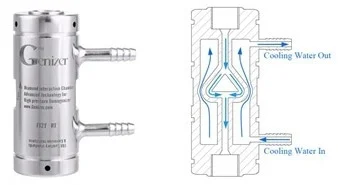
Diamond Interaction Chamber with Cooling Option. Image Credit: Genizer LLC
Types
Two types of DIXC are available: the 'Y' and the 'Z' configurations. These types can also be classified into a range of sizes, from experimental to production.
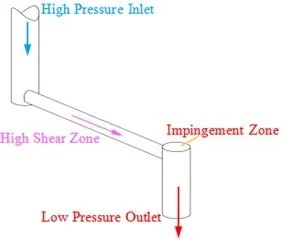
Z-Type Diamond Interaction Chamber. Image Credit: Genizer LLC
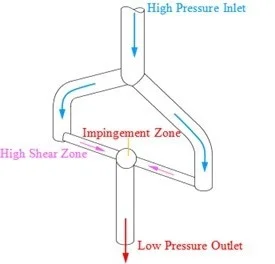
Y-Type Diamond Interaction Chamber. Image Credit: Genizer LLC