In this interview, industry expert Maximilian Ries explains how vibrational spectroscopy supports industry, highlighting FTIR and Raman solutions for material analysis, real-time monitoring, and scalable workflows from routine testing to advanced research applications.
Why is vibrational spectroscopy so important for today’s industries?
Because it is a highly versatile analytical technique. Vibrational spectroscopy uses visible and infrared light to investigate samples and extract molecular information, which is critical for understanding material composition and behavior. One of its key advantages is that it can be applied to solids, liquids, and gases, making it suitable across a wide range of industries.
It is also nondestructive, meaning the sample remains intact during analysis, which helps reduce waste and cost. Because of this versatility and efficiency, it is widely used to gain insight into materials, improve process understanding, and ultimately increase confidence in both products and workflows.
How does Thermo Fisher address these needs across different applications?
We address these needs through a very broad and flexible portfolio. Our solutions span from routine analysis to high-end research applications, ensuring that we can support customers at every stage.
We offer compact, reliable instruments for everyday laboratory tasks, and we also provide advanced systems for more complex analytical challenges. Importantly, we focus on creating solutions that bridge these levels, systems that can grow with the user’s requirements. This approach applies across both our FTIR and Raman portfolios, allowing us to maintain a balance between routine, mid-range, and high-end applications.
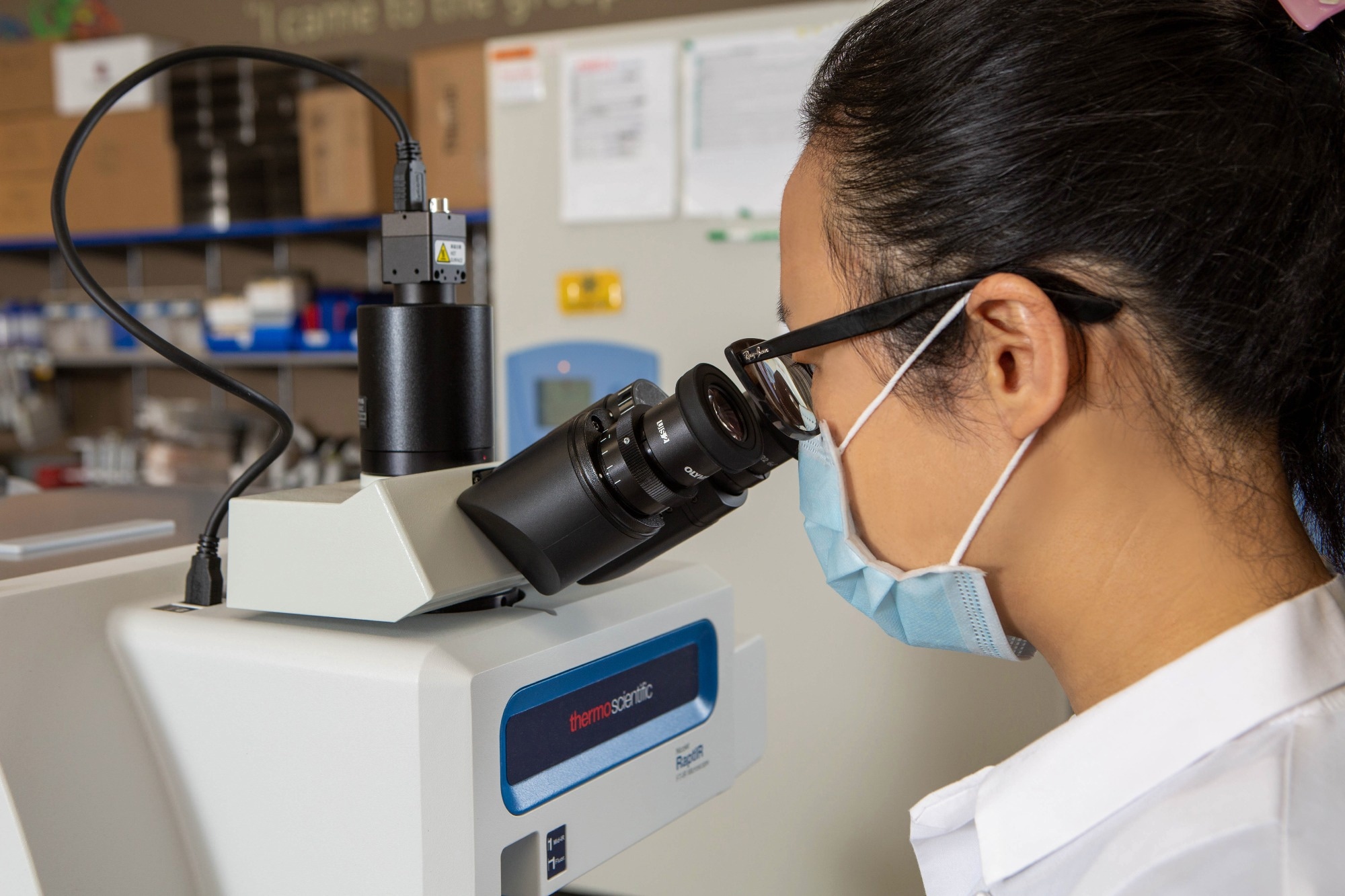
Image Credit: Thermo Fisher Scientific - Vibrational Spectroscopy
Can you explain this based on your FTIR spectrometers?
Our FTIR portfolio starts with compact, robust systems designed for routine laboratory tasks such as quality assurance, identification, and quantification. These instruments deliver excellent data quality and can be integrated into structured workflows using intuitive software, helping create a reliable and efficient lab environment.
From there, we expand into more advanced systems that support more complex applications. These instruments allow users to extend their capabilities over time, for example, by coupling with techniques like TGA-FTIR or integrating with microscopy solutions.
At the highest level, we offer systems designed for advanced research. These provide high spectral resolution and support a wide range of techniques, including step-scan spectroscopy, time-resolved spectroscopy, emission spectroscopy, and photoluminescence. This ensures that users can address even the most demanding analytical questions.
What if customers need more detailed, micro-scale analysis?
When customers need more detailed, micro-scale analysis, we move beyond benchtop instruments and into microscopy. Bulk analysis is often not sufficient when dealing with complex materials such as multilayer structures, inclusions, or contaminants.
Our FTIR microscopy solutions allow users to focus infrared light onto very small sample areas and perform highly detailed investigations. This is particularly useful for applications like microplastics analysis, contaminant detection, and identifying particles embedded in a matrix.
A key strength is the ability to perform multi-component analysis, where several materials can be identified within a single spectrum. This provides much deeper insight into complex samples compared to standard identification methods.
How do you support real-time or in-line analysis?
For real-time or in-line analysis, we focus on process environments where rapid decision-making is essential. While laboratory analysis is important, many industries require immediate insight to monitor and control production processes.
We provide integrated process analyzers that include everything from the laser and spectrometer to the computing system within a single unit. Using optical fibers, these systems can bring the analysis directly into the process, whether that’s inside a bioreactor, an extruder, or a flow system.
With a wide range of probes and sampling interfaces, customers can measure materials directly in-line, detect quality changes instantly, and react quickly to maintain process stability.
Speaking of Raman spectroscopy, how does it complement FTIR?
FTIR and Raman spectroscopy are naturally complementary techniques. FTIR works by measuring changes in dipole moment within molecular bonds, which makes it highly effective for many types of chemical analysis. However, it can struggle with highly polar substances like water.
Raman spectroscopy performs well in these cases and is particularly strong for analyzing liquids, small particles, and samples that require minimal preparation. Because Raman relies on a reflection-based approach, it is often easier to use in certain applications.
By combining both techniques, we can cover a much broader range of materials and analytical challenges, giving users a more complete understanding of their samples.
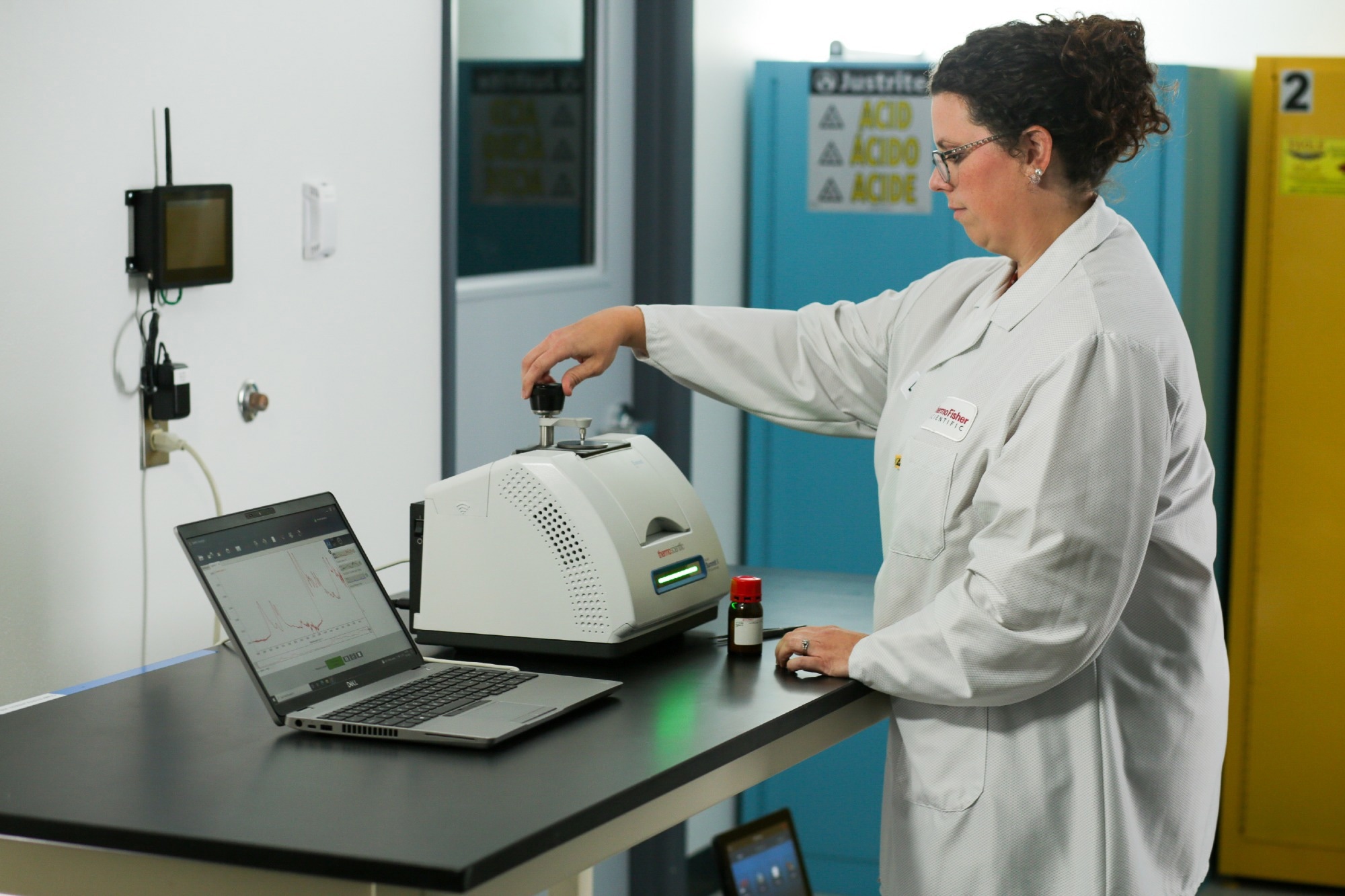
Image Credit: Thermo Fisher Scientific - Vibrational Spectroscopy
What differentiates Thermo Fisher’s approach?
What differentiates our approach is the combination of a very broad portfolio and a strong focus on usability. We provide solutions that cover everything from routine analysis to advanced research, while ensuring a consistent balance between performance and ease of use.
We place a strong emphasis on intuitive software, automated workflows, and user-focused design. This allows customers not only to generate data but to turn that data into actionable insights. Ultimately, our goal is to make advanced analytical techniques accessible and effective for all users.
What Raman instrumentation options do you offer across different use cases?
Our Raman portfolio covers a wide range of applications. For process environments, we offer Raman analyzers designed for in-line measurements. In laboratory settings, we provide benchtop spectrometers that are well-suited for analyzing fibers, powders, and liquids, and these can be optimized with autosamplers for quality control workflows.
For more detailed investigations, we offer Raman microscopy platforms. These include systems focused on spectroscopic analysis as well as imaging-based systems, allowing users to study both the chemical composition and spatial distribution of materials.
How do your Raman microscopy solutions differ depending on the analytical goal?
The difference is in whether the focus is on spectroscopy or imaging. A spectroscopy-first approach is ideal when the goal is to understand the spectral features and chemical composition of a sample in detail.
On the other hand, an imaging-focused approach is used when the goal is to visualize how materials are distributed across a surface. This allows users to map chemical information spatially and better understand material structure.
By offering both approaches, we enable users to choose the method that best fits their specific analytical needs.
What is your overall goal when developing these analytical solutions?
Our overall goal is to enable customers to carry out their analyses as effectively and efficiently as possible. We focus on delivering solutions that balance performance, usability, and integration, so users can move from raw data to meaningful insights with minimal complexity.
Everything we do is aligned with helping customers improve their processes, gain a deeper understanding of their materials, and ultimately contribute to making the world cleaner, healthier, and safer.
About Maximilian Ries 
Maximilian Ries holds a PhD in Physics from Technische Universität Berlin and has built his career at Thermo Fisher Scientific, where he progressed from Application Specialist to Business Development Manager, focusing on molecular spectroscopy, customer consultation, and strategic development across EMEA markets.
This information has been sourced, reviewed, and adapted from materials provided by Thermo Fisher Scientific - Vibrational Spectroscopy.
For more information on this source, please visit Thermo Fisher Scientific - Vibrational Spectroscopy.
Disclaimer: The views expressed here are those of the interviewee and do not necessarily represent the views of AZoM.com Limited (T/A) AZoNetwork, the owner and operator of this website. This disclaimer forms part of the Terms and Conditions of use of this website.