Ethanol (ethyl alcohol) is a volatile, flammable, and colorless liquid with a characteristic wine-like odor and pungent taste. It is the active ingredient in alcoholic beverages and can also be used as a solvent and as an additive in gasoline. Corn is the most produced crop in the United States, and most of the ethanol produced in the US is made from corn.
The complexity of processing corn into ethanol fuel requires extensive testing and quality control. Traditional methods are often ill-suited for large-scale measurements and can determine only a single chemical or physical parameter per measurement.
Most methods cannot provide real-time feedback during processing and cannot account for sample variation in natural products. NIR spectroscopy offers several advantages over traditional, time-consuming, and expensive analytical methods. NIR spectroscopy is fast and non-invasive. It can determine multiple parameters from a single measurement and requires little to no sample preparation. It can improve efficiency, maximize the use of raw materials and resources, and ultimately stabilize product quality in a manner that traditional analytical methods cannot match.
Galaxy Scientific FT-NIR spectrometers have been used at all stages of commercial ethanol production from corn for both ethanol intended for consumption and fuel ethanol, from raw material analysis to slurry and fermentation tank real-time feedback to final product analysis.
Ethanol Production and NIR Spectroscopy
Galaxy Scientific offers calibration models for whole corn, ground corn, corn mash, ethanol, corn oil, and DDGS for use with its QuasIR line of instruments. Distiller’s dried grains with solubles (DDGS) are a nutrient-rich co-product of dry mill ethanol production. The table below lists corn products and parameters for which calibration models are available for Galaxy Scientific FT-NIR spectrometers.
Table 1. Galaxy Scientific Calibrations for Corn Products. Source: Galaxy Scientific Inc

Ethanol is an alcohol produced by yeast from sugars. The basic process of manufacturing ethanol for fuel and ethanol for alcoholic beverages intended for consumption is the same. The main difference is that in fuel ethanol manufacturing, water left after distillation is removed, and the pure ethanol is blended with other compounds to make it unfit for human consumption. Approximately 90% of ethanol produced in the United States comes from the dry-mill process, with the remaining 10 % from wet mills.
Corn Analysis and NIR Spectroscopy – Delivery and Milling
NIR spectroscopy can be used to analyze starch, protein, oil, and moisture both upon delivery and during the dry milling process. One big advantage of using NIR spectroscopy is the ability to replace standard reference tests with a single measurement that can determine multiple parameters of interest. The value of NIR spectroscopy for accurately assessing variability in corn and other natural agricultural products cannot be overstated. Statistics for calibration models created using a Galaxy Scientific FT-NIR spectrometer for corn analysis are shown in the table below.
Table 2. Statistics for Galaxy Scientific Corn Analysis Calibration Models for Delivery and Hammer Mill Stages. Source: Galaxy Scientific Inc
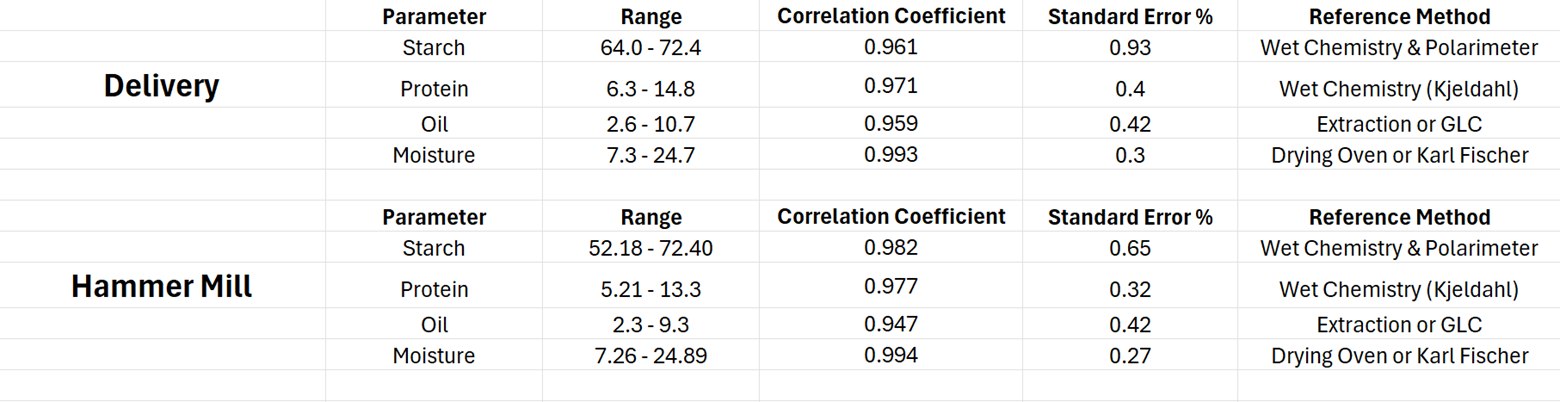
The statistics shown here are from calibration models created using NIR spectra collected with a Galaxy Scientific FT-NIR spectrometer and reference methods, as shown in the last column. The correlation coefficient (R2) is a measure of the statistical relationship between reference method values and NIR-spectra-derived values from calibration models. Correlation is high for all parameters, while prediction error is low.
Slurry Tank Analysis and NIR Spectroscopy
When corn is added to the slurry tank, it is cooked in a process known as liquefaction. Enzymes are added to break down starches to assist fermentation. Temperature and proper enzyme addition are key. The presence of lactic acid can indicate bacterial contamination, and it must be monitored during this process. Real-time NIR spectroscopy feedback can help optimize liquefaction in a way not possible with HPLC. Statistics for calibration models created using a Galaxy Scientific FT-NIR spectrometer for slurry tank analysis are shown in the table below.
Table 3. Statistics for Galaxy Scientific Calibration Models for Slurry Tank Analysis. Source: Galaxy Scientific Inc

Fermentation Tank Analysis and NIR Spectroscopy
The next step is called saccharification. During this process, the fermentation tank is filled with the mash. The mash is cooled, more enzymes are added after partial cooling, and yeast is added to begin fermentation after complete cooling.
The chemical reaction for fermentation breaks down glucose into ethanol and carbon dioxide under anaerobic conditions. The reaction takes about two to three days in a normal batch process. Supplements can be added to convert proteins to amino acids and prevent bacterial contamination.
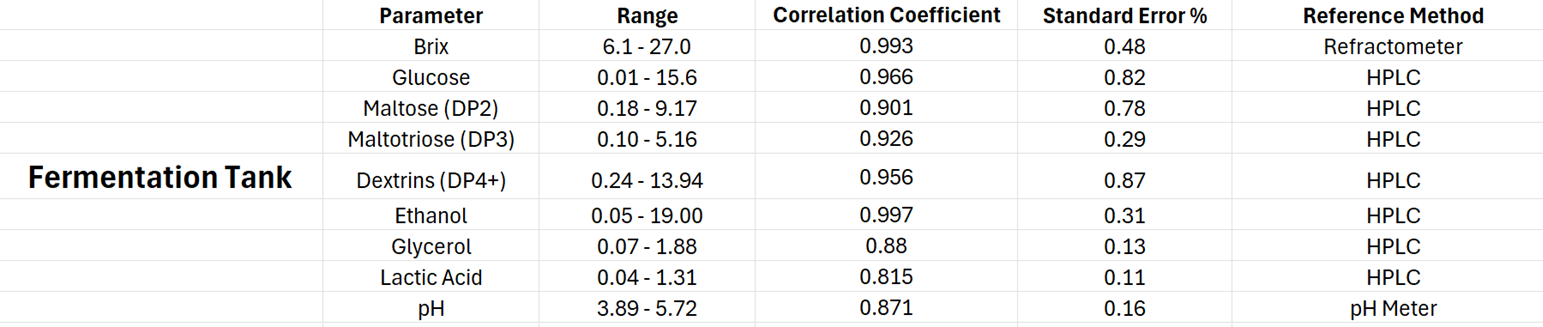
Statistics for calibration models created using a Galaxy Scientific FT-NIR spectrometer for fermentation tank analysis are shown in the table below.
Table 4. Statistics for Galaxy Scientific Calibration Models for Fermentation Tank Analysis. Source: Galaxy Scientific Inc
DDGS Analysis and NIR Spectroscopy
DDGS is the dried residue remaining after the starch fraction of corn is fermented with yeast to produce ethanol. DDGS is rich in protein, energy, fiber, vitamins, and minerals, and is used as feed for livestock and poultry.
As with corn and other grains used for animal feed, the value of DDGS is directly related to its nutritional composition. It is known as a “cost-competitive feed ingredient,” meaning it is added as a supplement to corn feed to reduce costs. DDGS also has a longer shelf life than corn meal, with comparable digestible and metabolizable energies.
While the nutrient content of DDGS is high, the variability of nutrient concentration in a batch is also very high. Variation in fat content in DDGS can be five times greater than that in corn, and the crude protein content variation can be sixteen times higher than that in corn. Given the significant variability in DDGS and the dietary and economic implications of optimizing animal diets, using NIR spectroscopy to determine the nutritional and energy content of DDGS can provide substantial benefits. Statistics for calibration models created using a Galaxy Scientific FT-NIR spectrometer for DDGS analysis are shown in the table below.
Table 5. Statistics for Galaxy Scientific Calibration Models for DDGS Analysis. Source: Galaxy Scientific Inc

For more information on how NIR spectroscopy can be beneficial in assessing variability in DDGS and other types of animal feed, please visit the Testing, Variation, and Economic Indicators section of the Galaxy Scientific NIR-For-Feed website:
NIR Spectroscopy in Animal Food: Parameters, Testing, Economics
NIR Spectroscopy for Process Control in Ethanol Manufacturing
The major value of NIR spectroscopy in ethanol manufacturing is its ability to serve as a real-time process control tool during liquefaction, saccharification, and fermentation. The benefits and potential improvements in fermentation efficiency are immense. For example, if a 200,000 L fermenter completes the fermentation process when the alcohol content reaches 9.6 %, the plant will produce 19,200 liters of absolute alcohol per fermenter. If real-time feedback provides protocols to adjust enzymes, process parameters, and nutritional supplements, increasing alcohol yield by 1 %, each fermenter will produce 21,200 liters of absolute alcohol. The optimization results in the same amount of absolute alcohol being produced in nine fermenters instead of 10, potentially saving a large distillery millions of dollars per year. Even a 0.1 % increase in alcohol yield during large-scale fermentation will result in substantial savings in resources and money.
Galaxy Scientific
Galaxy Scientific is an industry pioneer in the use of optical Near Infrared Spectroscopy. Our QuasIR™ family of NIR spectrometers uses Fourier Transform Near-Infrared (FT-NIR) technology for laboratory, field, and process applications. Our passion is innovation, and our mission is to develop uniquely robust NIR instruments to solve critical analytical problems in numerous sectors, including corn and ethanol manufacturing analysis.
For more information about Galaxy Scientific and to contact one of our applications specialists, please visit our website at Galaxy Scientific Inc.
This information has been sourced, reviewed, and adapted from materials provided by Galaxy Scientific Inc.
For more information on this source, please visit Galaxy Scientific Inc.