In this interview, industry experts Maximilian Ries and Alexandra Müller-Ewers discuss how extrusion, rheology, spectroscopy, microscopy, and inline analytics work together to improve polymer development, processing, characterization, and manufacturing control.
To get started, can you explain why polymers are such an important area for material characterization?
Maximilian Ries: Polymers are probably among the most versatile materials on the planet, but they are also highly complex. They can be elastic, multiphase, full of additives, and very sensitive to processing conditions. That means the way we process them has a direct impact on their final performance.
From a development perspective, everything starts with the concept. For example, if we look at glass fiber-based polymers, many of these materials are difficult to recycle. We have all seen examples such as wind turbine rotor blades being transported for disposal, and I think we can agree that it would be desirable to replace those materials with recyclable fibers designed for recycling.
Once we select the material and define what we want it to do, development usually begins with processing, and that is where extrusion becomes very important. Together, we look at polymers from two different but highly complementary perspectives: processing and rheology on one side, and molecular spectroscopy and microscopy on the other.
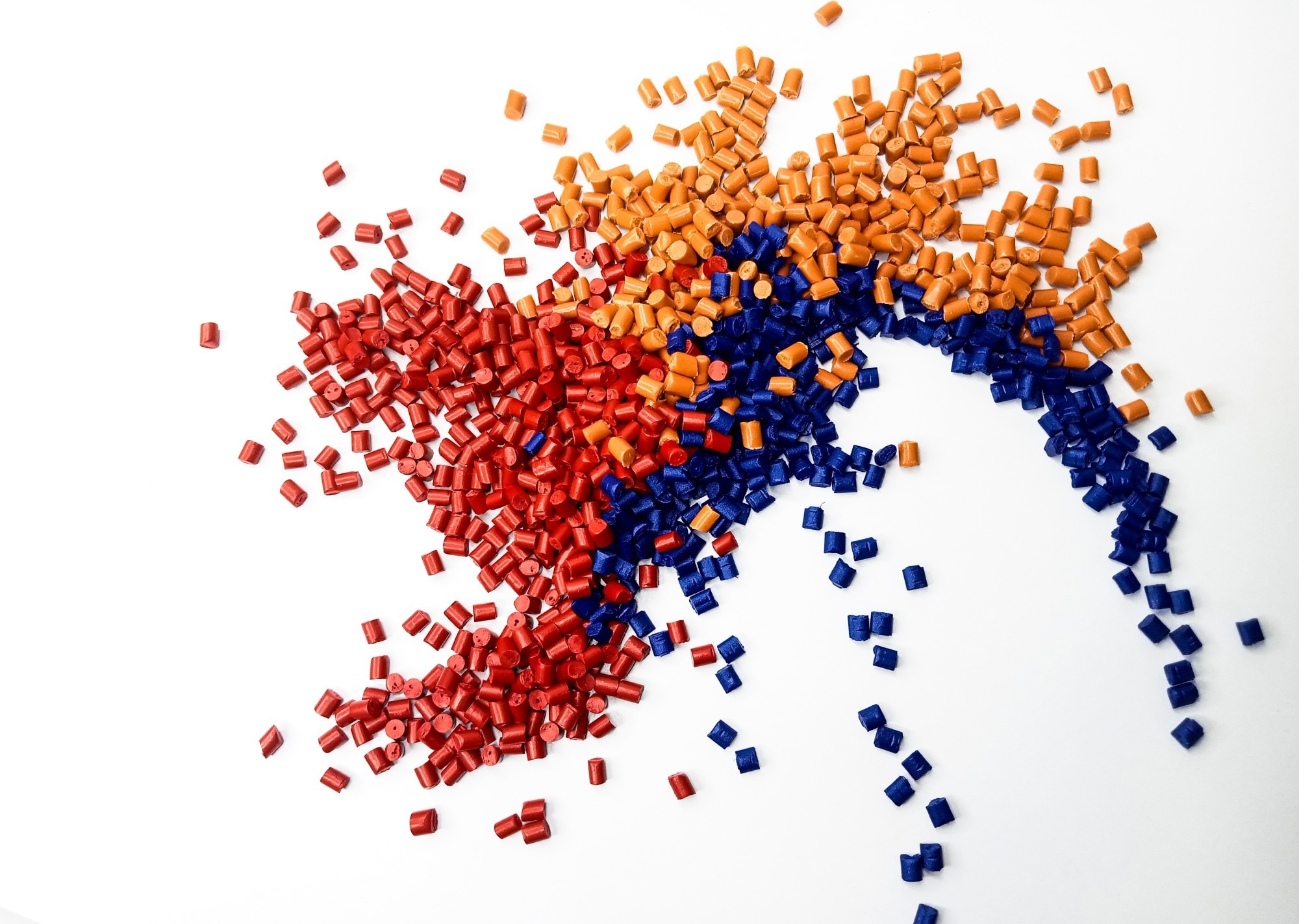
Image Credit: Copy.photography/Shutterstock.com
Why is lab-scale extrusion useful in polymer development?
Alexandra Müller-Ewers: An extruder can turn an idea into reality. On paper, a formulation or material concept might look perfect, but it is inside the extruder where we find out whether it actually works.
In extrusion, we melt the polymer, mix it, add additives, create blends, and most importantly, define the thermal and mechanical history of the material. That history directly shapes the final performance.
Lab-scale extrusion is especially powerful when we are working with a brand-new material. The material might be expensive, or we might only have a few grams available from synthesis. In that case, we would not want to put it straight into a large industrial extruder producing hundreds of pounds per hour.
With lab-scale extrusion, we can test different process conditions in a controlled way. For example, we can adjust the temperature step by step, modify screw elements, or change shear conditions to understand how the material behaves. We can do this with as little as 20 g of material, while still running it under real processing conditions that are relevant for later scale-up. If needed, a lab-scale extruder can also run at throughputs of up to 50 kg per hour.
How do you choose between lab mixers, single-screw extruders, and twin-screw extruders?
Alexandra Müller-Ewers: It really depends on what we want to achieve. Lab mixers can play an important role when the focus is on fusion or thermal behavior, for example, in PVC applications.
If we are mainly shaping and transporting a relatively homogeneous polymer melt, a single-screw extruder is often sufficient. It is robust, cost-efficient, and widely used in production.
However, if we are developing a new formulation, adding fillers, fibers, or additives, or working with recycled materials, then we typically need a twin-screw extruder. Twin-screw extruders provide much better mixing, better control over shear, and greater flexibility in configuration.
The intermeshing screws allow us to control mixing, residence time, and energy input very precisely. This becomes especially important when working with sensitive additives, high filler loadings, or materials that degrade easily. So, in the example of a polymer composite based on recyclable fibers, we would use a twin-screw extruder because we need to explore and optimize the material.
Click here to watch Analyze That episode 10 -
Let’s talk about Polymers – Analytical techniques and processing for material understanding
What does rheology tell us about polymers?
Alexandra Müller-Ewers: Rheology is the science of flow and deformation. In other words, everything flows, and in material processing that is exactly what we deal with every day. Rheology helps us understand how a material behaves when it is processed, pumped, stretched, or shaped.
It goes far beyond simply measuring viscosity. With a rotational shear rheometer, we mainly use two different shear-based measurement modes.
The first is a rotational test. Here, we apply a shear rate and measure the shear stress, or we do it the other way around depending on the application. From these values, we can calculate the viscosity. This tells us how easily the material flows.
The second is oscillation. In this case, we apply a small back-and-forth deformation to the material and measure its elastic and viscous response. The storage modulus describes the elastic response, while the loss modulus describes the viscous response.
This allows us to understand how dominant the elastic part is and how strong the viscous part is. When both are present, we are dealing with a viscoelastic material. That is what makes polymers so fascinating, but also challenging, because they do not behave purely like a liquid or purely like a solid. They behave somewhere in between.
What problems can occur if a polymer is too elastic during processing?
Alexandra Müller-Ewers: If a polymer has too much elasticity during extrusion, it can lead to flow instabilities. One example is die swell, where the extrudated strand expands after leaving the die. Another example is sharkskin, where the extrudate develops surface defects.
By understanding the visco-elastic behavior of the material, we can adjust either the material itself or the process conditions to help prevent these effects.
This is also why the melt flow index alone is not enough. The melt flow index gives us one number under one specific condition. It does not address viscoelasticity, nor does it show how the material behaves under different deformation rates.
Rheology gives us much deeper insight. It can provide information about melting and crystallization, help determine the glass transition TG, follow curing reactions in real time, and even provide information about molecular weight and molecular weight distribution.
Why is extensional rheology important for polymer processing?
Alexandra Müller-Ewers: Many industrial processes are not only shear-dominated. In processes such as film blowing or foam extrusion, the material is stretched rather than simply sheared. That brings us to extensional rheology.
Under shear, polymers often become thinner and flow more easily. Under extension, however, many polymers behave very differently. They can exhibit strain hardening, which means the more we stretch them, the more they resist.
That resistance is often called melt strength. It determines whether a film remains stable during film blowing or whether a foam holds its structure or collapses.
So, while shear rheology tells us how a material flows, extensional rheology tells us how well it holds together under stretching. Rheometers are very useful here because of their versatility. We can measure polymer films, polymer solids, polymer solutions, and we can also measure films or fibers in elongation, all on the same platform and across a wide temperature range.
Click here to watch Analyze That episode 10 -
Let’s talk about Polymers – Analytical techniques and processing for material understanding
How does molecular spectroscopy support polymer analysis?
Maximilian Ries: Spectroscopy measures the interaction of light and matter. Depending on the frequency of the light, we can probe different atomic or molecular excitations.
If we use ultraviolet or visible light, we interact with electronic transitions, which largely determine the material’s color. That is why these systems are widely used to control optical properties and monitor material degradation, for example, during aging.
If we use infrared light, we interact with the vibrational states of molecules. This provides a unique fingerprint for each material, depending on the atoms involved, the type of bond, and the surroundings of the bond. This technique is called Infrared Spectroscopy or Fourier Transform Infrared Spectroscopy, FTIR.
Together with Raman spectroscopy, FTIR is one of the main techniques used for polymer identification. Both techniques give us molecular-level information, which is very valuable when we want to understand what is happening inside a polymer sample.
What is the difference between FTIR and Raman spectroscopy?
Maximilian Ries: At a high level, infrared spectroscopy measures the direct absorption of infrared light. For a vibration to be visible in FTIR, there needs to be a change in the dipole moment of the molecule.
Raman spectroscopy analyzes inelastically scattered light from a laser interacting with the molecule. In Raman, the key requirement is a change in polarizability during bond vibration.
In principle, both techniques can measure the same bonds, but they do so through different mechanisms. For example, FTIR and Raman can both be used to identify PET. However, some bonds appear more strongly in FTIR, while others are more pronounced in Raman.
A carbonyl group is very pronounced in FTIR but weaker in Raman because it has lower polarizability. On the other hand, the polymer backbone, which consists mainly of carbon-carbon bonds, often gives strong Raman signals. These bonds have no permanent dipole moment, so they may have weaker infrared intensity, but they can show significant polarization changes.
That is why FTIR and Raman are complementary techniques. They both provide molecular information, but each technique highlights different aspects of the material.
Why combine rheology with Raman or FTIR?
Maximilian Ries: When we combine rheology with Raman or FTIR, we can connect mechanical changes with molecular changes in real time. Rheology tells us whether the material becomes stiffer or softer, while spectroscopy tells us what is happening on the molecular level.
A good example is a curing reaction. With rheology, we can see the transition from a liquid to a solid as the material stiffens and a network forms. With spectroscopy, we can observe the decrease in reactive groups as crosslinking progresses.
That means we are not only measuring stiffness. We are watching the formation of the network in real time.
With FTIR, we can also understand whether network formation is mainly driven by a decrease in monomer concentration or by intramolecular reactions, which usually become more dominant in the later stages of curing. This insight helps us optimize the curing process, for example, by increasing the monomer concentration or adjusting the temperature to enhance molecular mobility.
For structural ordering, such as crystallization, Raman spectroscopy allows us to track molecular ordering directly through specific bands that indicate crystalline domains. Rheologically, we may see a strong increase in the storage modulus as the sample transitions from a melt to a solid. When we combine both techniques, we can correlate that rise in storage modulus with the development of molecular order.
In some systems, this combination can reveal intermediate structural stages, such as changes from an amorphous to a crystalline state, or from one polymorph to another, which a single technique might miss.
Click here to watch Analyze That episode 10 -
Let’s talk about Polymers – Analytical techniques and processing for material understanding
How do X-Ray methods, microscopy, and inline analytics complete the picture?
Maximilian Ries: Raman can reveal molecular ordering, but if we want to quantify crystallinity, we use X-ray diffraction. Raman spectra do not provide a direct measurement of a lattice constant because lattice parameters are on the same length scale as X-ray wavelengths. X-ray diffraction patterns allow us to determine lattice spacing and quantify crystallinity.
This matters because manufacturing conditions directly influence crystallinity, and crystallinity strongly affects the mechanical, thermal, and barrier properties of the final product. XRD helps us link processing parameters to final material performance.
X-ray fluorescence adds elemental insights. It can be used for elemental fingerprinting, quantifying additives such as flame retardants, fillers, and pigments, and detecting heavy metals or contaminations throughout production.
Microscopy then adds spatial resolution. Polymers are rarely homogeneous, especially when we look at multilayer films, composites, defects, blends, crystalline domains, or unknown inclusions. Raman and FTIR microscopy provide chemical imaging at the micrometer scale. XPS can analyze the top few nanometers of a surface and reveal chemical states, which is important for adhesion, additive migration, and coating performance. SEM provides ultra-high-resolution imaging and can be equipped with elemental mapping, making it useful for studying filler dispersion or contamination.
Once we move into manufacturing, analytical insight needs to happen in real time. Online gas analysis using process mass spectrometer can track residual monomers or reaction gases, while Raman and near-infrared analyzers can monitor reactive extrusion, additive concentrations, or compositional changes without interrupting production.
From a rheological perspective, online process rheometers can track viscosity and melt flow index directly in the melt stream. Gauging systems can also monitor thickness and basis weight in film or sheet production. So, analytics becomes part of the control strategy itself, helping close the loop from R&D to full-scale production.
Analyze That episode 10 - Let’s talk about Polymers – Analytical techniques and processing for material understanding
Let’s talk about Polymers – Analytical techniques and processing for material understanding
About Maximilian Ries 
Maximilian Ries holds a PhD in Physics from Technische Universität Berlin and has built his career at Thermo Fisher Scientific, where he progressed from Application Specialist to Business Development Manager, focusing on molecular spectroscopy, customer consultation, and strategic development across EMEA markets.
About Alexandra Müller-Ewers
Dr. Alexandra Müller-Ewers holds a chemistry degree from Universität Bayreuth and completed doctoral research at the Max Planck Institute for Radiation Research, with earlier Thermo experience as a product specialist. With earlier Thermo experience as a product specialist, she is currently the Business Development Manager for Rheology and Extrusion EMEA at Thermo Fisher Scientific.
This information has been sourced, reviewed and adapted from materials provided by Thermo Fisher Scientific - Vibrational Spectroscopy.
For more information on this source, please visit Thermo Fisher Scientific - Vibrational Spectroscopy.
Disclaimer: The views expressed here are those of the interviewee and do not necessarily represent the views of AZoM.com Limited (T/A) AZoNetwork, the owner and operator of this website. This disclaimer forms part of the Terms and Conditions of use of this website.